


Listen to the article
Venezuelans remained in a state of shock on Sunday following the dramatic capture of President Nicolás Maduro by U.S. military forces, as an atmosphere of uncertainty enveloped the South American nation.
An eerie quiet descended upon the capital city of Caracas, where most businesses, gas stations and churches kept their doors closed. The few establishments that opened saw residents lining up patiently, many staring silently at their phones or into the distance, processing the sudden political upheaval.
“People are still shaken,” said David Leal, a 77-year-old parking attendant who arrived at work only to find deserted streets and no customers.
Though Maduro is now in custody in New York, his government apparatus remains largely intact. His closest officials continue to hold power and have demanded his immediate release. Armed civilians and military personnel maintained a protective cordon around Venezuela’s presidential palace, signaling the regime’s determination to preserve control.
The situation has created a complex political scenario that even U.S. officials seem uncertain how to navigate. President Donald Trump initially claimed his administration would “run” Venezuela with the assistance of Delcy Rodríguez, Maduro’s vice president who has been installed as interim president by the country’s high court.
However, Secretary of State Marco Rubio appeared to moderate this stance on Sunday, suggesting in television interviews that Washington would instead leverage control of Venezuela’s vital oil industry to force policy changes. Venezuela possesses the world’s largest proven oil reserves, making its petroleum sector a critical economic and geopolitical asset.
“We want to see Venezuela transition to be a place completely different than what it looks like today. But obviously, we don’t have the expectation that’s going to happen in the next 15 hours,” Rubio said, emphasizing a need for “realism” in the approach to Venezuela’s political transition.
The reaction within Venezuela has been notably subdued compared to celebrations among Venezuelan expatriate communities across the United States and Latin America. Some government supporters organized rallies over the weekend, burning American flags and holding signs with anti-U.S. slogans like “gringo go home.”
In a working-class neighborhood in eastern Caracas, construction worker Daniel Medalla informed parishioners outside a Catholic church that morning Mass had been canceled. He suggested that streets remained empty because citizens feared potential government reprisals if they celebrated Maduro’s capture.
“We were longing for it,” said Medalla, 66, referring to Maduro’s removal from power.
Such fears aren’t unfounded. Memories remain fresh of the government’s harsh crackdown during the contested 2024 elections, which Maduro was widely accused of manipulating. Those protests resulted in 28 deaths, 220 injuries, and approximately 2,000 detentions, according to official figures.
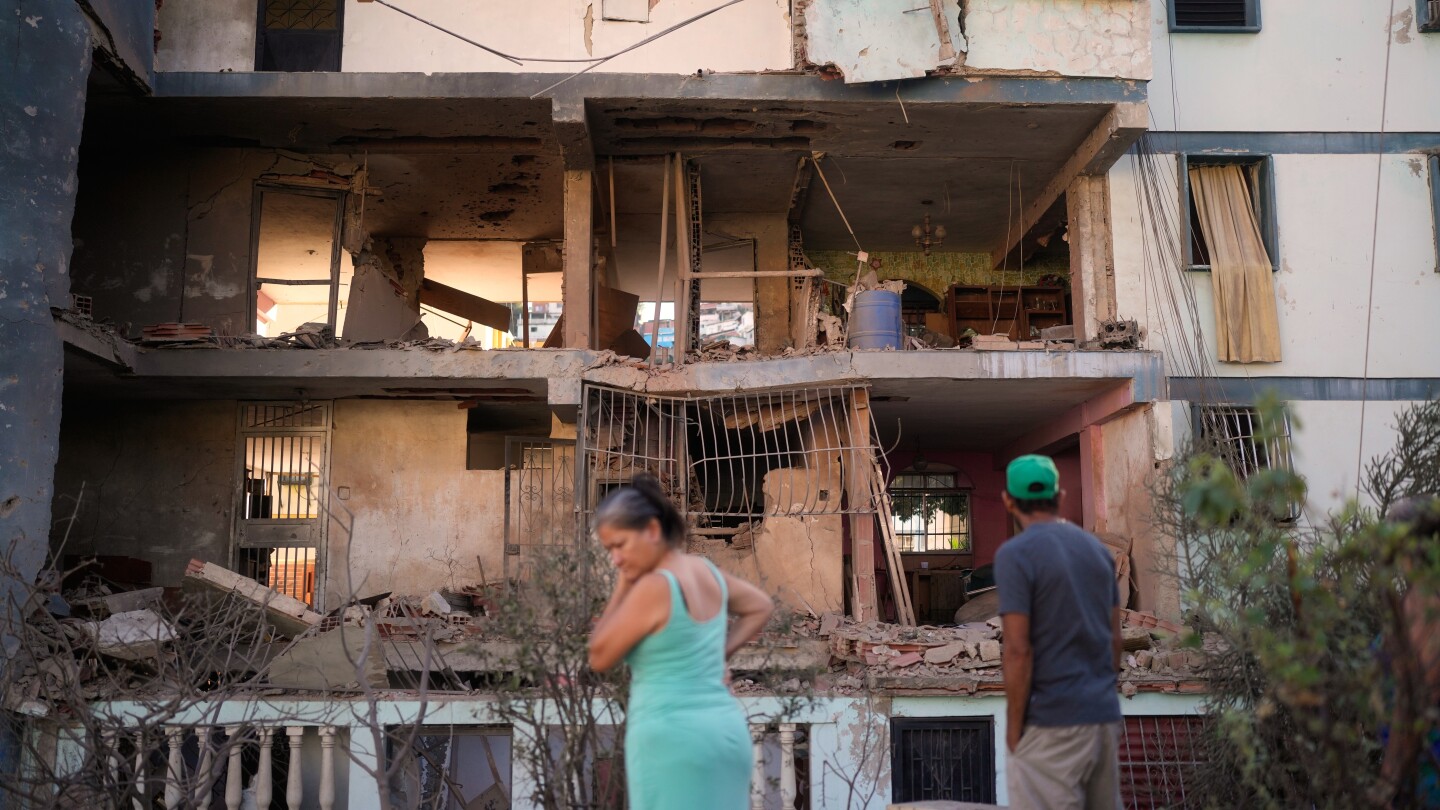
The human cost of the U.S. operation was evident in La Guaira, a coastal state where military action took place. Residents whose homes were damaged in the operation that captured Maduro and his wife were clearing debris and assessing structural damage.
Wilman González, who suffered a black eye during the assault, sorted through rubble in his apartment, surrounded by broken furniture. One section of his building was almost completely destroyed, with walls blown open. Venezuelan officials have not confirmed the total number of casualties from the U.S. strikes.
González’s aunt was among those killed in the operation.
“This is it, what we are left with: ruins,” he lamented, expressing anger not only at the immediate destruction but at the years of economic and political crisis that have plagued Venezuela.
“We are civilians, we are not with the government or anyone else,” González added, giving voice to ordinary Venezuelans caught in the crossfire of geopolitical conflict.
As the nation processes this dramatic change in leadership, questions remain about what political structure will ultimately emerge and how the transition of power will unfold in a country that has experienced profound instability and economic hardship for decades.
Fact Checker
Verify the accuracy of this article using The Disinformation Commission analysis and real-time sources.

14 Comments
The situation in Venezuela continues to be tumultuous and unpredictable. Maduro’s capture is a pivotal development, but it’s unclear how his loyalists will respond. I hope this opens the door for much-needed political and economic reforms, but the path forward is fraught with challenges.
You raise a good point. The Maduro regime’s grip on power appears tenuous, but they may still pose a threat to stability. A peaceful, negotiated transition would be ideal, but Venezuela’s deep divisions make that difficult. Cautious optimism is warranted as this situation unfolds.
This is a significant development in the Venezuelan political crisis, but the endgame remains uncertain. Maduro’s capture is a blow to his regime, but his loyalists may still try to maintain control. I hope this leads to meaningful democratic reforms, but the road ahead appears challenging.
This is a complex and concerning situation in Venezuela. While Maduro’s capture is significant, it remains to be seen how the regime’s power structure will evolve. I hope this leads to a peaceful transition that restores democracy and stability for the Venezuelan people.
Agreed, the road ahead seems uncertain. The US will need to tread carefully to avoid further unrest or violence. Venezuelans deserve a legitimate, representative government that can address the country’s dire economic and humanitarian crises.
This is a pivotal moment in the Venezuelan political crisis, but the path forward remains highly uncertain. Maduro’s capture is a major blow to his regime, but his loyalists may still fight to maintain control. I hope this leads to meaningful reforms, but the situation is fraught with risk and challenges.
I share your concerns. Venezuela is facing a critical juncture, and missteps could trigger further unrest and suffering. A careful, diplomatic approach that prioritizes the wellbeing of the Venezuelan people will be essential as this situation evolves.
The capture of Maduro is certainly a significant development in the Venezuelan crisis, but I worry about the potential for further instability and violence. This is a complex situation with no easy solutions. I hope the international community can help guide Venezuela towards a peaceful, democratic transition.
The situation in Venezuela is highly volatile and the long-term implications are unclear. Maduro’s capture is a major development, but his regime may still cling to power. I’m concerned about the potential for further unrest and violence as this plays out. Venezuelans deserve a stable, representative government.
Agreed, this is a delicate moment fraught with risk. The US and international community will need to tread carefully to avoid escalating tensions or provoking a violent crackdown. A peaceful, negotiated transition would be the best path forward, but that may be difficult given the entrenched divisions.
The situation in Venezuela seems increasingly complex and fluid. Maduro’s capture is undoubtedly a pivotal moment, but the political dynamics are still in flux. I’m concerned about the potential for further unrest and violence as this plays out. Venezuelans deserve peace, stability and a legitimate government.
You raise valid concerns. This is a highly volatile situation that will require a deft diplomatic touch. The US and international community will need to navigate a path that avoids provoking a dangerous response from Maduro’s loyalists while supporting a peaceful transition to democracy.
The capture of Maduro is certainly a dramatic development, but the future of Venezuela remains highly uncertain. While this represents a significant blow to his regime, Maduro’s loyalists may still try to cling to power. I hope this opens the door for a peaceful transition to democracy, but the challenges are immense.
This news from Venezuela is certainly impactful, but the fate of the country remains uncertain. Maduro’s capture is a significant blow to his regime, but his loyalists may resist handing over power. I hope this leads to democratic reforms, but the path forward is complex and uncertain.