


Listen to the article
Venezuela’s stability hangs in balance as armed groups threaten transition following Maduro’s capture by U.S. forces. Interim President Delcy Rodríguez faces formidable challenges in maintaining control amid a complex network of armed militias, guerrilla organizations, and criminal syndicates that permeate the country.
Military analysts warn that these heavily armed groups have the capacity to derail any progress toward political stability. “All of the armed groups have the power to sabotage any type of transition just by the conditions of instability that they can create,” said Andrei Serbin Pont, head of the Buenos Aires-based think tank Cries. “There are parastate armed groups across the entirety of Venezuela’s territory.”
Experts point to two key power brokers whose support Rodríguez must secure: Interior Minister Diosdado Cabello and Defense Minister Vladimir Padrino. Both men control significant military and paramilitary resources essential for maintaining government control.
“The focus is now on Diosdado Cabello,” Venezuelan military strategist José García told Reuters, “because he is the most ideological, violent and unpredictable element of the Venezuelan regime.”
Phil Gunson, a Crisis Group analyst in Caracas, described Rodríguez’s precarious position: “Delcy has to walk a tightrope. They are not in a position to deliver any kind of deal with Trump unless they can get the approval of the people with the guns, who are basically Padrino and Cabello.”
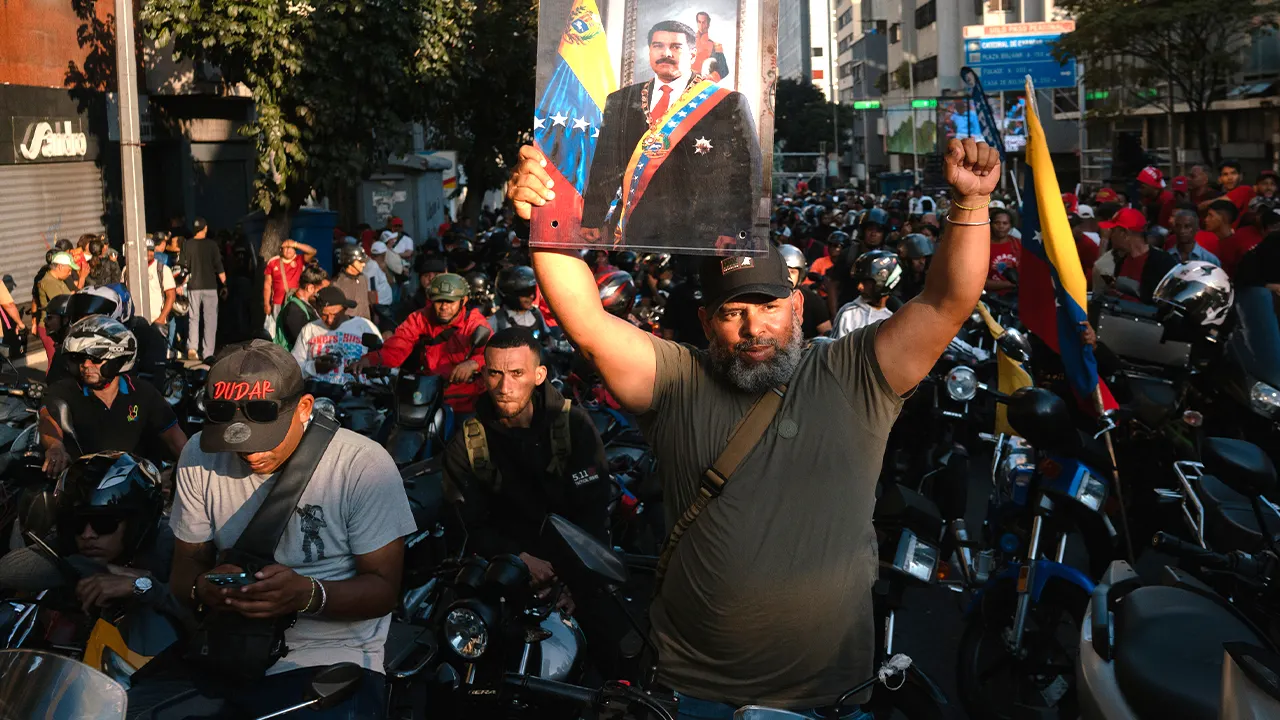
In the capital Caracas and other major cities, government-aligned militias known as “colectivos” have been deployed to enforce order and suppress opposition. These motorcycle-riding armed groups have established checkpoints throughout the capital, searching civilians’ phones and vehicles for signs of dissent against the government following the U.S. operation that captured Maduro.
“The colectivos have weapons, the Colombian guerrilla is already here in Venezuela, so we don’t know what’s going to happen,” said Oswaldo, a 69-year-old shop owner in Caracas, highlighting the uncertainty felt by many Venezuelans.
Beyond the capital, the security situation grows even more complex. Along Venezuela’s 2,219-kilometer border with Colombia, guerrilla groups like the National Liberation Army (ELN) operate with relative impunity. The ELN, a Colombian Marxist organization designated as a terrorist group by the United States, has functioned as a paramilitary force aligned with the Maduro government.
Elizabeth Dickson, Crisis Group’s deputy director for Latin America, noted that the ELN “in Venezuela has essentially operated as a paramilitary force, aligned with the interests of the Maduro government up until now.” Former ELN commander Carlos Arturo Velandia warned that if Venezuela’s power structure fractures, the group would likely support the most radical faction of Chavismo.
The Segunda Marquetalia, a splinter group of Colombia’s former FARC rebels, also maintains a significant presence. These guerrilla organizations collaborate with local criminal syndicates known as “sistemas,” which have established connections with political figures.
In resource-rich areas, particularly near the Orinoco oil belt, these groups control illegal mining operations, creating shadow economies that operate outside government oversight.
The Tren de Aragua cartel, recently designated as a foreign terrorist organization by the U.S., has expanded its reach across Venezuela and into neighboring countries including Colombia and Chile, and even established operations within the United States.
An unsealed U.S. indictment alleges Maduro “participates in, perpetuates, and protects a culture of corruption” involving drug trafficking with multiple criminal organizations, including Mexico’s Sinaloa Cartel, the ELN, FARC factions, and Tren de Aragua.
Luis Cortéz, commander of the Colectivo Catedral Combativa, underscored the militant loyalty these groups maintain toward the revolutionary ideology: “We are the ones being called on to defend this revolutionary process radically, without hesitation — us colectivos are the fundamental tool to continue this fight. We are always, and always will be, fighting and in the streets.”
As Venezuela navigates this unprecedented transition, the proliferation of armed groups presents perhaps the most significant obstacle to establishing stability and democratic governance in a country already devastated by years of economic collapse and political turmoil.
Fact Checker
Verify the accuracy of this article using The Disinformation Commission analysis and real-time sources.

13 Comments
This news highlights the complexity of the situation in Venezuela and the challenges facing the interim government. The presence of various armed groups, including guerrilla organizations and criminal syndicates, poses a significant threat to the country’s stability and the transition of power.
The presence of these heavily armed groups across Venezuela’s territory is a concerning development that could derail any progress towards political stability. The interim government faces a daunting challenge in asserting control and maintaining order amidst these competing factions.
It will be crucial for the interim government to engage with these armed groups in a diplomatic and strategic manner, while also strengthening the capacity of the security forces to effectively counter the threat posed by these groups.
This is a complex and concerning situation in Venezuela. The various armed groups vying for power pose a serious threat to any transition of power and stability in the country. It will be crucial for the interim government to carefully navigate this web of militias, guerillas, and criminal syndicates to maintain control.
Securing the support of key figures like Diosdado Cabello and Vladimir Padrino will be pivotal, as they control significant military and paramilitary resources. Navigating this delicate balance will require great political acumen.
This news underscores the fragility of the political situation in Venezuela and the potential for a protracted power struggle. The interim government must tread carefully to avoid being drawn into a conflict with the various armed groups vying for control of the country.
This news highlights the complex web of competing interests and power dynamics at play in Venezuela. The interim government’s focus on securing the support of key figures like Cabello and Padrino is understandable, but it remains to be seen whether they can effectively navigate this treacherous landscape.
The exploitation of the power vacuum by guerrilla groups and cartels is a concerning development that could further destabilize an already fragile situation in Venezuela. The interim government faces a daunting challenge in asserting control and maintaining order amidst these heavily armed factions.
It will be crucial for the interim government to adopt a comprehensive strategy that addresses the root causes of the instability and violence, while also engaging with these armed groups in a strategic manner to avoid further escalation.
The exploitation of the power vacuum by these armed groups is a troubling development that could have far-reaching consequences for the people of Venezuela. The interim government must act quickly and decisively to assert control and restore order, while also addressing the underlying issues that have led to this crisis.
Securing the support of key figures like Diosdado Cabello and Vladimir Padrino will be crucial, but the interim government must also engage with the broader population and address their concerns to build a sustainable path forward.
The capture of Maduro by U.S. forces has created a power vacuum that has been quickly filled by various armed groups. This is an alarming development that threatens to plunge Venezuela further into chaos and instability. The interim government faces an uphill battle to assert control and restore order.
The presence of these heavily armed groups across Venezuela’s territory makes the situation especially precarious. Their ability to disrupt any progress towards political stability is a major concern that the interim government must address urgently.