


Listen to the article
Iran struck the U.S. Embassy in Saudi Arabia’s capital with a drone early Tuesday as it continued its regional offensive, while the United States and Israel carried out extensive airstrikes against Iranian targets. U.S. President Donald Trump indicated this military campaign could last over a month.
The drone attack on the U.S. Embassy in Riyadh caused a “limited fire” and minor damage, according to Saudi Arabia’s Defense Ministry. The embassy advised Americans to avoid the compound. This incident followed a similar attack on the U.S. Embassy in Kuwait, which announced its closure until further notice. In response to the escalating threats, the U.S. State Department ordered the evacuation of non-emergency personnel and family members from Kuwait, Bahrain, Iraq, Qatar, Jordan and the United Arab Emirates.
The widening conflict has resulted in hundreds of casualties, with Iran bearing the brunt of the fatalities.
Throughout Monday night into Tuesday, explosions echoed across Tehran, with aircraft heard overhead. The International Atomic Energy Agency reported that Iran’s Natanz nuclear enrichment site had sustained “some recent damage,” though it stated there was “no radiological consequence expected.” The Natanz facility had previously been targeted by the U.S. during the Iran-Israel conflict in June.
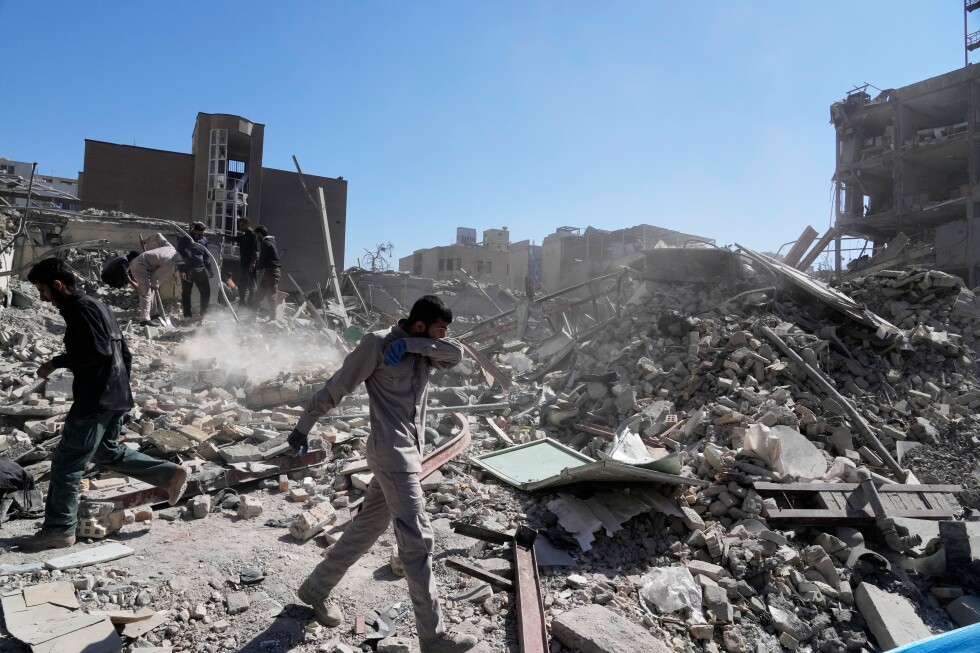
Israel continued its offensive against Hezbollah, the Iran-backed militant group in Lebanon. Explosions were reported in a southern suburb of Beirut, with visible smoke rising from the area. Israel confirmed its soldiers were “operating in southern Lebanon,” while Lebanon’s National News Agency reported that the Lebanese army was evacuating some of its border positions.
The escalation of Iranian retaliation across the Gulf region, the intensity of Israeli and American strikes, and the absence of any clear exit strategy suggest a potentially protracted conflict with far-reaching global implications. Iran has targeted locations previously considered secure in the Middle East, including two Amazon data centers in the UAE and another in Bahrain. Energy facilities in Qatar and Saudi Arabia have also been hit, along with several ships in the Strait of Hormuz, a critical chokepoint through which approximately 20% of global oil trade passes, causing global energy prices to surge.
Iranian Brigadier General Ebrahim Jabbari, an adviser to the Revolutionary Guard, declared: “The Strait of Hormuz is closed. Don’t come to this region,” threatening to set fire to any vessels attempting transit.
With airspace restrictions in place across much of the region, many foreign nationals remain stranded despite evacuation advisories from their governments. President Trump projected that military operations would likely continue for “four to five weeks” but added he was prepared “to go far longer than that.” He later emphasized that the U.S. had a “virtually unlimited supply” of munitions and pre-positioned “high grade weaponry.”
The human toll continues to mount. According to the Iranian Red Crescent Society, at least 787 people have been killed in the U.S.-Israeli operation. In Israel, Iranian missile strikes have claimed 11 lives. Iran’s semi-official Tasnim news agency reported that airstrikes killed 13 Iranian troops in Kerman, approximately 500 miles southeast of Tehran. In Lebanon, Israel’s retaliatory strikes against Hezbollah have resulted in 52 deaths.
Amy Pope, director general of the International Organization on Migration, warned that “military escalation would force more families from their homes and hit civilians hard,” noting that “millions are already displaced in the region.”
The U.S. military confirmed the deaths of six American service members, all Army soldiers from a logistics unit in Kuwait. Additionally, three people were killed in the United Arab Emirates, and one each in Kuwait and Bahrain.
The complexity of the conflict was highlighted when the U.S. military reported that Kuwait had “mistakenly shot down” three American fighter jets amid an Iranian attack involving aircraft, ballistic missiles, and drones. U.S. Central Command confirmed all six pilots ejected safely.
According to Iranian state television, airstrikes caused two explosions at a broadcasting facility in Tehran early Tuesday, though no injuries were reported. Reza Najafi, Iran’s ambassador to the IAEA, told reporters that the Natanz nuclear enrichment site had been targeted on Sunday, while insisting that “their justification that Iran wants to develop nuclear weapons is simply a big lie.”
Trump stated that the military campaign aims to destroy Iran’s missile capabilities, eliminate its navy, prevent nuclear weapon development, and halt its support for allied groups such as Hezbollah, which continues to fire missiles at Israel.
Iran maintains it has not enriched uranium since June, though it asserts its right to do so and insists its nuclear program is peaceful. Israeli Prime Minister Benjamin Netanyahu, however, claimed without providing evidence that Iran was constructing “new sites, new places” underground for making atomic bombs.
The conflict has drawn in various proxy forces across the region. In Lebanon, Hezbollah launched missiles at Israel on Monday, triggering Israeli retaliation. Israel continued striking Beirut early Tuesday, targeting what it described as “Hezbollah command centers and weapons storage facilities.” Hezbollah also claimed to have launched drones against an Israeli air base, though Israel reported downing two drones.
The Israeli military stated its troops operating in southern Lebanon were positioned at several points near the border in what it termed a “forward defense posture,” while clarifying there were no plans to evacuate Israeli residents from border areas.
Fact Checker
Verify the accuracy of this article using The Disinformation Commission analysis and real-time sources.

14 Comments
The drone attack on the US Embassy in Saudi Arabia is a very serious development that threatens to further escalate the regional tensions. With the Israeli military operations in Lebanon, this conflict appears to be spreading. Careful statecraft and a return to the negotiating table are critical to finding a peaceful resolution.
Well said. The stakes are incredibly high, and all sides must exercise maximum restraint to prevent this from spiraling out of control. Diplomacy, not military force, is the only way forward.
Deeply concerning to see the US Embassy in Saudi Arabia targeted by Iranian drones. With the Israeli military ramping up operations in Lebanon, the regional instability is clearly growing. All parties must prioritize diplomatic solutions and avoiding further escalation of this conflict.
Agreed, the situation is extremely volatile and the humanitarian costs are mounting. Urgent diplomacy and a genuine effort to address the root causes are essential to pulling the region back from the brink of wider war.
The escalating conflict in the Middle East is alarming. Attacks on diplomatic facilities cross a dangerous line. I hope cooler heads can prevail and diplomatic solutions be found to address the root causes of these tensions.
Absolutely, further military escalation will only breed more violence and suffering. Urgent diplomacy and good-faith negotiations are needed to pull the region back from the brink.
This latest drone attack on the US Embassy in Saudi Arabia is very troubling. With the Israeli military ramping up operations in Lebanon, the regional tensions are clearly intensifying. Careful diplomacy and restraint will be critical to avoid an all-out war.
The high casualty toll is deeply concerning. All parties must prioritize de-escalation and protect civilian lives. Measured responses and a return to the negotiating table seem the only path forward.
The escalating tensions in the Middle East are very troubling. Attacks on diplomatic facilities are a serious breach and could have far-reaching consequences. I hope all sides can step back, engage in good-faith dialogue, and find a peaceful resolution to these complex issues.
Absolutely, further military action will only lead to more death and destruction. Diplomacy, restraint, and a focus on de-escalation are the only responsible paths forward at this stage.
Concerning developments in the Middle East. Attacks on diplomatic facilities are extremely worrying and could escalate the conflict further. Hoping all sides can de-escalate tensions and find a diplomatic solution to these complex issues.
Agreed, the situation seems highly volatile. Diplomatic channels need to be fully engaged to prevent this from spiraling out of control.
Concerning news about the drone attack on the US Embassy in Saudi Arabia. The situation seems to be spiraling with the Israeli military operations in Lebanon as well. Restraint and diplomacy are critical to prevent this conflict from becoming a full-blown regional war.
Agreed, the regional tensions are extremely high and the humanitarian toll is deeply worrying. All parties must show leadership and put the safety of civilians first through diplomatic solutions.