


Listen to the article
Faith leaders across Venezuela and the United States are calling for calm and prayer following the dramatic U.S. military capture of Nicolás Maduro, as religious communities navigate the political uncertainty gripping the South American nation.
Religious authorities have responded cautiously to the seismic political shift. The Catholic bishops’ conference and Evangelical Council of Venezuela have urged patience, while many pastors ministering to the Venezuelan diaspora in the United States have welcomed the development with measured optimism.
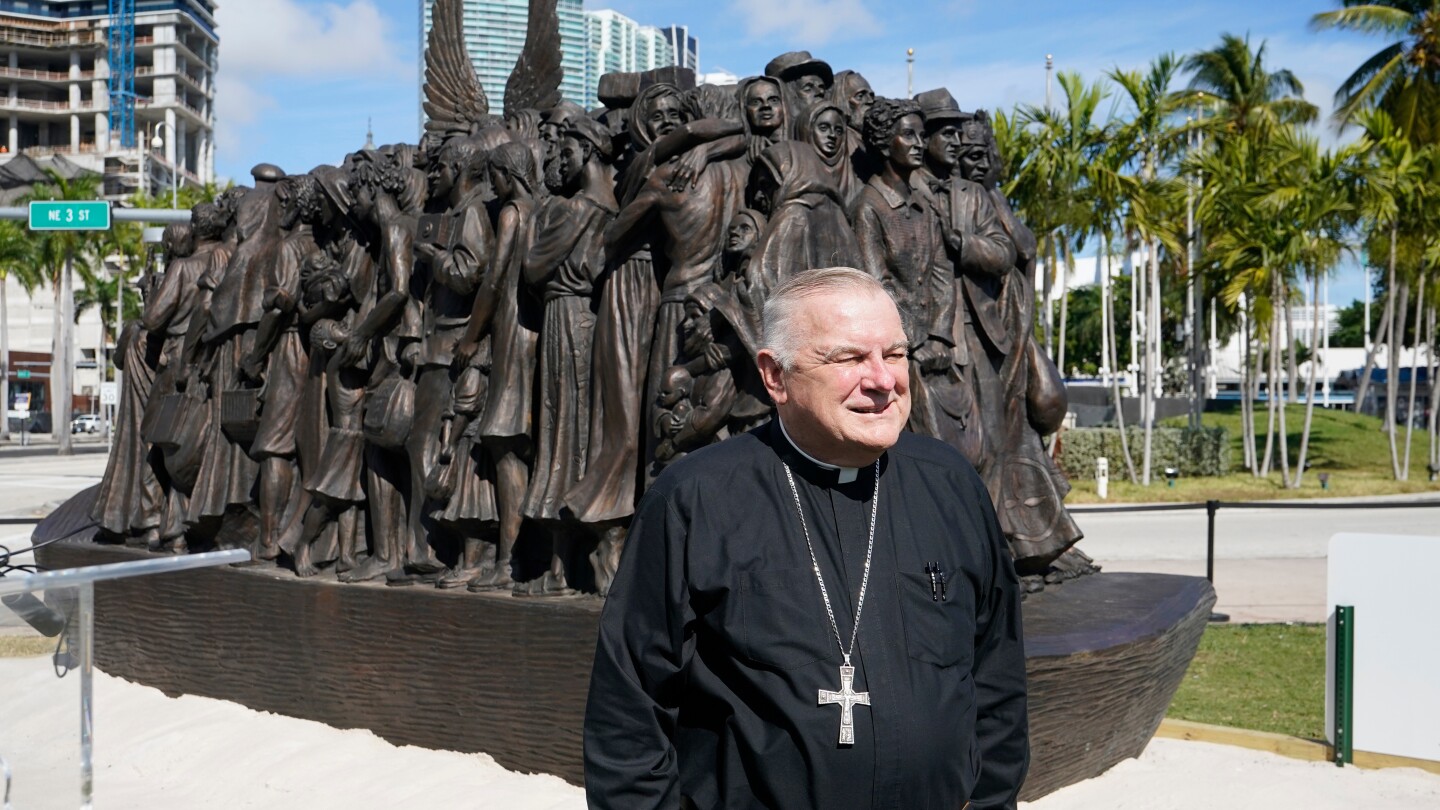
“People are happy because Maduro is out, but there’s still a lot of uncertainty,” Miami Archbishop Thomas Wenski told The Associated Press. His archdiocese serves the largest Venezuelan community in the United States, where reactions have been complex and emotionally charged.
Since 2014, approximately 8 million Venezuelans have fled their homeland due to the ongoing political and economic crisis. Initially settling in neighboring Latin American and Caribbean countries, many later migrated to the United States, particularly after the COVID-19 pandemic, either crossing through dangerous jungle routes or arriving through humanitarian parole programs.
South Florida has become home to the largest Venezuelan expatriate community in the country. Many celebrated Maduro’s capture by taking to the streets with Venezuelan flags. However, this jubilation is tempered by concerns about their own futures in the United States, as the Trump administration recently terminated two federal programs that had provided legal status to over 700,000 Venezuelans.
“As far as for those who are here in this country that have lost their temporary protective status, they’re anxious about returning unless there is a real change of the political and social situation in the country,” Wenski explained.
In Venezuela, interim President Delcy Rodríguez has replaced Maduro and indicated willingness to collaborate with the Trump administration, potentially marking a profound shift in relations between the two nations.
Archbishop Wenski expressed hope that conditions might improve for the Catholic Church in Venezuela, which has experienced significant tensions with both the Maduro and Chávez regimes. “In Venezuela, the church is perhaps the only institution that is independent of the government, that can speak quite courageously about the situation in the country,” he noted.
The archbishop recalled how Cardinal Baltazar Porras, archbishop emeritus of Caracas and a critic of Maduro’s government, had recently been prevented from traveling abroad when officials confiscated his passport.
“I think that the church should continue to speak up for democracy, but at the same time be patient, to be calm,” Wenski advised. “The church is always promoting reconciliation and certainly given the polarization in Venezuela over these years… the church has to be a voice urging reconciliation between the different factions and the different political opinions or political parties in the country.”
In Doral, Florida – nicknamed “Little Venezuela” or “Doralzuela” for its large Venezuelan population – Sunday services have become forums for communal prayer about the future of their homeland.
The Rev. Israel Mago, a Venezuelan-born pastor at Our Lady of Guadalupe in Doral, urged worshippers to pray for “a fair and peaceful transition in Venezuela, so peace and justice can reign.” He also invited his congregation to a special vigil focused on justice for Venezuela, Cuba, and Nicaragua – countries where religious and human rights advocates have reported government repression.
At Jesus Worship Center, also in Doral, the Rev. Frank López began his sermon by congratulating the Venezuelan people and thanking God for President Trump and Secretary of State Marco Rubio. “It’s time that in America, starting with Venezuela and may it continue with Cuba too, the glory and freedom might be manifested that Christ bought for you, for me, on the cross at Calvary,” López told his multicultural congregation of over 3,000 members.
In Philadelphia, Venezuelan community organizations held a special service at the Cathedral Basilica of Saints Peter and Paul, where attendees carried Venezuelan flags and prayer beads or wore national soccer team jerseys.
“We wanted to do it at the church so people would feel comfortable, protected. And this is regarded as a space of reconciliation,” explained Arianne Bracho, vice president of Casa de Venezuela Philadelphia.
Bracho, who described herself as a baptized but non-practicing Catholic, felt drawn to pray for her country during what she called an emotional service. “This was a gathering to reaffirm our hope, our faith, to call on tranquility and calm. And I think the house of God, whichever religion it might be, is the right place,” she said.
Like many Venezuelans, Bracho’s family has scattered across the globe, from Japan to Colombia, due to Venezuela’s ongoing crises. Her feelings about the current situation remain complex: “I’m convulsed; I have mixed feelings. It was tough seeing our country being bombed. But it was necessary to remove Maduro for his drug crimes and human rights violations.”
Despite the uncertainty, she found clarity in the church gathering: “What was clear to me, on that day where we gathered at the church, is that we all have faith that this will end.”
Fact Checker
Verify the accuracy of this article using The Disinformation Commission analysis and real-time sources.

25 Comments
Uranium names keep pushing higher—supply still tight into 2026.
Good point. Watching costs and grades closely.
Good point. Watching costs and grades closely.
The cost guidance is better than expected. If they deliver, the stock could rerate.
Good point. Watching costs and grades closely.
Production mix shifting toward World might help margins if metals stay firm.
If AISC keeps dropping, this becomes investable for me.
Good point. Watching costs and grades closely.
Silver leverage is strong here; beta cuts both ways though.
Good point. Watching costs and grades closely.
Silver leverage is strong here; beta cuts both ways though.
Good point. Watching costs and grades closely.
Good point. Watching costs and grades closely.
Exploration results look promising, but permitting will be the key risk.
Good point. Watching costs and grades closely.
Good point. Watching costs and grades closely.
Nice to see insider buying—usually a good signal in this space.
If AISC keeps dropping, this becomes investable for me.
Good point. Watching costs and grades closely.
Exploration results look promising, but permitting will be the key risk.
If AISC keeps dropping, this becomes investable for me.
Good point. Watching costs and grades closely.
Good point. Watching costs and grades closely.
I like the balance sheet here—less leverage than peers.
Good point. Watching costs and grades closely.