


Listen to the article
US and South Korea Launch Annual Military Exercises Amid Middle East Tensions
The United States and South Korea commenced their annual Freedom Shield military exercise Monday, bringing together thousands of troops for joint drills while Washington simultaneously manages escalating conflicts in the Middle East.
According to South Korea’s Joint Chiefs of Staff, approximately 18,000 South Korean troops will participate in the exercise, which runs through March 19. U.S. Forces Korea has not disclosed the specific number of American personnel involved in the training operations.
The military exercise comes amid South Korean media reports suggesting that the U.S. is relocating certain defense assets from the Korean Peninsula to support ongoing operations against Iran in the Middle East. When questioned about these reports, which specifically mentioned the transfer of Patriot anti-missile systems and other equipment, U.S. Forces Korea declined to comment on specific asset movements, citing security protocols.
South Korean officials have similarly refrained from addressing these reports directly but have assured the public that any redeployments would not significantly impact the allies’ combined defense capabilities in the region. “Our defensive readiness remains robust despite any routine adjustments in force posture,” a defense ministry spokesperson stated.
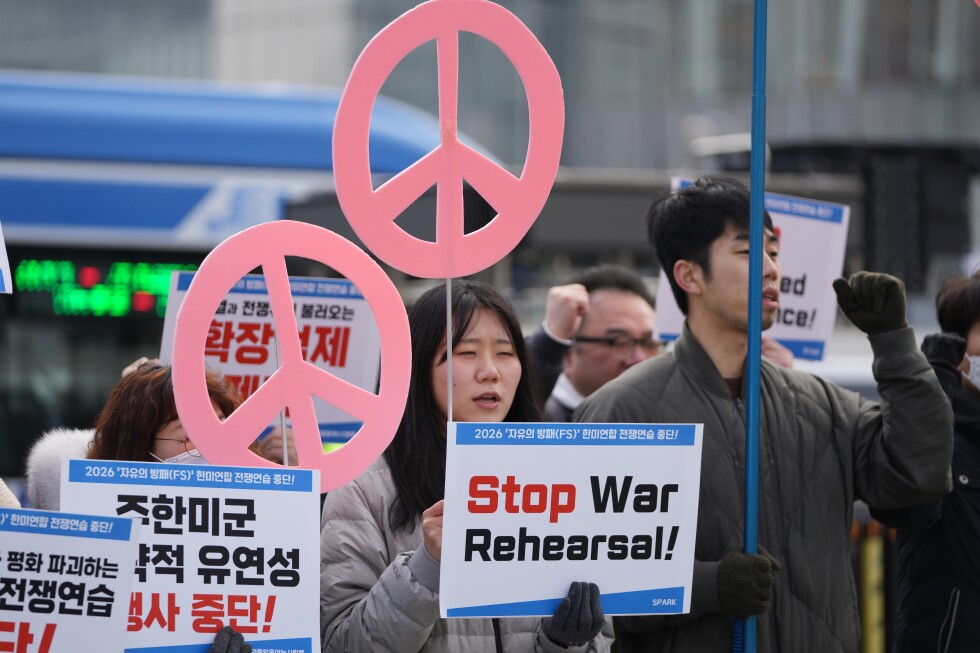
The annual exercise is likely to provoke a negative response from North Korea, which has consistently characterized these joint drills as rehearsals for invasion. Pyongyang has frequently used these exercises as justification for its own military demonstrations and weapons tests, while the U.S. and South Korea maintain that the drills are purely defensive in nature.
Relations between North Korea and the U.S.-South Korea alliance have deteriorated significantly since the collapse of diplomatic talks in 2019 between North Korean leader Kim Jong Un and then-U.S. President Donald Trump. In recent years, Kim has leveraged Russia’s Ukraine invasion as an opportunity to accelerate his nuclear program and strengthen ties with Moscow. Intelligence reports indicate North Korea has dispatched thousands of troops and substantial weapons shipments to support Russia’s war effort.
The exercises follow a major political conference in Pyongyang last month where Kim reaffirmed his hardline stance toward South Korea but appeared to leave room for potential dialogue with Washington. However, Kim emphasized that the United States would need to drop its denuclearization demands as a prerequisite for any meaningful talks.
Freedom Shield represents one of two annual command post exercises conducted by the U.S. and South Korea, with the other being Ulchi Freedom Shield held in August. These drills primarily consist of computer-simulated scenarios designed to test joint operational capabilities while addressing emerging security challenges. The March exercises will also include a field training component called Warrior Shield, though the number of field exercises has been reduced to 22 this year, down from 51 in 2023.
Military analysts suggest this reduction might reflect a deliberate attempt to moderate the scale of the spring drills to create more favorable conditions for potential dialogue with North Korea. South Korean President Lee Jae Myung has expressed interest in pursuing diplomatic engagement, and some of his senior officials have suggested that former President Trump’s anticipated visit to China in late March or early April could potentially create a diplomatic opening with Pyongyang.
The exercises are taking place against the backdrop of evolving regional security dynamics, including China’s growing military assertiveness and the deepening military cooperation between North Korea and Russia, which has alarmed both Washington and Seoul.
“These annual exercises remain crucial for maintaining readiness and interoperability between U.S. and South Korean forces,” said a regional security expert. “But their timing and scope now factor into a much more complex geopolitical equation spanning from East Asia to the Middle East.”
Fact Checker
Verify the accuracy of this article using The Disinformation Commission analysis and real-time sources.

16 Comments
These joint military drills reinforce the strategic importance of the US-South Korea alliance. However, the potential impact of asset redeployments on regional defense capabilities is worth closely monitoring.
The US-South Korea military exercises are a clear demonstration of the allies’ commitment to regional security. But the reported asset redeployments highlight the need for careful management of competing priorities.
Transparent communication between the US and South Korea will be crucial to ensuring their security partnership remains strong and effective, despite the complex geopolitical environment.
The scale of these military drills shows the importance the US places on its alliance with South Korea. But the potential redeployment of assets raises concerns about potential gaps in regional defense capabilities.
Conducting large-scale exercises while engaged in other conflicts requires careful planning and coordination. The US and South Korea will need to ensure readiness and deterrence are maintained on the Korean Peninsula.
Balancing priorities across multiple theaters is a constant challenge for military planners. Transparent communication between allies will be key to managing these complex dynamics.
It’s a delicate geopolitical dance as the US juggles military commitments in Asia and the Middle East. Careful resource allocation and clear messaging to allies will be crucial in this environment.
Conducting large-scale military drills while engaged in other conflicts speaks to the US’s ability to project power globally. However, the potential impact on regional defense capabilities warrants close monitoring.
These military exercises underscore the strategic importance of the US-South Korea alliance, even as the US faces other global challenges. Maintaining regional stability will require deft diplomacy and military coordination.
The reported asset transfers raise valid concerns, but the US and South Korea will need to work together to ensure readiness is not compromised on the Korean Peninsula.
This joint exercise with South Korea is a clear signal of the US commitment to the region amid rising tensions. However, the reported asset transfers raise questions about resource allocation and potential vulnerabilities.
The South Korean public will likely be watching closely to ensure their security interests are not overlooked. Transparent communication between allies will be crucial.
Interesting to see the US balancing military exercises in Asia with ongoing conflicts in the Middle East. Curious how this will impact regional dynamics and force posture in both theaters.
Given the complex geopolitical landscape, it’s understandable the US needs to manage multiple fronts. Maintaining readiness and deterrence in Asia while addressing Middle East challenges will be a delicate dance.
The scale of these military exercises underscores the US’s global reach and the strength of its alliance with South Korea. But the reported asset transfers raise questions about resource allocation and potential vulnerabilities.
Balancing commitments across multiple theaters is a constant challenge. The US and South Korea will need to work closely to ensure readiness and deterrence are maintained on the Korean Peninsula.