


Listen to the article
Iran and U.S. Hold Critical Nuclear Talks as Military Tensions Rise
Iran and the United States engaged in another round of indirect talks in Geneva on Thursday, seeking to reach an agreement on Tehran’s nuclear program amid escalating tensions that threaten to trigger a regional conflict. As negotiations continue, the U.S. has deployed a significant fleet of aircraft and warships to the Middle East, underscoring the high stakes of the diplomatic effort.
President Donald Trump is pursuing a deal to limit Iran’s nuclear capabilities at a time when the Islamic Republic faces internal challenges, including growing dissent following nationwide protests. Iranian officials, while also hoping to avoid war, maintain that uranium enrichment is their sovereign right and resist discussing other contentious issues like their missile program or support for groups such as Hamas and Hezbollah.
“There would be no victory for anybody — it would be a devastating war,” Iranian Foreign Minister Abbas Araghchi warned in an interview with India Today shortly before departing for Geneva. “Since the Americans’ bases are scattered through different places in the region, then unfortunately perhaps the whole region would be engaged and be involved, so it is a very terrible scenario.”
The current negotiations represent the third meeting since June, when previous talks collapsed following Israel’s 12-day war against Iran and subsequent American strikes that severely damaged Iran’s nuclear infrastructure. The exact extent of that damage remains unclear.
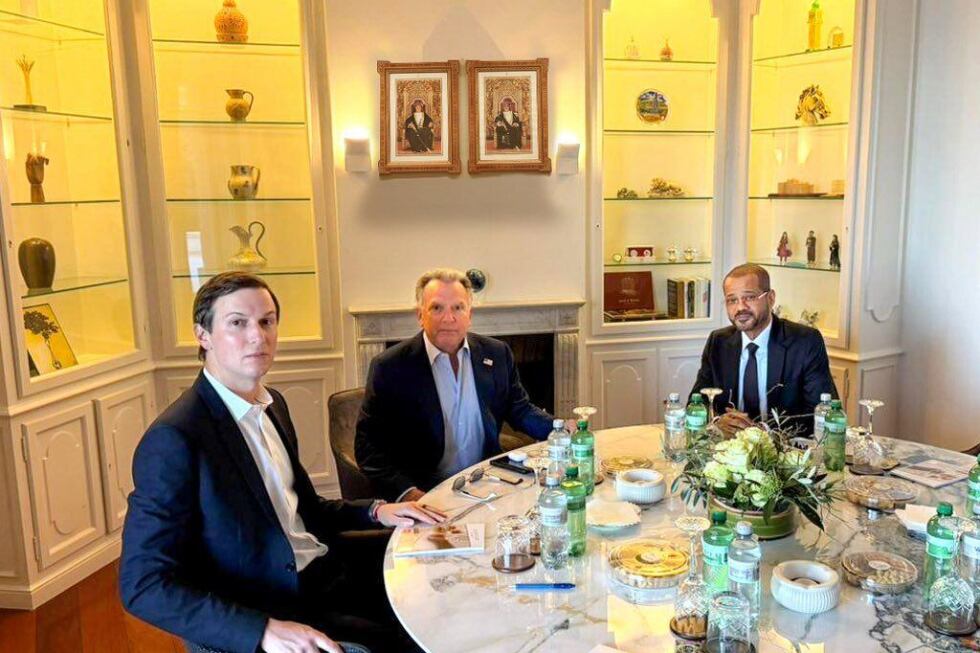
The Iranian delegation is led by Araghchi, while the American team is headed by Steve Witkoff, a billionaire real estate developer and Trump ally who serves as a special Middle East envoy, accompanied by Trump’s son-in-law Jared Kushner. Oman continues its role as mediator, leveraging its long-standing position as an intermediary between Iran and Western powers.
After approximately three hours of discussions on Thursday, the parties adjourned with plans to resume talks later the same day. “We’ve been exchanging creative and positive ideas in Geneva today,” said Oman’s Foreign Minister Badr al-Busaidi. “We hope to make more progress.”
Iranian Foreign Ministry spokesperson Esmail Baghaei described the negotiations as “very intensive,” noting that diplomats met with both the Omani envoy and the head of the International Atomic Energy Agency (IAEA), the UN’s nuclear watchdog. Baghaei expressed optimism, stating that both sides offered “constructive proposals” on nuclear issues and sanctions relief.
The fundamental disagreement between the two countries remains significant. Trump demands that Iran completely halt uranium enrichment and curtail both its long-range missile program and support for regional armed groups. Iran insists on limiting discussions to nuclear matters only and maintains that its atomic program exists solely for peaceful purposes.
U.S. Secretary of State Marco Rubio expressed concern on Wednesday that Iran is “always trying to rebuild elements” of its nuclear program. While acknowledging that Tehran is not currently enriching uranium, he suggested they are working toward that capability.
Iran claims it has not enriched uranium since June but has prevented IAEA inspectors from visiting sites damaged in American bombardments. Satellite imagery analyzed by The Associated Press has revealed activity at two of these locations, suggesting Iranian efforts to assess and potentially recover materials.
Western nations and the IAEA believe Iran maintained a nuclear weapons program until 2003. Following Trump’s withdrawal from the 2015 nuclear agreement, Iran increased its uranium enrichment to 60% purity—just short of the 90% considered weapons-grade. Although U.S. intelligence agencies assess that Iran has not yet restarted a weapons program, they note the country has “undertaken activities that better position it to produce a nuclear device, if it chooses to do so.”
The failure of negotiations could lead to military action with unpredictable consequences. If the U.S. aims to pressure Iran into nuclear concessions through limited strikes, success is uncertain. A more ambitious goal of regime change would likely require a larger, prolonged military campaign, with no clear public planning for the aftermath, including potential chaos in Iran.
Regional implications of military action could be severe. Iran might retaliate against U.S. allies in the Persian Gulf or Israel. Oil prices have already risen to around $70 per barrel for benchmark Brent crude, partly due to these concerns. During previous talks, Iran briefly disrupted shipping through the Strait of Hormuz, a critical chokepoint through which one-fifth of globally traded oil passes.
Recent satellite imagery shows American vessels typically stationed in Bahrain, home to the U.S. Navy’s 5th Fleet, currently deployed at sea—a precautionary measure similar to actions taken before Iran’s attack on a U.S. base in Qatar during the final days of last June’s conflict.
As diplomatic efforts continue in Geneva, the region remains on edge, with the threat of another devastating Middle Eastern conflict hanging in the balance.
Fact Checker
Verify the accuracy of this article using The Disinformation Commission analysis and real-time sources.

14 Comments
It’s good to see the US and Iran engaging in diplomacy, even if indirectly. Hopefully they can find common ground and de-escalate the situation before it gets out of hand. The risks of armed conflict in the Middle East are simply too great.
I agree. Both sides need to show flexibility and compromise if they hope to reach a deal. The alternative – a breakdown in talks and potential war – would be disastrous for the region and the world.
This is a delicate diplomatic dance with much at stake. Both sides appear eager to avoid conflict, but resolving the nuclear issue remains a major challenge. I’m curious to see if any progress can be made through these indirect talks.
Absolutely. Given the military build-up in the region, the stakes are incredibly high. A miscalculation could easily spiral into a regional conflagration that nobody wants.
It’s good to see the two sides engaging in indirect talks, even if progress is slow. Resolving the nuclear issue and broader tensions will require flexibility, creativity and a shared recognition that the alternative – war – is unacceptable.
Agreed. Both the US and Iran need to be willing to make concessions and compromises. The risks of miscalculation and escalation are simply too high. Diplomacy remains the best path forward.
This is a high-stakes game of diplomatic chess. The US and Iran seem to be testing each other’s resolve, but ultimately they need to find a way to de-escalate and reach an understanding on the nuclear issue. Anything less risks sparking a regional conflagration.
Absolutely. The military posturing is concerning, but open lines of communication are vital. Cooler heads must prevail if both sides want to avoid a catastrophic conflict.
The posturing and saber-rattling are concerning, but I’m glad the two sides are still talking. An agreement on Iran’s nuclear program could help ease broader tensions and open the door for further dialogue on other issues.
Absolutely. Even small steps toward détente are important here. With so much at stake, both countries need to prioritize diplomacy and conflict resolution over escalation.
The military buildup is certainly concerning, but I’m glad to see the US and Iran still talking, even if indirectly. Reaching a negotiated settlement on the nuclear program could help ease broader tensions in the region. Continued dialogue is critical, despite the challenges.
Absolutely. While the path forward is unclear, staying engaged is essential. Both sides need to show restraint and a genuine commitment to conflict resolution if they want to avoid a catastrophic outcome.
The military buildup in the region is worrying, but I hope the indirect talks can yield some progress. A negotiated settlement, even an imperfect one, would be far preferable to the alternative of open conflict.
Agreed. While the current situation is tense, dialogue is critical. Both sides need to show restraint and a willingness to compromise if they want to avoid a disastrous war.