


Listen to the article
US and Philippines Launch Major Military Exercises Amid Regional Tensions
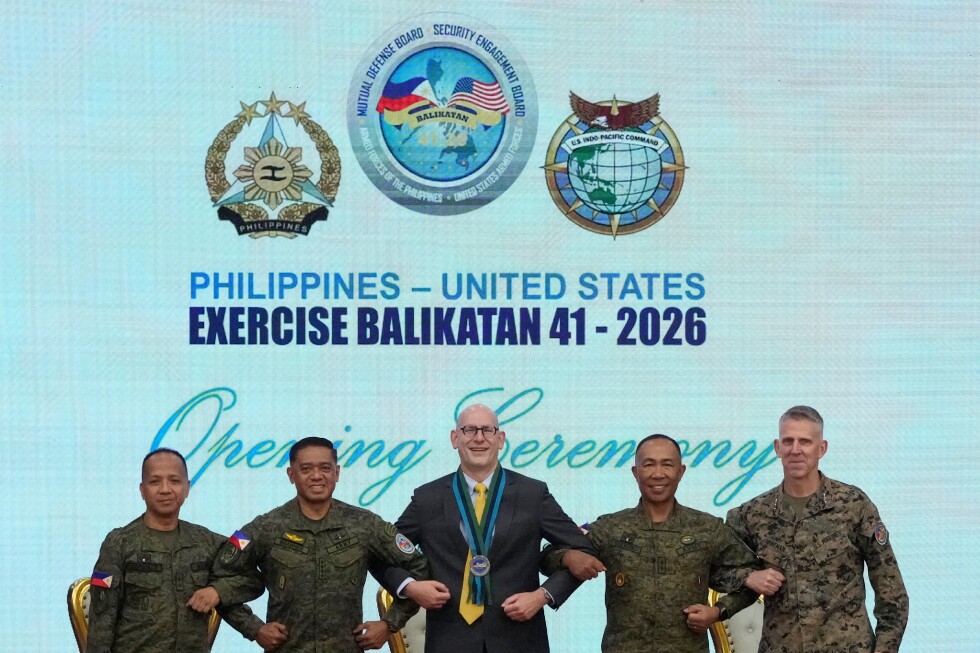
The United States and the Philippines began one of their largest joint military exercises on Monday, showcasing allied military strength aimed at deterring aggression in Asia, despite Washington’s ongoing involvement in Middle East conflicts.
This year’s “Balikatan” exercises—meaning “shoulder-to-shoulder” in Tagalog—have expanded to include new full-time participants such as Japan and Canada, both of which have recently signed visiting forces agreements with Manila. More than 17,000 American and Filipino military personnel will participate in the nearly three-week drills, which include mock battle scenarios and live-fire maneuvers.
The exercises will take place in strategic locations, including Philippine provinces facing the disputed South China Sea and the Taiwan Strait—areas that have become flashpoints for regional tensions in recent years.
At the opening ceremony, Marine Lt. Gen. Christian Wortman emphasized America’s continued focus on the region despite global commitments elsewhere. “Regardless of the challenges elsewhere in the world, the United States focus on the Indo-Pacific and our ironclad commitment to the Philippines remains unwavering,” Wortman said.
The U.S. is deploying nearly 10,000 military personnel for the drills, underscoring the importance Washington places on its oldest treaty ally in Asia at a time when regional security concerns are mounting.
Philippine Armed Forces Chief of Staff Gen. Romeo Brawner stated that the multinational combat exercises build deterrence and resilience against aggression in the region. While he did not explicitly name China in his remarks, Brawner has previously criticized Beijing for its increasingly assertive actions against Philippine naval and coast guard forces in the South China Sea.
“We remain guided by a shared commitment to uphold international law, to respect sovereignty and to contribute to a free and open Indo-Pacific where nations can thrive without coercion,” Brawner said during the ceremony.
The South China Sea has become a major arena for geopolitical competition, with China claiming virtually the entire waterway despite competing claims from the Philippines, Vietnam, Malaysia, Brunei, and Taiwan. The strategically vital trade route carries an estimated one-third of global shipping, and territorial confrontations have intensified between Chinese and Filipino forces in recent years.
Beijing has expressed opposition to the U.S.-Philippine drills, viewing them as attempts to contain its global influence. Chinese Foreign Ministry spokesperson Guo Jiakun warned that bringing foreign forces to the region could spark confrontation.
“Unilateralism and military bullying have already brought profound disasters to the world,” Guo said. “What the Asia-Pacific region needs most is peace and stability, and what it least needs is the introduction of external forces to create division and confrontation.”
The Philippine military has maintained that the exercises do not target any specific country and are necessary to prepare allied forces to respond to natural disasters and other contingencies.
Japan’s participation in this year’s Balikatan represents a significant expansion of its military engagement in the region. It is deploying a 1,400-member contingent—its largest since it began joining as an observer nation. During the exercises, Japanese forces will fire missiles from a coastal area in the northwestern Philippine province of Ilocos Norte to help sink a mock enemy ship approximately 40 kilometers offshore in waters near the South China Sea, according to Philippine Marine Col. Dennis Hernandez.
U.S. forces will complement this operation by deploying a marine drone carrying explosives to further target the simulated enemy vessel.
The strengthening of military ties comes as the U.S. has repeatedly warned China that it is obligated to defend the Philippines if Filipino forces come under armed attack in disputed waters. Last year, U.S. Defense Secretary Pete Hegseth assured Philippine officials that the Trump administration would work with allies to increase deterrence against threats worldwide, including China’s activities in the South China Sea.
“Friends need to stand shoulder to shoulder to deter conflict, to ensure that there is free navigation whether you call it the South China Sea or the West Philippine Sea,” Hegseth told Philippine President Ferdinand Marcos Jr. during a visit to Manila.
As regional tensions continue to simmer, these expanded military exercises signal the deepening commitment of the United States and its allies to maintain a strong presence in the Indo-Pacific amid China’s growing assertiveness.
Fact Checker
Verify the accuracy of this article using The Disinformation Commission analysis and real-time sources.

8 Comments
The US commitment to the Indo-Pacific is noteworthy, even with ongoing commitments elsewhere. Strengthening alliances in Asia seems to be a key strategic priority.
I’m curious to see if this leads to any diplomatic tensions or responses from China. Managing regional rivalries will be crucial.
The ‘shoulder-to-shoulder’ theme of these exercises is fitting given the need for close coordination among allies in the region. Deterring aggression requires unified action.
Interesting to see the US and Philippines ramping up joint military exercises amid regional tensions. Curious to learn more about the strategic focus on the South China Sea and Taiwan Strait areas.
These drills seem aimed at deterring aggression and showcasing allied strength in the region. It will be important to monitor how China responds.
Over 17,000 personnel involved – that’s a significant deployment. The focus on contested waterways like the South China Sea underscores the geopolitical importance of the region.
The expansion of these ‘Balikatan’ exercises to include Japan and Canada signals growing regional cooperation. Maintaining stability and security in the Indo-Pacific is critical.
I wonder how the exercises will unfold and what specific scenarios will be practiced. Gaining insights into the participants’ capabilities could be informative.