


Listen to the article
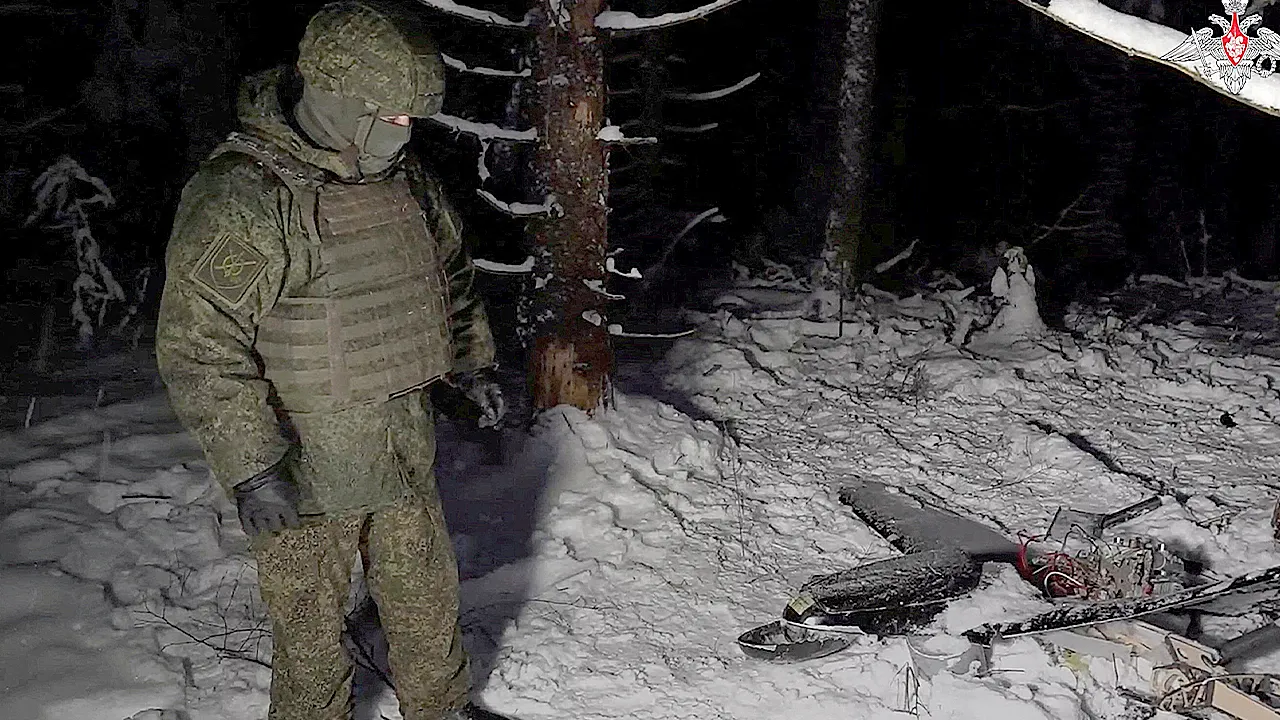
Russia’s defense ministry has released video footage purportedly showing the wreckage of a Ukrainian drone that was intercepted during what Moscow claims was an attempted attack on one of President Vladimir Putin’s residences near Lake Valdai in the Novgorod region.
The nighttime footage, filmed in a snow-covered forested area, shows a Russian serviceman standing over debris that Russian officials identified as parts of a Ukrainian-made Chaklun-V drone. According to Moscow, the drone was carrying a six-kilogram explosive device that failed to detonate before it was shot down.
This evidence release comes as Moscow faces growing skepticism over its account of the alleged assassination attempt. The Wall Street Journal reported Wednesday that U.S. national security officials have concluded Ukraine did not target Putin or any of his residences in the alleged drone incident. The Journal cited a CIA assessment, referenced by a U.S. official briefed on intelligence, that determined no attempted attack on Putin occurred.
U.S. intelligence suggests Ukraine was instead targeting a military site it had previously struck in the same region, but not near Putin’s residence, according to the report.
Ukrainian officials have categorically denied involvement in any plot to attack Putin. Ukraine’s Foreign Ministry spokesperson Heorhii Tykhyi dismissed the Russian footage as “laughable,” stating Kyiv was “absolutely confident that no such attack took place.”
Military drone experts have cast doubt on Russia’s narrative. Cameron Chell, CEO of Draganfly, a firm that supplies drones to the U.S. Department of Defense and allied militaries, told Fox News Digital that the footage “does not offer proof of anything other than that there is a wrecked drone on the ground somewhere being stood over by a Russian serviceman.”
Chell pointed out technical inconsistencies in Russia’s claims, noting that the drone shown in the video appeared ill-suited for such a mission. “The engines on the drone in this new footage are very small, and though capable of multiple hours of flight with the type of fixed-wing drone displayed, it would be extremely slow and unsophisticated,” he said.
“This drone is not untypical of many Ukraine drones, but these would only be used for infrastructure targets and woefully ineffective in an attack on a facility the likes of Putin’s residence,” Chell concluded.
Further inconsistencies have emerged in Russia’s official statements. Russian Foreign Minister Sergey Lavrov claimed that 91 drones had been intercepted en route to Putin’s residence, a figure that appears to conflict with earlier Defense Ministry statements. The ministry initially reported that 89 drones were shot down across eight regions, including 18 over Novgorod, before revising the numbers upward.
Only after Lavrov’s remarks did the Defense Ministry claim that 49 drones intercepted over Bryansk—nearly 300 miles from Valdai—were also targeting the presidential residence, raising questions about the coherence of Russia’s narrative.
The timing of the allegations has drawn additional scrutiny, coming shortly after what Moscow described as a positive meeting between former President Trump and Ukrainian President Volodymyr Zelenskyy in Florida. Zelenskyy called the alleged drone attack a “complete fabrication,” suggesting it was designed to justify further Russian strikes and undermine diplomatic efforts.
Putin’s residence near Lake Valdai is one of several presidential retreats and is presumed to be among Russia’s most heavily secured locations, making the feasibility of such an attack questionable according to military analysts.
Kremlin spokesman Dmitry Peskov has rejected Ukraine’s denials and indicated that Moscow would toughen its diplomatic stance in response to the alleged assassination attempt.
As the Russia-Ukraine conflict continues well into its third year, the incident highlights the ongoing information warfare accompanying the physical conflict, with both sides accusing the other of fabrications and provocations as diplomatic efforts to resolve the war have repeatedly stalled.
Fact Checker
Verify the accuracy of this article using The Disinformation Commission analysis and real-time sources.

12 Comments
It’s good to see the US taking a cautious, fact-based approach here rather than fueling further escalation. Verifying the details of such a sensitive incident is crucial before making accusations. Transparency and restraint are key.
I agree. Maintaining an objective, evidence-based stance is critical, especially in the midst of an active conflict. Rushing to judgment or spreading unconfirmed information could have dangerous repercussions.
The conflicting reports around this alleged attack on Putin’s residence highlight the complexities of the Ukraine conflict and the challenges in assessing the veracity of claims made by all sides. Careful analysis of the facts is essential.
Absolutely. With so much at stake, it’s vital that policymakers and the public have access to accurate, well-substantiated information before drawing conclusions. Maintaining skepticism and demanding transparency is the responsible approach.
Interesting that US officials are skeptical of Russia’s claims about this alleged attack on Putin’s residence. It seems Ukraine was likely targeting a different site in the region, not the president’s home. The details around this incident are still quite murky.
Yes, the conflicting reports make it hard to know the full truth of what happened. It will be important to see if any more concrete evidence or information emerges to clarify the situation.
This is an intriguing development in the Ukraine war. The US assessment that Ukraine was not behind the attack on Putin’s residence, if accurate, could have significant implications. It will be important to see what additional details and evidence emerge.
Yes, the US intelligence community’s findings will be closely watched. Their analysis could shed important light on the true nature of this incident and the broader dynamics of the conflict.
This highlights the challenges in verifying information and intelligence, especially around sensitive geopolitical events like this. It’s good to see the US taking a measured approach and not jumping to conclusions without solid evidence.
Absolutely. In such a charged environment, it’s crucial for officials to carefully evaluate the facts before making any definitive statements. Rushing to judgment could have serious consequences.
The attack on Putin’s residence, if true, would be a major escalation in the Ukraine conflict. But the US assessment that Ukraine was not behind it is certainly intriguing. I wonder what their reasoning and evidence is for that conclusion.
Yes, the US intelligence community’s assessment will be important to understand. They likely have access to more detailed information that informs their view on this incident.