


Listen to the article
Two Years After Navalny’s Death, Poisoning Suspicions Mount
Mourners gathered in Moscow Monday to mark two years since the death of Russian opposition leader Alexei Navalny, as new evidence reinforces suspicions that he was killed by a rare poison while in state custody.
Navalny died on February 16, 2022, while serving a 19-year sentence in an Arctic penal colony. The 47-year-old’s death left Russia’s opposition movement fragmented and struggling to maintain momentum without its most charismatic leader.
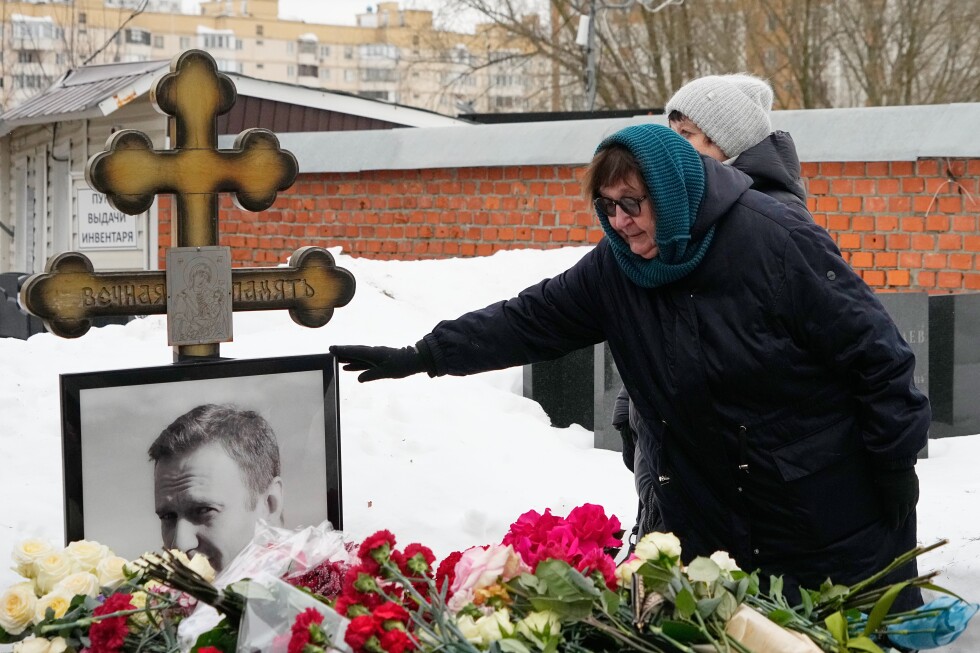
At Moscow’s snow-covered Borisovsky Cemetery, Navalny’s mother Lyudmila Navalnaya and mother-in-law Alla Abrosimova joined dozens of mourners laying flowers at his grave. A substantial mound of bouquets rose above the heavy snowdrifts, with representatives from several European embassies also paying respects under the watchful eyes of security personnel.
“We knew that our son did not simply die in prison,” Lyudmila Navalnaya told those gathered. “He was murdered.”
Her statement aligns with explosive new findings released just days before the anniversary. In a joint statement Saturday, the foreign ministries of the UK, France, Germany, Sweden and the Netherlands revealed that European laboratory analysis of samples from Navalny’s body “conclusively confirmed the presence of epibatidine,” a deadly neurotoxin secreted by poison dart frogs native to South America.
“Russia had the means, motive and opportunity to administer this poison,” the statement declared, noting the toxin does not occur naturally in Russia.
French President Emmanuel Macron echoed these conclusions in a tribute Monday: “I said then that I believed his death said everything about the Kremlin’s weakness and its fear of any opponent. It is now clear that this death was premeditated.”
The Kremlin has vehemently denied involvement, with presidential spokesperson Dmitry Peskov telling journalists Monday that Moscow “does not accept such accusations” and considers them “biased and unfounded.”
Navalny’s widow, Yulia Navalnaya, who attended the Munich Security Conference in Germany over the weekend, said she had been “certain from the first day” about her husband’s poisoning. “Now there is proof,” she wrote on social media. “Putin killed Alexei with a chemical weapon.”
This wasn’t the first poisoning attempt against the opposition leader. In 2020, Navalny nearly died after being exposed to a Novichok nerve agent in an attack he blamed on the Kremlin. Following emergency treatment and rehabilitation in Germany, Navalny made the courageous but fateful decision to return to Russia in January 2021, where he was immediately arrested and remained imprisoned until his death.
Beyond Moscow, Russians found ways to honor Navalny’s memory despite growing repression. In St. Petersburg, mourners laid flowers at a memorial for victims of political repression, though authorities later blocked access to the site with temporary fencing, according to local reports.
The anniversary highlights the fractured state of Russia’s opposition movement since Navalny’s death. Many of his closest allies, like other key opposition figures, now operate from exile, having been sentenced to lengthy prison terms in absentia. Some, including Navalny himself, have been officially designated as “terrorists and extremists” by Russian authorities.
Despite their shared goal of opposing the Kremlin, these exiled groups have struggled to form a united front. Rival factions have publicly criticized one another, which some observers view as counterproductive competition for influence within the opposition movement.
One modest development came in late January when the Parliamentary Assembly of the Council of Europe (PACE) announced the creation of a Platform for Dialogue with Russian Democratic Forces. This initiative aims to give opposition Russians a formal channel to engage with European lawmakers, though it has drawn criticism for not being democratically elected and for the absence of members from Navalny’s anti-corruption organization.
Russian members of PACE marked Navalny’s death anniversary with a statement calling it “an inevitable link in a chain of systemic crimes by the Kremlin regime against its own citizens and the citizens of foreign states.”
“Alexei Navalny gave his life for a free Russia,” the statement concluded. “We are obliged to ensure that his death was not in vain.”
Fact Checker
Verify the accuracy of this article using The Disinformation Commission analysis and real-time sources.

18 Comments
Exploration results look promising, but permitting will be the key risk.
Production mix shifting toward World might help margins if metals stay firm.
Good point. Watching costs and grades closely.
Nice to see insider buying—usually a good signal in this space.
Interesting update on Two years later, Navalny’s death still casts a shadow over Russia and wider Europe. Curious how the grades will trend next quarter.
Interesting update on Two years later, Navalny’s death still casts a shadow over Russia and wider Europe. Curious how the grades will trend next quarter.
Nice to see insider buying—usually a good signal in this space.
If AISC keeps dropping, this becomes investable for me.
Good point. Watching costs and grades closely.
Uranium names keep pushing higher—supply still tight into 2026.
Good point. Watching costs and grades closely.
The cost guidance is better than expected. If they deliver, the stock could rerate.
Good point. Watching costs and grades closely.
Uranium names keep pushing higher—supply still tight into 2026.
Good point. Watching costs and grades closely.
Good point. Watching costs and grades closely.
I like the balance sheet here—less leverage than peers.
Good point. Watching costs and grades closely.