


Listen to the article
Trump Defends Foreign Policy Record in State of the Union Amid Growing Public Skepticism
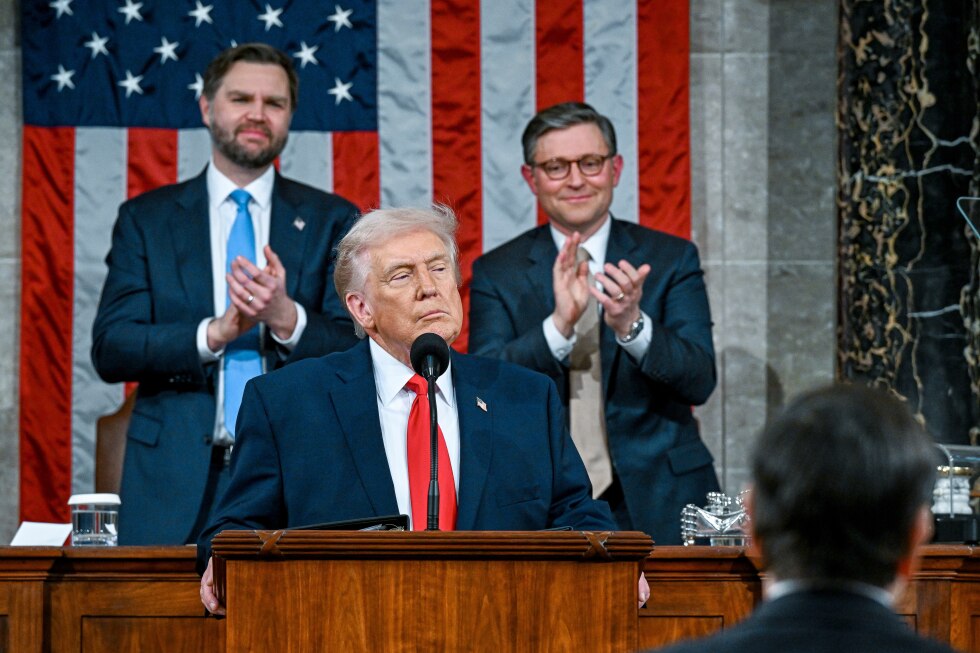
President Donald Trump used his State of the Union address Tuesday night to vigorously defend his foreign policy approach as polls show Americans increasingly concerned about his international priorities and military interventions abroad.
While the speech primarily focused on domestic issues, Trump devoted significant time to framing his foreign policy decisions as both strategic and successful, highlighting what he considers his major diplomatic and military achievements during his second term.
“As president, I will make peace wherever I can, but I will never hesitate to confront threats to America wherever we must,” Trump told lawmakers and the nation during his 108-minute address.
The president’s defense of his international agenda comes at a challenging time. According to recent surveys from The Associated Press-NORC Center for Public Affairs Research, 61% of Americans disapprove of his handling of foreign policy, while 56% believe Trump has “gone too far” in deploying U.S. military forces overseas.
Among his claimed foreign policy successes, Trump highlighted the brokering of a fragile ceasefire in Gaza and the return of American hostages taken by Hamas. He also celebrated the controversial military operation that led to the capture of Venezuelan leader Nicolás Maduro last month.
“This was an absolutely colossal victory for the security of the United States,” Trump declared of the Venezuela operation, pausing during his speech to award the Congressional Medal of Honor to a helicopter pilot wounded during the mission. The president also introduced Enrique Márquez, a former Venezuelan presidential candidate and political prisoner freed by the Maduro regime following the U.S. intervention.
The president further touted receiving “more than 80 million barrels of oil” from Venezuela since the operation, though administration officials had previously estimated a more modest 30-50 million barrels.
Trump’s increasingly assertive stance in Latin America has raised concerns throughout the region. His administration has conducted dozens of military strikes against suspected drug vessels in the Caribbean, seized oil tankers, and tightened the embargo on Cuba as part of what he calls the “Donroe Doctrine” – a play on the 19th-century Monroe Doctrine that asserted U.S. dominance in the Western Hemisphere.
“We’re also restoring American security and dominance in the Western Hemisphere, acting to secure our national interests and defend our country from violence, drugs, terrorism and foreign interference,” Trump said.
On Iran, the president warned Tehran about pursuing nuclear weapons capabilities, just eight months after claiming U.S. strikes had “obliterated” three key Iranian nuclear facilities and left “the bully of the Middle East” with no alternative but to seek peace.
“We wiped it out and they want to start all over again. And they’re at this moment again pursuing their sinister ambitions,” Trump said. “We are in negotiations with them. They want to make a deal, but we haven’t heard those secret words: We will never have a nuclear weapon.”
Notably, Iranian Foreign Minister Abbas Araghchi posted on social media earlier Tuesday: “Our fundamental convictions are crystal clear: Iran will under no circumstances ever develop a nuclear weapon.”
Trump envoys Steve Witkoff and Jared Kushner are scheduled to meet with Iranian officials in Geneva on Thursday, though significant obstacles remain. Iranian leaders insist on limiting discussions to nuclear matters, while the U.S. and Israel want the talks to address Iran’s missile program and support for regional proxies like Hezbollah, Hamas and the Houthis.
The president made only brief mention of the Russia-Ukraine conflict, which marked its four-year anniversary this week. Despite campaign promises to end the war “in one day,” Trump has struggled to broker peace between the warring nations.
“The killing and slaughter between Russia and Ukraine, where 25,000 soldiers are dying each and every month,” Trump noted, adding that his administration continues working to end the conflict.
U.S.-mediated talks between Moscow and Kyiv continue but face significant hurdles, including Russian demands for Ukrainian territorial concessions and disputes over control of the Zaporizhzhia nuclear power plant. According to Ukrainian President Volodymyr Zelenskyy, the White House has set a June deadline for reaching a peace agreement.
Trump also addressed last week’s Supreme Court ruling that struck down his use of a 1977 legal authority for imposing tariffs on both allies and adversaries. Taking a more measured tone than in his social media posts, he called it “an unfortunate ruling” but warned foreign nations to honor previously negotiated trade agreements.
“The good news is almost all countries and corporations want to keep the deal that they already made,” Trump said, adding that his authority “to make a new deal could be far worse for them and therefore they will continue to work along the same successful path we had negotiated before the Supreme Court’s unfortunate involvement.”
As Trump approaches the midterm elections of his second term, his foreign policy record remains under intense scrutiny, with the president clearly seeking to convince voters that his international engagements serve America’s interests despite growing public skepticism.
Fact Checker
Verify the accuracy of this article using The Disinformation Commission analysis and real-time sources.

12 Comments
Interesting to see the president defend his foreign policy approach. While his decisions have been controversial, it’s important to consider the strategic factors at play. I’m curious to learn more about how the public views his international priorities.
I agree, it’s a complex issue that deserves nuanced discussion. The public opinion data is certainly thought-provoking.
As someone interested in geopolitics, I’m curious to hear more about the specifics of Trump’s foreign policy approach and how it has played out in practice. The polling data indicates there are significant concerns to address.
A balanced and nuanced discussion of foreign policy is always valuable, regardless of one’s political affiliation.
Trump’s foreign policy has been a source of ongoing controversy. It will be intriguing to see how his defense of his approach is received, especially given the public skepticism reflected in the surveys.
Agreed. Foreign policy is a complex issue, and it’s important to carefully consider multiple perspectives.
The president’s defense of his foreign policy record is timely given the growing public concerns. It will be insightful to see how the speech is received and whether it shifts perceptions on these issues.
Agreed. The public opinion data suggests there is room for further dialogue and debate on these matters.
The president’s foreign policy decisions have certainly had a significant impact, both domestically and internationally. It will be interesting to see how his arguments are perceived, particularly in light of the public opinion data.
A thorough and objective analysis of foreign policy is crucial, as it affects us all on a global scale.
Trump’s foreign policy has been a divisive topic, with both supporters and critics. It will be interesting to see how his claims of success and strategic rationale are received, especially given the public skepticism reflected in the polls.
Valid point. The public’s views on foreign policy are an important consideration, regardless of one’s political leanings.