


Listen to the article
President Donald Trump downplayed concerns Saturday about Russia potentially providing Iran with intelligence to target U.S. military assets in the Middle East, suggesting such information sharing has proven ineffective as the week-old conflict intensifies.
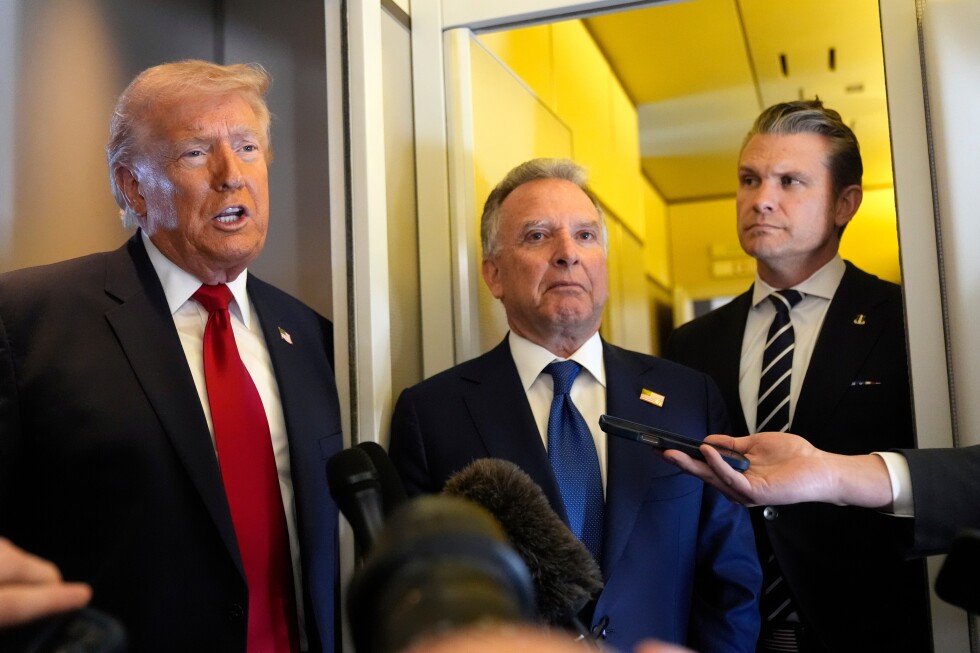
Speaking to reporters aboard Air Force One en route to Miami, Trump addressed reports from The Associated Press and other news outlets about Russian intelligence support to Iran without explicitly confirming them.
“If you take a look at what’s happened to Iran in the last week, if they’re getting information, it’s not helping them much,” Trump remarked after attending the dignified transfer ceremony for six Army reservists killed in a drone strike in Kuwait following the U.S.-Israeli military campaign against Iran.
When questioned about how such Russian assistance might affect U.S.-Russia relations, Trump deflected by suggesting equivalence in intelligence sharing. “They’d say we do it against them,” he responded. “Wouldn’t they say that we do it against them?”
His comments reference the established practice of the United States providing Ukraine with intelligence to defend against Russian missiles and identify targets since Russia’s 2022 invasion began.
Trump’s apparent indifference to potential Russian-Iranian cooperation comes amid growing criticism of his administration’s recent decision to grant India a temporary exemption from sanctions on Russian oil purchases. The Treasury Department announced earlier this week that India can continue buying crude oil and petroleum products from Russia until April 4.
The move has triggered bipartisan backlash. Representative Don Bacon (R-Neb.) described the “weakness towards Russia” as “appalling” in a social media post, while Representative Ted Lieu (D-Calif.) directly addressed Treasury Secretary Scott Bessent, calling the decision “traitorous conduct” that helps Russia while it “assists Iran in targeting American troops.”
The temporary waiver follows Trump’s earlier announcement of reduced tariffs on India after officials there agreed to decrease their reliance on discounted Russian crude. India has significantly increased Russian oil imports since 2022, taking advantage of reduced prices as Western nations imposed sanctions following the Ukraine invasion.
Global oil markets have been severely disrupted by the widening Middle East conflict. The price of oil has surged dramatically one week into the U.S.-Israel military campaign against Iran, with no signs of stabilization. Ships carrying approximately 20 million barrels of oil daily cannot safely navigate the Strait of Hormuz, the critical maritime chokepoint bordered by Iran that connects the Persian Gulf to global shipping lanes.
The combination of shipping disruptions and damage to key Middle Eastern oil and gas infrastructure has interrupted supplies from several of the world’s largest oil producers, further straining global energy markets already concerned about the conflict’s duration and potential for escalation.
When asked about potential measures to ease oil prices, Trump indicated openness to interventions that would “take a little of the pressure off,” though he appeared reluctant to immediately tap the Strategic Petroleum Reserve (SPR).
“We’ve got a lot of oil. Our country has a tremendous amount,” Trump said. “There’s a lot of oil out there. That’ll get healed very quickly.”
The SPR currently holds over 415 million barrels, an increase from approximately 395 million barrels at this time last year. When at full capacity, the reserve can store more than 700 million barrels of oil for use during supply disruptions or national emergencies.
The president’s comments come as his administration navigates the complex geopolitical and economic fallout from the escalating Middle East conflict while attempting to manage domestic energy prices and international relationships with both allies and adversaries.
Fact Checker
Verify the accuracy of this article using The Disinformation Commission analysis and real-time sources.

11 Comments
This is a delicate geopolitical dance. The US and Russia have a long history of intelligence competition, so it’s not surprising to see accusations of information sharing with Iran. The key is managing escalation while protecting national interests.
The potential for Russia to share intelligence with Iran is a concerning development that deserves serious consideration. While the President may want to downplay it, the strategic implications could be significant. Vigilance and a measured response will be essential.
While the President may want to downplay the significance, the reported intelligence sharing is a significant development that warrants close monitoring. The potential impact on regional stability and US-Russia relations should not be underestimated.
This situation highlights the complex web of alliances and rivalries in the Middle East. With Russia, Iran, and the US all involved, the potential for miscalculation and unintended consequences is high. Careful diplomacy will be crucial to navigate these waters.
Absolutely. The stakes are high, and missteps could lead to a dangerous escalation. Maintaining clear communication channels and a steady, measured approach will be critical in the weeks and months ahead.
Interesting to see how this alleged intel sharing could impact regional dynamics. It’s a complex issue with a lot of geopolitical implications. I’m curious to learn more about how this might affect US-Russia relations going forward.
You raise a good point. The potential for escalation here is concerning. Hopefully both sides can exercise restraint and avoid further destabilization in the region.
The President’s dismissive tone is notable. While the effectiveness of any intel sharing is debatable, it seems unwise to downplay it entirely. Maintaining situational awareness is crucial, even if the impacts aren’t immediately apparent.
I agree. Complacency in the face of potential threats is risky. Prudent leaders should take such reports seriously and consider potential contingencies, even if the threat is not yet fully realized.
This is a complex geopolitical issue with far-reaching implications. The President’s dismissive tone is concerning, as it may signal a lack of appreciation for the nuances and risks involved. Careful, fact-based analysis will be essential going forward.
Well said. Maintaining a clear-eyed, objective understanding of the situation is crucial, even if the ultimate outcomes are difficult to predict. Constructive dialogue and sound decision-making will be key to navigating this challenge effectively.