


Listen to the article
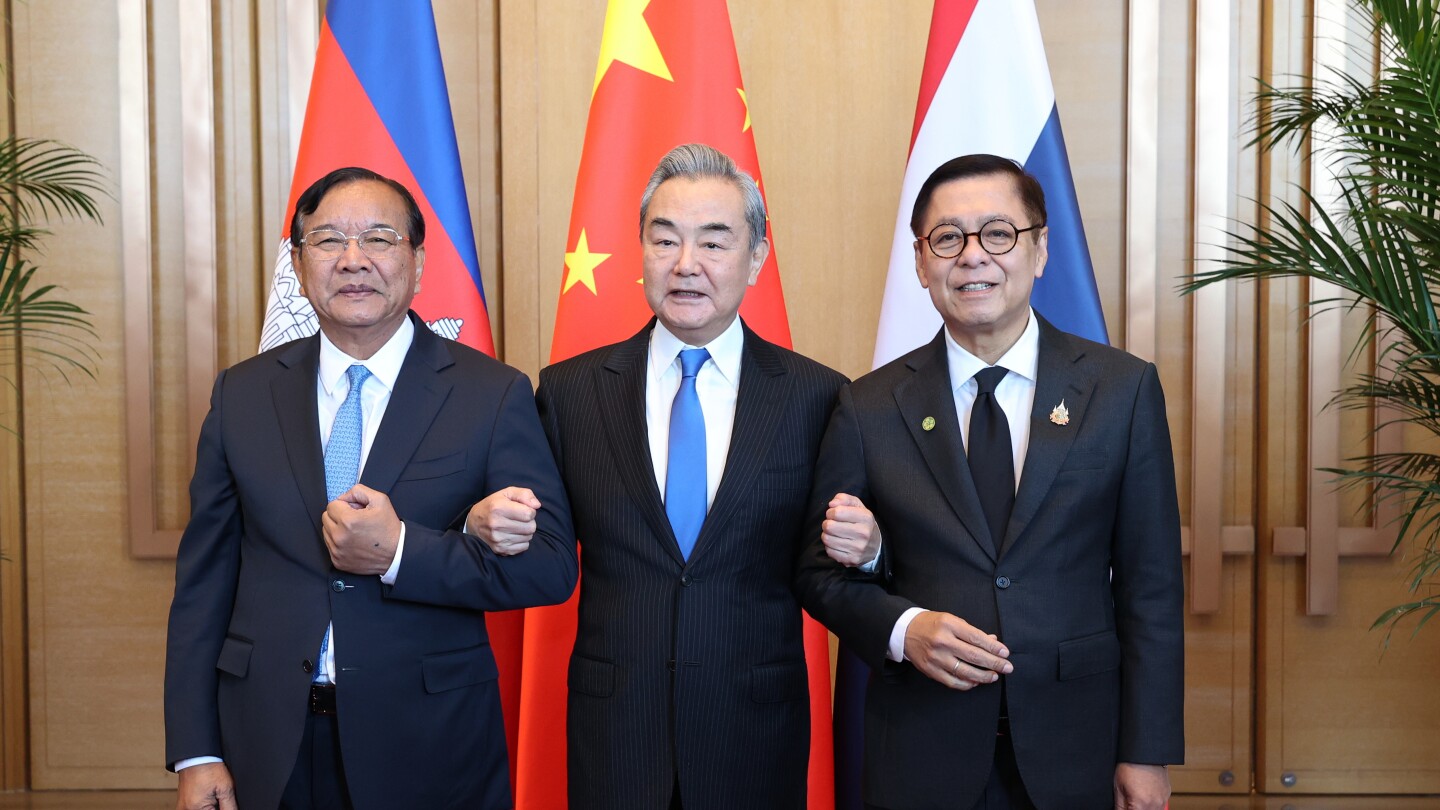
Foreign ministers from Cambodia and Thailand met with their Chinese counterpart on Monday as Beijing sought to strengthen its mediating role in the violent border conflict between the two Southeast Asian nations. The trilateral meeting was held in China’s southwestern Yunnan province, strategically located closer to the disputed border area rather than in Beijing.
The gathering came just two days after Thailand and Cambodia signed a fresh ceasefire agreement aimed at ending weeks of fighting that has claimed more than 100 lives and displaced hundreds of thousands of residents on both sides of the border.
“We haven’t resolved everything, but I think we are making progress in the right direction and we have to keep up the momentum,” Thai Foreign Minister Sihasak Phuangketkeow told reporters after the meeting. He emphasized that establishing a sustained ceasefire and rebuilding trust were immediate priorities.
The location of the talks in Yunnan, approximately 1,300 miles southwest of Beijing, highlights China’s strategic approach to positioning itself as a key regional mediator. This meeting represents Beijing’s latest effort to enhance its diplomatic influence, particularly in Asian regional conflicts.
During the discussions, Chinese Foreign Minister Wang Yi urged joint action to promote regional stability. “Allowing the flames of war to be reignited is absolutely not what the people of the two countries want and not what China, as your friend, wants to see. Therefore, we should resolutely look ahead and move forward,” Wang stated.
Cambodian Foreign Minister Prak Sokhonn expressed optimism that the latest ceasefire would endure, creating conditions for both nations to resume previously established dispute resolution mechanisms. “We don’t want to return to the past, which means that no one wants to see this fighting happening again. Therefore, what is important is that this ceasefire is to be permanent and must be firmly respected and implemented,” he told Cambodian state media TVK.
According to China’s official news agency Xinhua, the three nations reached consensus on maintaining the ceasefire without reversal and restoring ties between Cambodia and Thailand incrementally. China also offered immediate humanitarian assistance for displaced residents.
The joint statement released by Xinhua, Cambodia’s Agence Kampuchea Presse, and the Thai Foreign Ministry indicated that the three sides committed to combating transnational crimes, including telecommunications and online scams—issues that have become significant concerns in the region.
The border conflict has a complex history. The two Southeast Asian neighbors initially reached a ceasefire in July, brokered by Malaysia under pressure from U.S. President Donald Trump, who threatened to withhold trade privileges. This preliminary agreement was followed by a more detailed accord in October.
Despite these previous efforts, tensions persisted, with both sides engaging in propaganda campaigns and sporadic violence. The situation escalated into heavy fighting in early December, necessitating the new ceasefire agreement signed on Saturday.
A key provision of the latest agreement requires Thailand to repatriate 18 Cambodian soldiers captured during the earlier fighting in July, once the ceasefire holds for 72 hours. Their release has been a major demand from Cambodia. The agreement also commits both sides to adhere to international conventions against land mine deployment, addressing one of Thailand’s primary concerns.
Sihasak confirmed Thailand would begin repatriating the Cambodian soldiers if the 72-hour ceasefire milestone could be achieved without incident. Thailand has also requested Cambodia’s assistance in facilitating the return of Thai nationals currently in Poipet, a Cambodian border city.
In a parallel development, Cambodian Prime Minister Hun Manet issued a statement to Cambodian forces along the Thai border, acknowledging the limitations of prolonged conflict. “Even though we can still fight,” he noted, “as a small country we still have nothing to gain from prolonging the fighting for a long time.”
The situation reflects broader geopolitical dynamics in Southeast Asia, where China continues to expand its influence as a mediator while smaller nations navigate complex border disputes with significant humanitarian implications. The effectiveness of this latest diplomatic intervention will be measured by the durability of the ceasefire in the coming weeks.
Fact Checker
Verify the accuracy of this article using The Disinformation Commission analysis and real-time sources.

22 Comments
Production mix shifting toward World might help margins if metals stay firm.
Good point. Watching costs and grades closely.
Uranium names keep pushing higher—supply still tight into 2026.
Silver leverage is strong here; beta cuts both ways though.
Good point. Watching costs and grades closely.
Uranium names keep pushing higher—supply still tight into 2026.
Good point. Watching costs and grades closely.
Interesting update on Top diplomats of China, Cambodia and Thailand meet as Beijing seeks a stronger role in dispute. Curious how the grades will trend next quarter.
Good point. Watching costs and grades closely.
I like the balance sheet here—less leverage than peers.
Good point. Watching costs and grades closely.
Exploration results look promising, but permitting will be the key risk.
I like the balance sheet here—less leverage than peers.
Good point. Watching costs and grades closely.
Exploration results look promising, but permitting will be the key risk.
Good point. Watching costs and grades closely.
If AISC keeps dropping, this becomes investable for me.
Uranium names keep pushing higher—supply still tight into 2026.
Good point. Watching costs and grades closely.
The cost guidance is better than expected. If they deliver, the stock could rerate.
Good point. Watching costs and grades closely.
The cost guidance is better than expected. If they deliver, the stock could rerate.