


Listen to the article
Vietnam’s Transformation: From Folk Songs to Factory Hub Amid US-China Tensions
The transformation of Vietnam’s Bac Ninh is unmistakable in its urban landscape—Chinese and Korean restaurants now dot streets once known primarily for rice fields and the melodic Quan Ho folk songs that earned UNESCO recognition centuries ago. This northern Vietnamese city has emerged as one of the country’s busiest industrial zones, riding a wave of investment accelerated by trade tensions between Washington and Beijing.
Vietnam has capitalized on the friction between the United States and China, with factories relocating from Chinese soil to join earlier investment waves from Japan and South Korea. This migration has firmly established Vietnam as a global manufacturing powerhouse. However, the rapid industrialization is showing signs of strain as labor costs rise, worker shortages intensify, and infrastructure limitations become apparent.
With regional competitors like Indonesia and the Philippines aggressively pursuing new manufacturing projects, Vietnam is working to climb the value chain and diversify its export markets to maintain momentum. These efforts are particularly visible in Bac Ninh’s ongoing evolution.
The city’s initial manufacturing boom began around 2008 when Samsung established its first phone factory there, eventually making Vietnam the tech giant’s largest offshore manufacturing base. More recently, Chinese companies have poured investments into the region, seeking to circumvent U.S. tariffs and trade restrictions.
Since Vietnam and China normalized diplomatic relations in the 1990s, Chinese investment has steadily increased. Chinese firms in Bac Ninh have tapped into Vietnam’s electronics supply chain, skilled workforce, and business-friendly local governments, often with assistance from Chinese-speaking intermediaries who facilitate regulatory processes and logistics.
Despite this growth, Vietnam’s economy—roughly 40 times smaller than China’s—cannot fully replace the manufacturing capacity of the world’s second-largest economy. Vietnamese authorities are responding by rapidly developing infrastructure, including a highway to the Chinese border that has reduced travel time by more than an hour. A new railway will soon connect Hanoi to Vietnam’s largest seaport at Haiphong, and then extend to the border town of Lao Cai.
In December, Bac Ninh broke ground on an expansion of its industrial zone dedicated to high-tech manufacturing, including electronics, pharmaceuticals, and clean energy. This project is part of a coordinated nationwide development push that launched 234 major projects worth more than $129 billion just weeks before January’s National Party Congress, which will determine Vietnam’s political leadership and economic trajectory.
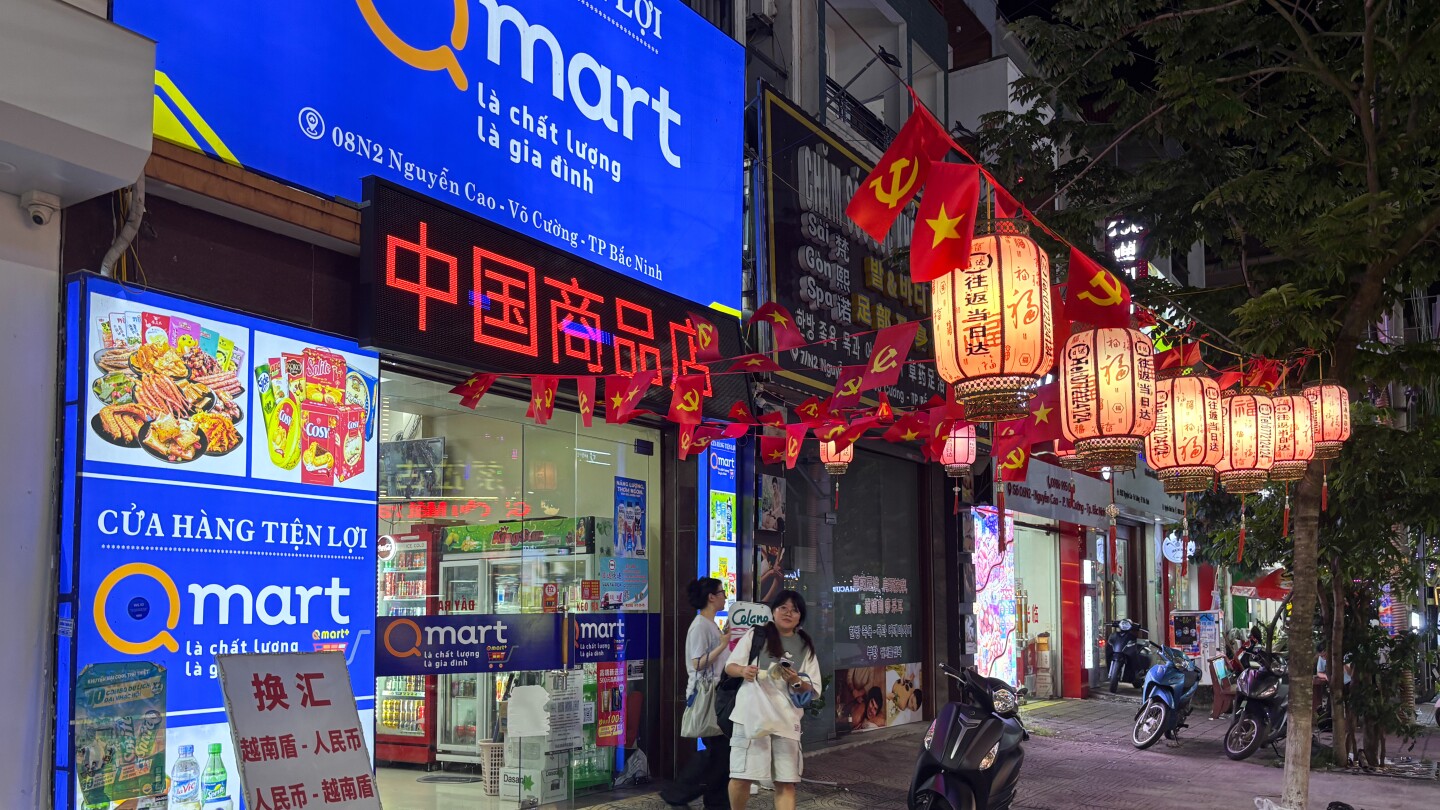
The Chinese influence in Bac Ninh is increasingly evident. Downtown storefronts bear names like Tmall, after Alibaba’s flagship e-commerce platform. Chinese-language signage advertises services for investors, and Chinese-Vietnamese language schools have opened to facilitate communication between locals and Chinese business operators.
However, as Chinese companies compete for Vietnam’s best talent and resources, costs are rising for manufacturers pursuing a “China plus one” strategy. “It is becoming difficult to recruit workers,” notes Peng, an employee at a telecommunications equipment company that relocated from Shenzhen. “Labor costs have jumped 10-15% since 2024, and we expect them to keep rising.”
Industry experts point out that Vietnam still relies heavily on Chinese technology, equipment, and expertise. “China has created the best manufacturing ecosystem,” explains Jacob Rothman, co-founder and CEO of China-based Velong Enterprises, which has shifted some production to Southeast Asian countries. “You can’t recreate that overnight.”
Few countries have benefited more from Trump’s trade war than Vietnam, whose largest export market remains the United States. In 2024, Vietnam ran a $123.5 billion surplus with the U.S.—the third largest after China and Mexico. This imbalance prompted Trump to threaten a 46% import tax on Vietnamese goods before settling on 20%.
The two nations continue to negotiate a trade agreement to maintain most tariffs at 20%. Vietnam has offered preferential access for U.S. products, according to the White House, and has largely absorbed the existing tariffs, running a trade surplus of $121.6 billion in January-November 2025.
Despite the recent trade truce between the U.S. and China, which lowered average tariffs on Chinese exports to the U.S. to about 47%, persistent uncertainty means companies are diversifying their manufacturing locations across multiple countries. “The race to move outside of China is still happening, and it’s accelerating,” Rothman states.
Vietnam maintains strong foreign investment, with cumulative inflows exceeding $28.5 billion as of September—15% higher than the previous year. However, increased scrutiny of Vietnam’s role in tariff-dodging transshipments has prompted some manufacturers to hedge their bets by looking to alternative production bases.
Vietnam aims to become Asia’s next “tiger economy” by 2045, following the model of South Korea and Taiwan by shifting from low-cost assembly work to higher-value manufacturing. The government offers incentives including tax breaks on imported machinery and discounted rents to help suppliers upgrade and modernize their operations.
As Prime Minister Pham Minh Chinh declared when announcing hundreds of infrastructure projects in December, Vietnam must “reach far into the ocean, delve deep underground and soar high into space” to achieve its ambitious economic goals in an increasingly competitive region.
Fact Checker
Verify the accuracy of this article using The Disinformation Commission analysis and real-time sources.

16 Comments
The transformation of Bac Ninh is a remarkable example of Vietnam’s ability to adapt and capitalize on global economic shifts. However, the challenges of rising labor costs and infrastructure limitations underscore the need for strategic long-term planning.
That’s a great point. Vietnam will need to invest in skills development, innovation, and targeted infrastructure upgrades to maintain its competitiveness in the global manufacturing landscape.
It’s fascinating to see how Vietnam has seized the opportunity presented by the US-China trade tensions to become a manufacturing powerhouse. The rapid growth in Bac Ninh is certainly impressive, but the long-term sustainability of this model remains to be seen.
Absolutely, Vietnam will need to carefully manage the transition and ensure that the benefits of this growth are distributed equitably and that the environmental impact is mitigated.
The rapid industrialization of Bac Ninh is certainly an impressive feat, but it also raises questions about the social and environmental implications of this growth model. Ensuring sustainable and equitable development will be crucial for Vietnam’s long-term success.
Agreed. Vietnam will need to carefully balance its economic ambitions with a commitment to social and environmental responsibility to create a truly resilient and inclusive growth model.
The transformation of Bac Ninh from a rural area to a bustling industrial hub is quite remarkable. It highlights Vietnam’s ability to adapt and seize opportunities in the global supply chain shifts.
You’re right, Vietnam’s success in attracting manufacturing investment is a testament to its pragmatic approach and willingness to provide a conducive business environment.
The story of Bac Ninh’s transformation highlights Vietnam’s impressive economic dynamism, but also raises concerns about the social and environmental impacts of rapid industrialization. Careful planning and stakeholder engagement will be key.
Well said. Vietnam will need to strike a delicate balance between economic development and safeguarding the wellbeing of its citizens and natural resources.
The rise of Bac Ninh as a manufacturing hub is an impressive example of Vietnam’s ability to adapt and capitalize on global shifts. However, the potential risks of overreliance on a narrow export base are worth considering.
Agreed. Diversifying the economy and moving up the value chain will be crucial for Vietnam to ensure sustainable long-term growth and resilience.
While the economic benefits of this rapid industrialization are clear, I’m curious to see how Vietnam will address the potential downsides, such as the strain on labor and infrastructure. Balancing growth and sustainability will be crucial.
That’s a great point. Ensuring the long-term viability and livability of these industrial hubs will be a key challenge for Vietnam’s policymakers in the years ahead.
Fascinating to see how Vietnam has capitalized on the US-China tensions to become a manufacturing powerhouse. The rapid industrialization is certainly impressive, but the challenges of rising labor costs and infrastructure limitations are worth watching closely.
Absolutely, Vietnam will need to carefully manage this transition to maintain its competitive edge. Diversifying export markets and moving up the value chain will be key.