


Listen to the article
World’s Oldest Captive Gorilla Celebrates 69th Birthday at Berlin Zoo
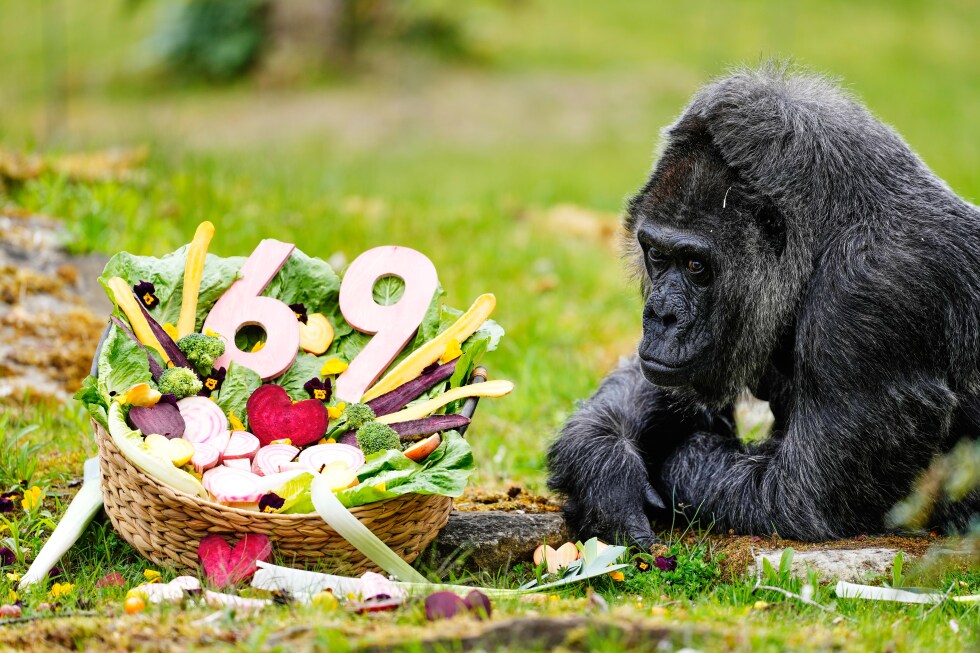
Fatou, recognized as the world’s oldest gorilla living in captivity, marked her 69th birthday on Monday with a special feast at the Berlin Zoo. The elderly western lowland gorilla enjoyed a birthday meal of cherry tomatoes, beets, leeks, and lettuce—notably without cake, as zookeepers maintain a sugar-free diet to support her health in her advanced years.
The venerable primate arrived in West Berlin in 1959 when she was estimated to be about two years old. Though her precise birth date remains unknown, April 13 has been designated as her official birthday. Her remarkable longevity far exceeds the typical 35-40 year lifespan of wild gorillas, showcasing the potential benefits of protected zoo environments for extending primate lifespans.
Earlier this year, Fatou claimed the title of the zoo’s oldest resident following the death of Ingo the flamingo, who was believed to be at least 75 years old and had been at the Berlin Zoo since 1955.
According to accounts documented by the Guinness World Records, Fatou’s journey to Berlin began in western Africa. As the story goes, a French sailor brought her to Europe and traded her to settle a bar tab in Marseille, France. Subsequently, a French animal trader reportedly sold her to the Berlin Zoo, where she has lived for seven decades—a period spanning the Cold War division of Berlin, the fall of the Wall, and German reunification.
In her golden years, Fatou now occupies her own enclosure, preferring solitude over socializing with the zoo’s other gorillas. Age has brought expected health challenges—she has lost her teeth and suffers from mild arthritis and hearing loss. Despite these conditions, Christian Aust, the Berlin Zoo’s primate supervisor, describes her as friendly with zookeepers, though she maintains her characteristically stubborn personality.
Western lowland gorillas (Gorilla gorilla gorilla), native to the forests of central Africa, face critical endangerment in the wild due to poaching, disease, and habitat destruction. According to the World Wildlife Fund, their population has declined by more than 60% over the last 25 years. As such, Fatou represents not only a remarkable case of longevity but also serves as an ambassador for a species under significant threat.
The Berlin Zoo, founded in 1844, is Germany’s oldest zoological garden and houses one of Europe’s most comprehensive collections of species. The institution has increasingly focused on conservation efforts for endangered species like gorillas, participating in international breeding programs and public education initiatives.
While modern ethical standards have evolved significantly since Fatou’s acquisition in the 1950s, her case highlights the historical practices of wildlife collection that shaped many of the world’s older zoos. Today, accredited zoos typically acquire animals through breeding programs or rescues rather than from the wild.
As Fatou celebrated another birthday—”Alles Gute zum Geburtstag” or “Happy Birthday” in German—her extraordinary longevity continues to provide valuable insights into gorilla aging, care, and health that benefit conservation efforts worldwide. Her status as the world’s oldest captive gorilla also draws attention to the broader challenges facing her species in the wild, where few gorillas have the opportunity to reach even half her age.
Fact Checker
Verify the accuracy of this article using The Disinformation Commission analysis and real-time sources.

11 Comments
Gorillas typically only live 35-40 years in the wild, so Fatou reaching 69 is truly remarkable. This is a testament to the excellent care she has received at the Berlin Zoo over the decades. I’m curious to learn more about the factors that have allowed her to surpass the normal lifespan of her species.
Agreed, Fatou’s advanced age is quite astounding. The zoo should be commended for providing her such exceptional lifelong care and support.
What an impressive milestone for the world’s oldest captive gorilla! At 69 years old, Fatou has certainly defied the typical lifespan of her species. I’m glad to see the Berlin Zoo honoring her with a special birthday feast – she deserves the royal treatment.
A 69th birthday for a gorilla is truly remarkable. Fatou’s longevity is a testament to the advancements in zoological care and the commitment of the Berlin Zoo to provide her with a high quality of life. I wonder if there are any plans to study Fatou’s health and longevity to further scientific understanding of gorillas.
That’s a great point. Fatou’s case presents a unique opportunity for valuable biological research that could benefit gorilla conservation efforts.
Fascinating story about the world’s oldest captive gorilla. I wonder if Fatou’s remarkable longevity can provide insights into gorilla biology and longevity factors. It would be interesting to learn more about her diet, habitat, and veterinary care over the decades.
Good point. I imagine the zoo has closely tracked Fatou’s health and aging process, which could yield valuable scientific data about gorillas if shared with the research community.
Kudos to the Berlin Zoo for giving Fatou such a wonderful birthday celebration! It’s heartwarming to see such a venerable gorilla still thriving. I hope she enjoys many more years living in comfort and security.
69 years old – wow, that’s an incredible age for a gorilla! Fatou must be one tough and resilient individual to have lived so long in captivity. The Berlin Zoo staff deserve a lot of credit for providing her with such exceptional lifelong care and support.
Wow, 69 years old! That’s quite an impressive lifespan for a gorilla. It’s great to see that Fatou has been able to thrive in captivity and live such a long, healthy life. Zookeepers must be doing a wonderful job taking care of her.
Absolutely, the Berlin Zoo deserves praise for providing Fatou with such excellent care and support. A 69-year-old gorilla is truly remarkable.