


Listen to the article
South Korean Pianist Defies Stroke to Perform with One Hand, Prepares for Orchestral Debut
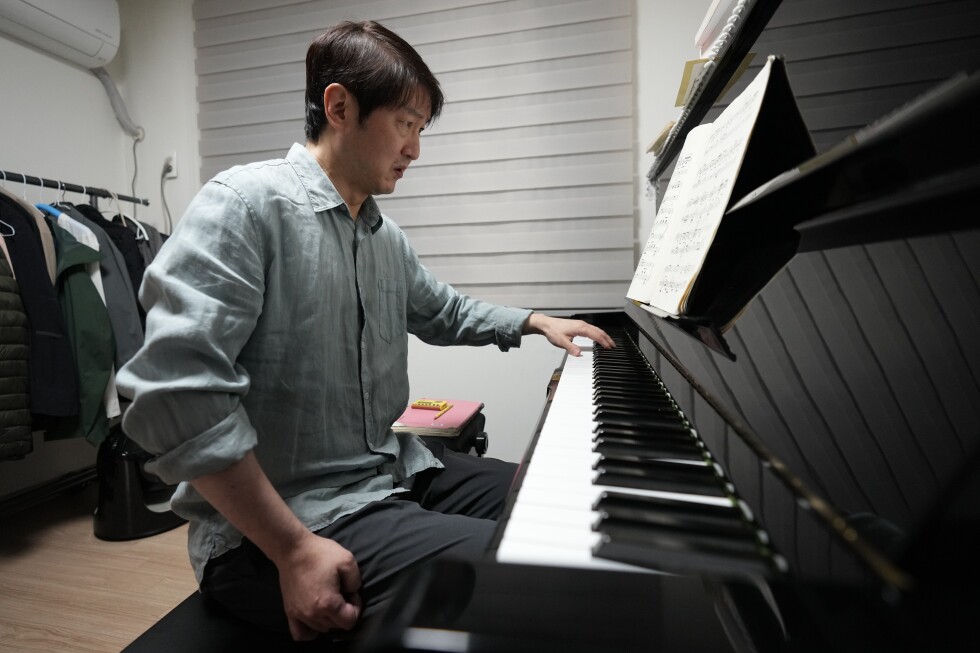
When a major stroke paralyzed the right side of South Korean pianist Lee Hun’s body in 2012, his immediate concern wasn’t whether he would play piano again—it was whether he would ever walk. Now, twelve years later, the 54-year-old musician is preparing for a milestone achievement: his first performance with an orchestra at an international music festival.
“I’m so, so nervous I could die,” Lee said with a smile during a recent interview at his Seoul home. Despite his lighthearted tone, the upcoming performance represents the pinnacle of an extraordinary journey of recovery and resilience.
The devastating event occurred in August 2012 while Lee was pursuing his doctorate at the University of Cincinnati’s music school. He suddenly collapsed at home, requiring extensive surgery that couldn’t prevent damage to approximately 60% of his brain’s left hemisphere. The stroke left him unable to move his right arm and leg, and he temporarily lost his ability to speak.
Lee returned to South Korea in a wheelchair, his condition so severe that he couldn’t recognize his father—Lee Hae Chang, a baseball legend in South Korea—upon arrival.
“After the stroke, I didn’t even imagine playing the piano. I only thought about whether I could stand on my feet again,” Lee recalled.
His rehabilitation was challenging not only physically but emotionally. His mother, Poong Ok Hee, remembers frequent conflicts with her son, whose mood swings made caregiving particularly difficult. Lee often resisted assistance and advice during this difficult period.
The turning point came in 2013 during a dinner with his former piano teacher, Chun Yung Hae. She suggested something that would transform his outlook—there were more than 1,000 musical pieces written specifically for the left hand alone. That single conversation reignited Lee’s passion for the piano, and he began practicing that very night.
Three years later, in 2016, Lee made his formal debut as a one-handed pianist at Seoul St. Mary’s Hospital, where he had received treatment and rehabilitation. His performance of Camille Saint-Saens’ “6 Etudes for the Left Hand Alone” moved the audience. When Lee and Chun played “Amazing Grace” together—Lee using his left hand, Chun her right—at least one spectator was moved to tears.
“He is a pianist so he must play the piano,” said Chun, who served as dean of the College of Music at Seoul’s Kyung Hee University. “He was completely hopeless and in despair, so I tried to give him some hope. But I didn’t expect him to play as well as this.”
Since then, Lee has built a remarkable career, giving recitals, appearing on television programs, and writing a memoir. His physical recovery has progressed significantly—he now walks without assistance and communicates relatively smoothly in Korean.
Local media have dubbed him “Korea’s Paul Wittgenstein,” referring to the acclaimed Austrian pianist who lost his right arm in World War I and commissioned left-hand repertoires from renowned composers including Ravel, Strauss, Prokofiev, and Britten. Wittgenstein was the brother of philosopher Ludwig Wittgenstein.
On May 2, Lee will perform at the annual Icheon Young-Artist International Music Festival in South Korea, accompanying a festival orchestra. The piece they’ll play—Ravel’s “Piano Concerto for the Left Hand”—was originally commissioned by Wittgenstein himself.
“It’s a highly difficult piece for a pianist,” Lee acknowledged, but one he has long aspired to perform. Chung Eun-hyon, head of Lee’s agency Tool Music, said Lee has described it as his dream to play this concerto, adding that he feels deeply emotional helping to “make his dream come true.”
Lee’s approach to music has fundamentally changed since his stroke. Before becoming a one-handed pianist, he concentrated on technical perfection to impress audiences. Now, he focuses on conveying emotion and his personal interpretation of the music.
“He plays a sort of music that truly touches the heart of people and it’s not about finger dexterity,” said Lee Eungkwang, head of the cultural foundation responsible for the Icheon festival. “I’m really curious what it was like when he played with both hands.”
Lee Hun maintains hope for eventually returning to two-handed playing, noting that he succeeded in pressing a piano key once with his right hand during a concert in November 2024. However, his doctor at St. Mary’s Hospital, Koo Jaseong, cautions that the medical prospects for regaining full use of his right hand are slim.
“I still would like to give him a round of applause for his efforts,” Dr. Koo said. “Though rare, there have been reports of miraculous recoveries too.”
As Lee prepares for his orchestral debut, his journey stands as a powerful testament to human resilience and the transformative power of music, demonstrating how artistic passion can flourish even in the face of profound physical limitations.
Fact Checker
Verify the accuracy of this article using The Disinformation Commission analysis and real-time sources.

7 Comments
Preparing for an orchestral debut after such a major setback is truly remarkable. I admire Lee Hun’s perseverance and resilience in the face of adversity. This is an inspiring story of the power of the human spirit.
This is such an inspiring story of resilience and determination. It’s amazing how this pianist was able to reinvent himself and overcome the devastating impact of a stroke to continue pursuing his musical passion.
I’m really curious to learn more about the techniques and adaptations Lee Hun used to adapt his piano playing for one-handed performance. It must have required incredible skill and creativity.
Yes, it would be fascinating to hear the details of his approach. I imagine he had to develop completely new playing techniques and repertoire.
This is a remarkable story of human resilience and the power of the arts to transcend physical limitations. I’m eager to learn more about Lee Hun’s creative process and the unique techniques he has developed for one-handed piano playing.
Wow, what an incredible journey of recovery and reinvention. I’m in awe of Lee Hun’s determination to not let a devastating stroke stop him from pursuing his passion for piano. This is a truly inspiring story.
It’s wonderful to see this Korean pianist reclaiming his musical career and finding new ways to express himself through the piano despite his disability. I’m looking forward to hearing more about his upcoming orchestral performance.