


Listen to the article
Syria Joins Global Coalition Against Islamic State, but Stays Out of Military Operations
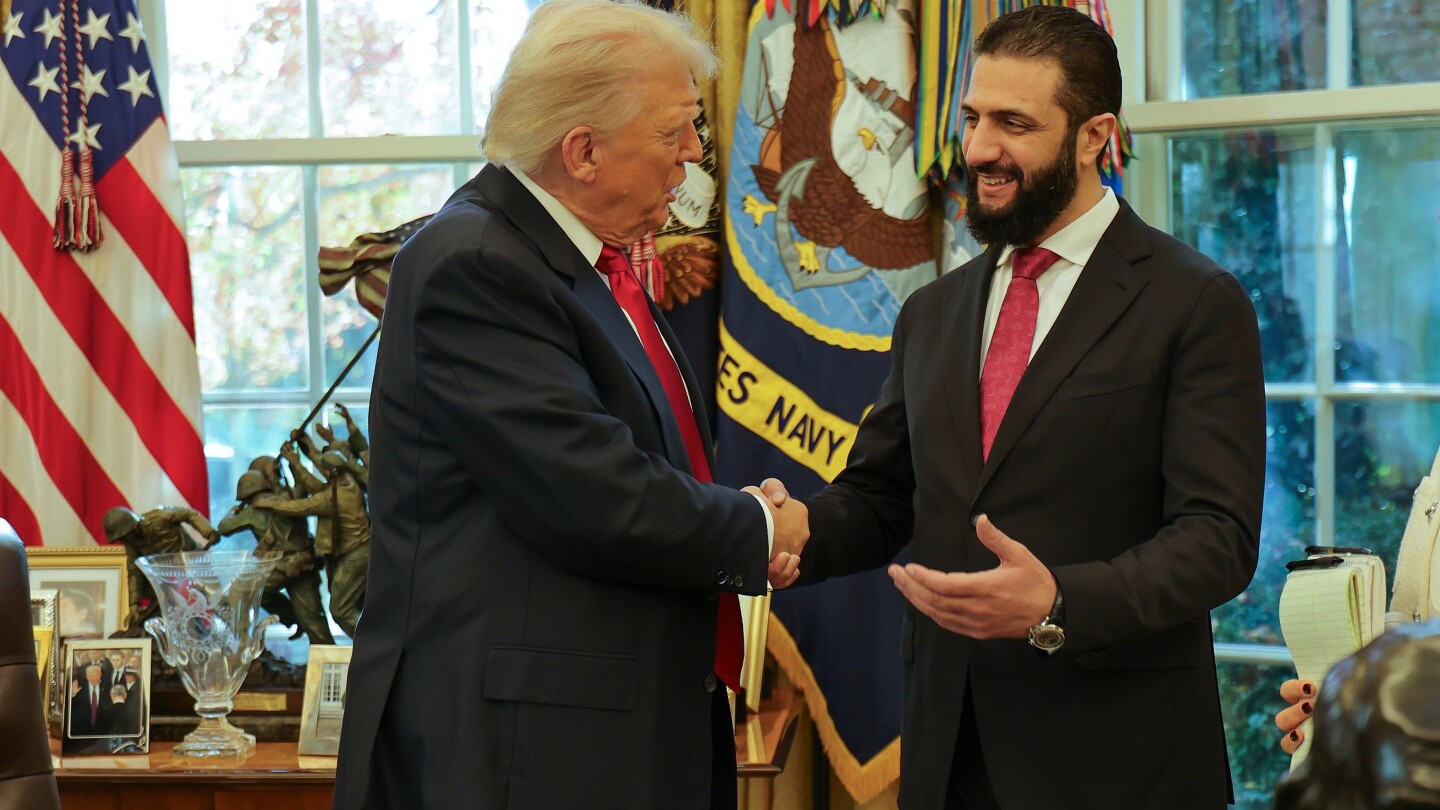
Syria has officially joined the global coalition against the Islamic State group following President Ahmad al-Sharaa’s landmark visit to Washington, though the country will not participate in U.S.-led military operations against the extremist organization, a Syrian official confirmed Tuesday.
Syrian Minister of Information Hamza al-Mustafa clarified in a telephone interview that while Syria expressed its “desire, intentions and readiness” to join the 89-country coalition during al-Sharaa’s meeting with U.S. President Donald Trump, no formal agreement has been signed.
“The political coalition is different from Operation Inherent Resolve, which is a military operations room,” al-Mustafa explained. The U.S.-led military mission has been conducting operations against ISIS in Iraq and Syria for years, primarily partnering with Iraqi security forces and the Kurdish-led Syrian Democratic Forces in northeast Syria.
The minister acknowledged existing coordination between Damascus and Washington on some anti-IS operations but emphasized, “Syria is not part of the Operation Inherent Resolve that is carrying out the operations of this coalition.”
While the U.S. has not publicly announced Syria’s entry into the coalition, a senior U.S. administration official, speaking anonymously due to the lack of formal announcement, confirmed Syria’s commitment following the presidential meeting.
This diplomatic breakthrough comes amid a significant transformation in Syrian politics. The U.S. had severed diplomatic relations with Syria under former President Bashar Assad, but ties have improved considerably since Assad’s overthrow last year in a rebellion led by al-Sharaa, who previously commanded an Islamist insurgent group.
Despite the Islamic State having lost all its territorial holdings in Syria and Iraq years ago, the extremist organization continues to pose a security threat. U.S. Central Command reports 311 IS attacks in Syria and 64 in Iraq so far this year, showing a decline from 878 and 160 respectively in 2024.
Al-Sharaa’s White House visit marked the first by a Syrian head of state since the country gained independence from France in 1946. Beyond coalition membership, the Syrian president advocated for a permanent repeal of sanctions imposed on Syria for alleged human rights abuses under Assad’s regime. While President Trump recently renewed a six-month waiver of the Caesar Act sanctions, a permanent repeal would require congressional action.
The visit also addressed ongoing tensions with Israel, which has regarded al-Sharaa’s rise to power with suspicion. Since Assad’s fall, Israeli forces have seized a formerly U.N.-patrolled buffer zone in southern Syria established under a 1974 disengagement agreement. Israel has also conducted hundreds of airstrikes on Syrian military sites and pushed for a demilitarized zone south of Damascus.
Al-Mustafa acknowledged ongoing security negotiations with Israel but stated there was “nothing new regarding the possibility of reaching a security agreement.” He firmly ruled out Syria’s participation in the Abraham Accords, the series of U.S.-mediated normalization deals between Israel and several Arab states.
“We’re not in the position now to talk about the Abraham Accords, because Israel is occupying part of our country,” the minister stated. He emphasized that before discussing normalization, the two countries must either return to the 1974 agreement or reach a new arrangement that includes “the withdrawal of Israel from all territory occupied after Dec. 8” when Assad’s government collapsed.
The developments highlight Syria’s cautious reentry into international diplomacy as the country navigates complex regional relationships while addressing the persistent threat from Islamic State remnants that continue to destabilize parts of the region.
Fact Checker
Verify the accuracy of this article using The Disinformation Commission analysis and real-time sources.

7 Comments
This seems like a pragmatic move by Syria to balance its interests and relationships. By joining the coalition, they can demonstrate their commitment to fighting terrorism while avoiding direct military involvement. It will be interesting to see how this plays out in the long run.
While Syria’s reluctance to join the military operations is understandable given the complex geopolitical situation, I hope they can find ways to contribute more tangibly to the coalition’s efforts. Defeating ISIS requires a united front, and Syria’s participation could be invaluable.
This is a notable development, though the limitations on Syria’s participation in the military mission are understandable given the country’s own internal conflicts. Continued cooperation and information-sharing will be crucial, even if Syria is not directly engaged in combat operations.
I’m curious to understand Syria’s rationale for joining the coalition but not the military mission. Is this a strategic decision, or are there political or logistical obstacles preventing their full participation? Either way, their involvement in the broader effort is a positive step.
This is a complex situation, and Syria’s approach of joining the coalition but not the military operations reflects the delicate geopolitical landscape. While I would prefer to see a more unified effort, I understand the reasons behind Syria’s decision and hope it can still contribute meaningfully to the anti-ISIS campaign.
It’s encouraging to see Syria take this step, even if they are not fully committing to the military aspect of the coalition. Defeating ISIS requires a multilateral approach, and any country’s willingness to contribute, even in a limited capacity, is a positive sign.
This is an interesting development in the fight against ISIS. It’s encouraging to see Syria join the global coalition, even if they are not participating directly in the military operations. Continued coordination and information-sharing will be key to defeating this terrorist group.