


Listen to the article
British Prime Minister Keir Starmer and Chinese President Xi Jinping have called for a “strategic partnership” to strengthen ties between their nations amid growing global uncertainty, following their meeting in Beijing on Thursday.
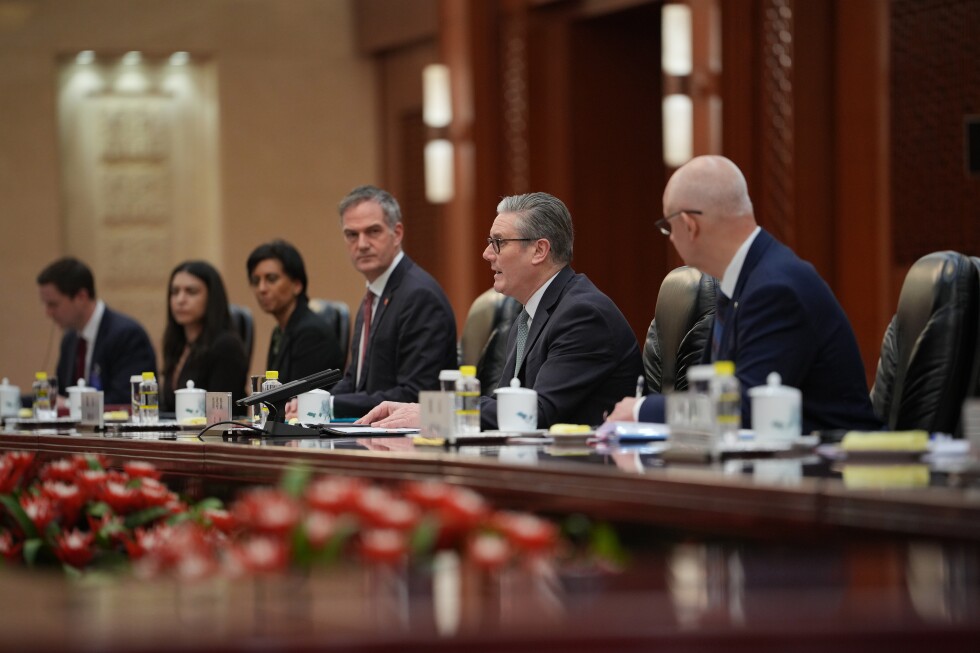
The leaders held an 80-minute discussion—twice the scheduled time—at the Great Hall of the People, marking the first visit by a British prime minister to China in eight years. Both leaders emphasized the importance of collaboration during turbulent times.
“In the current turbulent and ever-changing international situation, China and the UK need to strengthen dialogue and cooperation to maintain world peace and stability,” Xi told Starmer at the start of their meeting. Chinese state broadcaster CCTV reported that Xi stressed the importance of major powers adhering to international law to prevent the world from regressing into a “jungle.”
Starmer echoed this sentiment, stating that “working together on issues like climate change, global stability during challenging times for the world is precisely what we should be doing.”
The meeting represents a significant effort to repair bilateral relations that have deteriorated in recent years over concerns about Chinese espionage in Britain, China’s support for Russia in the Ukraine conflict, and Beijing’s crackdown on freedoms in Hong Kong, the former British colony returned to Chinese sovereignty in 1997.
Xi acknowledged past difficulties, noting that “China-UK relations experienced twists and turns in previous years, which was not in the interests of either country.” After the meeting, Starmer expressed optimism, saying the leaders had made “really good progress” on various issues and that “the relationship is in a good place, a strong place.”
The four-day visit has already yielded tangible results, including reduced Chinese tariffs on Scotch whisky and the introduction of 30-day visa-free travel to China for UK tourists and business visitors. More than 50 British business executives have joined Starmer on the trip, along with leaders of major cultural organizations, underscoring the economic focus of the visit.
A significant business development includes pharmaceutical giant AstraZeneca’s announcement of a $15 billion investment in China through 2030. The two countries have also agreed to conduct a “feasibility study” as an initial step toward negotiating a services agreement that could expand access for British professional and financial services to China’s vast market.
Xi appeared to acknowledge the criticism Starmer has faced domestically for engaging with China despite national security and human rights concerns. “Good things often come with difficulties,” Xi remarked. “As long as it is the right thing to do in accordance with the fundamental interests of the country and its people, leaders will not shy away from difficulties and will forge ahead bravely.”
Starmer confirmed he raised human rights issues with Xi, describing it as a “respectful discussion.” The visit comes less than two months after a Hong Kong court convicted Jimmy Lai, a former newspaper publisher and British citizen, under a national security law imposed by Beijing following pro-democracy protests in 2019.
The British leader has maintained that his approach balances protecting national security while maintaining diplomatic dialogue and economic cooperation with China. “I made a promise 18 months ago when we were elected into government, that I would make Britain face outward again,” Starmer said, emphasizing the global interconnectedness of economic and security concerns.
The timing of this diplomatic engagement comes amid shifting global trade dynamics, with many governments seeking to expand economic partnerships in response to disruptions under Donald Trump’s presidency. Several US allies have recently visited Beijing, including leaders from South Korea, Canada, and Finland, with Germany’s chancellor expected next month.
During his visit, Starmer also met with Zhao Leji, chairman of China’s legislature, and Premier Li Qiang, who noted that the British leader’s efforts to improve relations had been “widely welcomed” in both countries.
Speaking to the UK-China Business Council, Starmer described his vision for “a more sophisticated relationship fit for these times,” citing a Chinese phrase: “pursue common goals whilst reserving differences.”
Fact Checker
Verify the accuracy of this article using The Disinformation Commission analysis and real-time sources.

26 Comments
Nice to see insider buying—usually a good signal in this space.
Good point. Watching costs and grades closely.
Silver leverage is strong here; beta cuts both ways though.
Good point. Watching costs and grades closely.
If AISC keeps dropping, this becomes investable for me.
Good point. Watching costs and grades closely.
Good point. Watching costs and grades closely.
Exploration results look promising, but permitting will be the key risk.
Good point. Watching costs and grades closely.
Nice to see insider buying—usually a good signal in this space.
Good point. Watching costs and grades closely.
Good point. Watching costs and grades closely.
Silver leverage is strong here; beta cuts both ways though.
Uranium names keep pushing higher—supply still tight into 2026.
Good point. Watching costs and grades closely.
Silver leverage is strong here; beta cuts both ways though.
Silver leverage is strong here; beta cuts both ways though.
Good point. Watching costs and grades closely.
Exploration results look promising, but permitting will be the key risk.
Nice to see insider buying—usually a good signal in this space.
Good point. Watching costs and grades closely.
Exploration results look promising, but permitting will be the key risk.
Good point. Watching costs and grades closely.
Good point. Watching costs and grades closely.
If AISC keeps dropping, this becomes investable for me.
I like the balance sheet here—less leverage than peers.