


Listen to the article
South Korea’s climate commitments stand at odds with U.S. natural gas trade deals, as the nation attempts to navigate complex energy transitions while balancing international relations and economic interests.
South Korea recently announced ambitious plans to retire most of its coal-fired power plants by 2040 and slash carbon emissions by at least half by 2035. The announcement, made at United Nations climate talks by the country’s new Ministry of Climate, Energy and Environment, signals a significant shift for one of the world’s largest coal consumers.
This accelerated renewable energy transition represents a major policy pivot for South Korea, whose clean energy adoption has lagged behind global averages. Currently, the nation generates only about 10.5% of its power from renewable sources—considerably lower than comparable economies like Spain, which produces 42% of its electricity from renewables.
However, South Korea’s climate ambitions face a potential contradiction. As part of ongoing trade negotiations with the Trump administration, Seoul has agreed to increase imports of U.S. liquefied natural gas (LNG). These talks, initiated partly in response to Trump’s “America First” tariffs, could see South Korea importing between 3 million to 9 million tons of American LNG annually for the next three to ten years.
“If we just replace coal plants with LNG, that means the coal exit actually doesn’t lead to a green transition and merely shifts Korea’s addiction from coal to gas, which undermines the whole spirit of climate action,” said Insung Lee, a Greenpeace representative in Seoul.
The trade agreement, still being finalized, is part of broader negotiations that could see South Korea investing $350 billion in U.S. projects and purchasing up to $100 billion worth of American energy products. While natural gas burns cleaner than coal, it still produces significant greenhouse gas emissions, particularly methane, raising questions about its compatibility with aggressive climate goals.
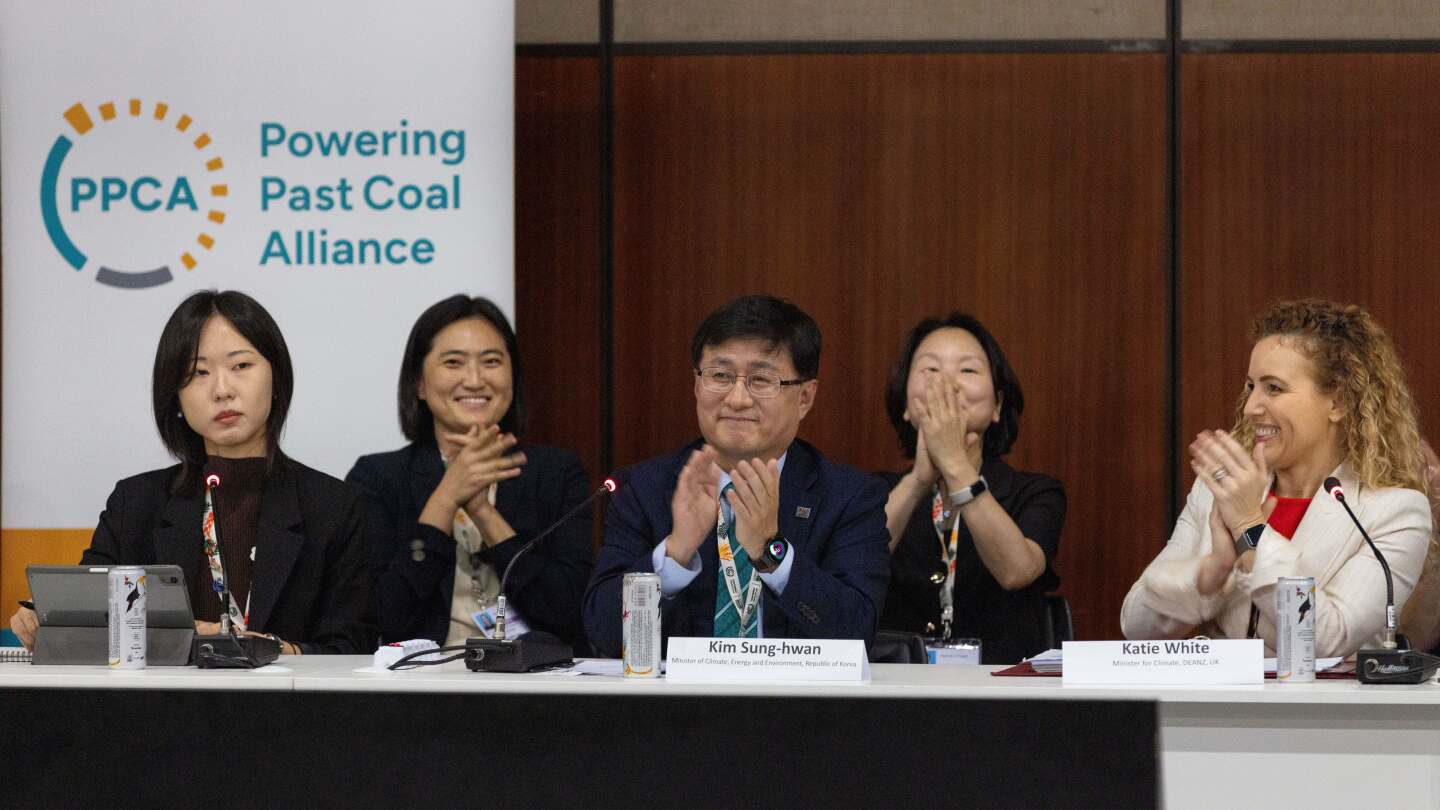
Kim Sung-hwan, South Korea’s inaugural Minister of Climate, Energy and Environment, defended the government’s approach in an interview with the Associated Press. “As the global temperature rises, we all need to responsibly take climate action and Korea will have a stronger sense of responsibility in tackling the climate crisis,” he stated.
The minister clarified that LNG would serve as a “complementary or emergency energy source” to address intermittency issues with renewable energy, while the country transitions to “a new energy system that focuses on renewables and nuclear, while phasing out coal.”
South Korea’s recent political changes have influenced its climate policy direction. President Lee Jae Myung, who won a snap election in June, campaigned on stronger climate commitments after they had weakened under his conservative predecessor Yoon Suk Yeol.
The country’s new emissions reduction goal—cutting carbon by 53% to 61% of 2018 levels—represents a compromise between environmental advocates, who wanted more aggressive targets, and business lobbies, which had proposed a more modest 48% reduction.
“This range presents an effort by the government to accommodate two very different ways of thinking about the economic and climate future of the nation,” explained Joojin Kim of Solutions for Our Climate, a Seoul-based advocacy group.
Nuclear energy remains a critical component of South Korea’s power mix, accounting for 31% of total electricity generation last year. To boost renewable capacity, the government recently announced plans to increase offshore wind power capacity to 4 gigawatts, about ten times current levels.
South Korea’s decision to join the Powering Past Coal Alliance last month sends a clear message about its intentions to reduce fossil fuel dependency. Bruce Douglas of the Global Renewables Alliance described the move as “mainly symbolic” but noted it “signifies very clear government intention to move away from fossil fuels and towards clean power.”
The planned retirement of 40 of South Korea’s 61 coal sites by 2040 will likely impact regional coal markets, particularly affecting major exporters like Australia, Indonesia, and Russia.
“It’s an enforced transition for coal exporters in the Asia-Pacific region,” said James Bowen of Climate Analytics. “The writing’s on the wall. One of the biggest importers in the world, one of the biggest customers, is starting to move away from coal.”
For South Korean companies, failure to reduce carbon emissions could become a competitive disadvantage in global markets, according to Michelle Kim of the Institute for Energy Economics and Financial Analysis. With international industries increasingly adopting mechanisms that reward low emitters and penalize high ones, South Korea faces mounting pressure to accelerate its renewable transition.
Fact Checker
Verify the accuracy of this article using The Disinformation Commission analysis and real-time sources.

26 Comments
I like the balance sheet here—less leverage than peers.
Good point. Watching costs and grades closely.
Good point. Watching costs and grades closely.
If AISC keeps dropping, this becomes investable for me.
I like the balance sheet here—less leverage than peers.
Nice to see insider buying—usually a good signal in this space.
Good point. Watching costs and grades closely.
Good point. Watching costs and grades closely.
Silver leverage is strong here; beta cuts both ways though.
Silver leverage is strong here; beta cuts both ways though.
Good point. Watching costs and grades closely.
The cost guidance is better than expected. If they deliver, the stock could rerate.
Uranium names keep pushing higher—supply still tight into 2026.
Good point. Watching costs and grades closely.
Exploration results look promising, but permitting will be the key risk.
Good point. Watching costs and grades closely.
Good point. Watching costs and grades closely.
Nice to see insider buying—usually a good signal in this space.
Uranium names keep pushing higher—supply still tight into 2026.
Good point. Watching costs and grades closely.
Silver leverage is strong here; beta cuts both ways though.
Uranium names keep pushing higher—supply still tight into 2026.
Good point. Watching costs and grades closely.
Silver leverage is strong here; beta cuts both ways though.
Silver leverage is strong here; beta cuts both ways though.
Good point. Watching costs and grades closely.