


Listen to the article
South Korean President Lee Seeks China’s Mediation in North Korean Nuclear Crisis
South Korean President Lee Jae Myung has requested Chinese President Xi Jinping to serve as a mediator in resolving the ongoing North Korean nuclear crisis and reducing tensions between the two Korean nations, Lee disclosed Wednesday.
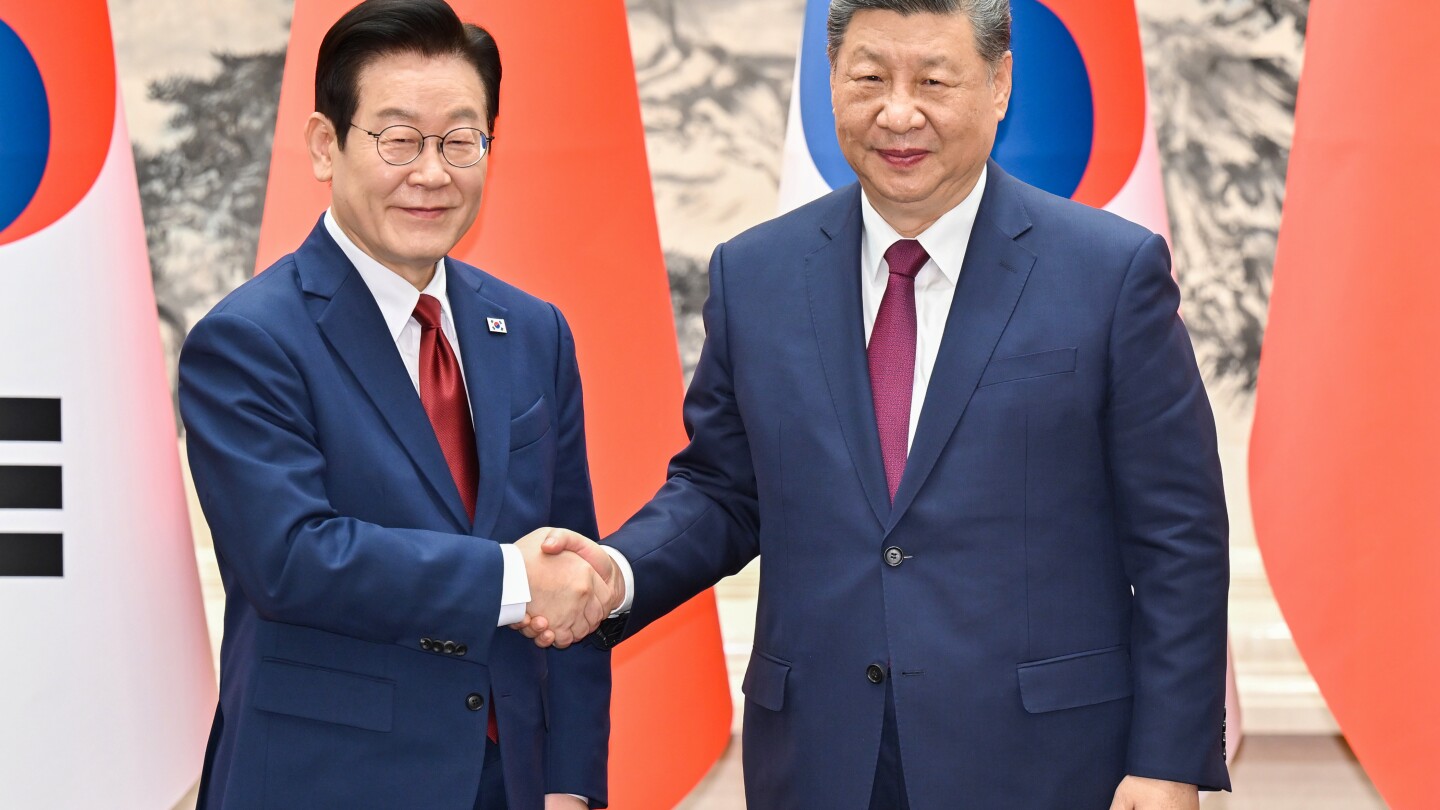
During his China trip, Lee revealed to reporters in Shanghai that he made this request during his summit with Xi in Beijing on Monday. According to Lee, Xi responded that patience would be necessary regarding North Korean issues.
“We’re making efforts but all our channels with North Korea are completely blocked so we can’t communicate at all,” Lee explained in televised comments. “I told him it would be good for China to play the role of a mediator for peace. President Xi appraised our efforts and said we need to be patient.”
As North Korea’s largest trading partner and principal diplomatic supporter, China holds significant influence over Pyongyang. South Korea and the United States have consistently urged Beijing to leverage this relationship to persuade North Korea to return to diplomatic negotiations or commit to denuclearization.
However, China’s approach has been cautious. In recent years, despite North Korea conducting weapons tests that violate UN resolutions, China has repeatedly blocked efforts by the US and other nations to strengthen sanctions against the isolated regime. Instead, Chinese officials have consistently called for restraint from all parties involved in the Korean Peninsula situation.
The diplomatic stalemate has deepened since 2019, when high-stakes nuclear talks between North Korean leader Kim Jong Un and former US President Donald Trump collapsed without an agreement. Since then, Pyongyang has steadfastly refused dialogue with both South Korea and the United States while continuing to expand its nuclear capabilities.
Since taking office in June last year, Lee’s liberal administration has made significant efforts to restart talks with North Korea. These overtures have largely been ignored by Pyongyang, which remains deeply suspicious of Seoul’s motives. In July, Kim Yo Jong, sister and senior advisor to Kim Jong Un, dismissed Lee’s government, claiming its “blind trust” in the South Korea-US alliance and hostility toward North Korea made it indistinguishable from its conservative predecessor.
The diplomatic challenges were further emphasized during Lee’s China visit when Chinese Premier Li Qiang also stressed the need for patience during their separate meeting on Tuesday. “Roles of neighbors are necessary. We requested China to play such a role, and China said it will anyway make such efforts,” Lee noted.
During discussions with Chinese officials, Lee outlined his approach of seeking phased, gradual denuclearization steps from North Korea with corresponding benefits in return. He emphasized the critical importance of first freezing North Korea’s nuclear and missile programs to prevent further expansion of its arsenal and potential proliferation risks – a view he said China shared.
“Leaving the current status would be a loss for Northeast Asia and the entire world, because North Korea’s nuclear weapons are being produced continuously,” Lee warned.
The diplomatic path forward remains challenging. North Korean officials have repeatedly stated they will no longer put denuclearization on the negotiating table. Meanwhile, regional security experts have expressed concern that offering rewards for limited denuclearization steps could potentially allow North Korea to manipulate the diplomatic process, securing sanctions relief while maintaining much of its nuclear capability.
This latest diplomatic initiative comes amid increasing regional tensions and growing concerns about North Korea’s advancing weapons programs, which have demonstrated significant technological progress in recent years. The situation underscores the complex geopolitical dynamics in Northeast Asia, where competing interests and historical animosities continue to complicate efforts toward achieving lasting peace and stability on the Korean Peninsula.
Fact Checker
Verify the accuracy of this article using The Disinformation Commission analysis and real-time sources.

11 Comments
China’s involvement as a mediator could provide a fresh approach to the North Korea issue. However, the regime’s intransigence and history of broken promises will make it challenging to reach a lasting agreement. Patience and perseverance will be required.
China’s role as a mediator could be pivotal, but the North Korean regime’s track record of broken promises raises doubts. Verification and tangible progress on denuclearization will be key if any diplomatic breakthrough is to be achieved.
Ultimately, all parties involved must show flexibility and a genuine commitment to peace and stability on the Korean peninsula. The stakes are high, but the potential benefits make this diplomatic initiative worth pursuing.
The blocked communication channels between the two Koreas are concerning. Diplomatic engagement and dialogue seem critical to reducing tensions and making progress on denuclearization. China’s involvement as a mediator could be helpful, if handled skillfully.
Patience will likely be required, as North Korea has shown itself to be a stubborn negotiating partner in the past. But the potential benefits of China’s mediation make it worth pursuing.
Given China’s close ties to North Korea, its willingness to act as a mediator is noteworthy. However, the North’s intransigence on its nuclear program poses a major challenge. Careful diplomacy and compromise from all sides will be essential.
It’s encouraging to see South Korea reaching out to leverage China’s influence. Continued dialogue, even in the face of difficulties, seems the best path forward to address this longstanding regional security issue.
The request for China to mediate is a pragmatic move by President Lee. As North Korea’s closest ally, Beijing holds unique leverage that could prove useful in breaking the diplomatic impasse. However, past attempts at mediation have had limited success.
Careful management of expectations and a willingness to compromise from all sides will be crucial if any meaningful progress is to be achieved. The path ahead remains uncertain, but the effort seems worthwhile given the high stakes involved.
Interesting that President Lee is reaching out to China to mediate the North Korea nuclear issue. As a major trading partner and ally of the North, China could potentially play an influential role in encouraging Pyongyang to return to the negotiating table.
However, China’s approach has been cautious, preferring stability over confrontation. It remains to be seen if Xi can persuade the North to compromise on its nuclear program.