


Listen to the article
Chinese Mythological Hero Takes Center Stage in Groundbreaking Opera
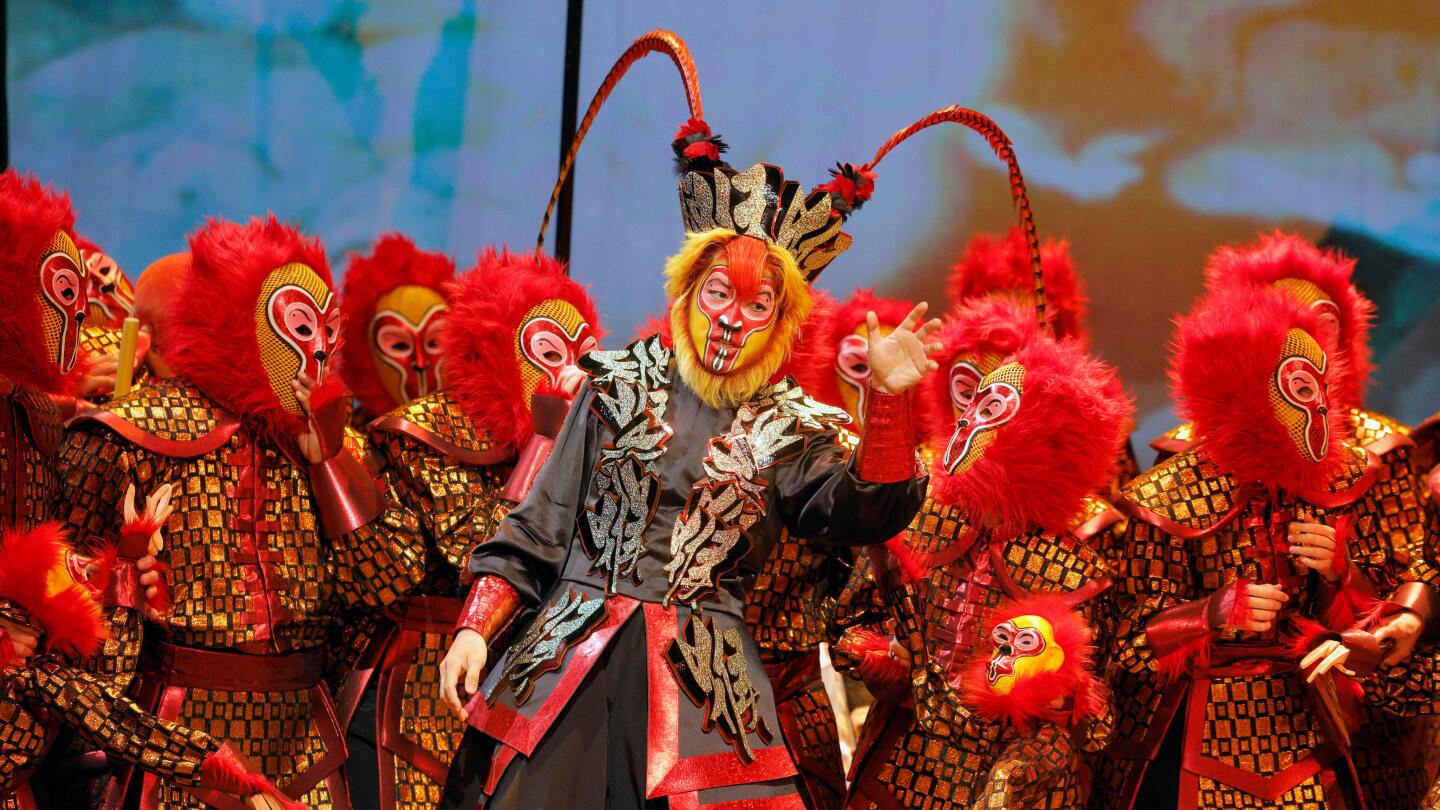
A mischievous superhero born from a stone egg is making his operatic debut in San Francisco this week. “The Monkey King,” a new opera featuring music by composer Huang Ruo and libretto by playwright David Henry Hwang, premieres at the San Francisco Opera on Friday, with performances scheduled through November 30.
The production draws from “Journey to the West,” a 16th century Chinese epic novel that has inspired countless adaptations across media ranging from comics to animated films, video games, and even poetry by Mao Zedong. The 100-chapter novel was itself inspired by the true story of a 7th-century Chinese monk who traveled to India to retrieve Buddhist scriptures.
“It’s essentially an allegory of how Buddhism came to China,” explains Hwang, whose libretto—written in both English and Mandarin—focuses on the early chapters of the epic. The story traces Monkey King’s birth, supernatural exploits, and the pride that leads to his 500-year imprisonment until he learns humility and compassion. By the opera’s conclusion, he becomes worthy of accompanying the monk on his sacred journey.
For Hwang, the Monkey King represents a fascinating counter-narrative to common stereotypes about Chinese culture. “Everyone associates the Chinese persona with respect and deference and conformity,” Hwang said. “And Monkey represents this whole other side that doesn’t normally get expressed in terms of being individualistic, being rebellious, being egotistical.”
The character’s anti-authoritarian nature also carries potential political resonance, as Hwang notes: “Given the fact that Monkey is rebelling against a corrupt administration, people can look at that however they want to see it.”
Bringing this fantastical tale to life posed unique challenges for the San Francisco Opera. Director Diane Paulus confronted the difficulty of portraying a character who “flies on clouds, dives underwater, and soars to the heavens” within the constraints of live theater.
Her solution was a collaboration with renowned puppeteer Basil Twist, who designed both sets and puppets with extensive use of his signature silk elements. “The whole notion of the ephemeral and letting go of things and the power of transformation is beautifully expressed by silk that can become water that then disappears and becomes clouds, and then becomes a giant column,” Paulus explained.
To portray the Monkey King’s supernatural abilities while maintaining operatic quality, the creative team made a bold decision to represent him through what tenor Kang Wang calls “the Holy Trinity of Monkey King”—a singer, a puppet, and a dancer all embodying different aspects of the character.
This doesn’t mean an easy role for Wang, who still must maintain a crouched, simian posture whenever he isn’t singing at full voice. The company brought in Jamie Guan, a Peking Opera specialist, to train Wang in appropriate gestures and movements, including complex staff-twirling techniques.
“It’s not easy,” admitted Wang, whose background is primarily in Western opera. “In rehearsal I’ve been taking a shower on stage with my own sweat. My colleagues were telling me they could see me losing weight… It’s like a CrossFit session every day.”
The production features an international cast, with tenor Konu Kim singing the corrupt Jade Emperor and soprano Mei Gui Zhang portraying Guanyin, the Goddess of Mercy who guides the Monkey King. Carolyn Kuan conducts the orchestra, which blends Western instrumentation with traditional Chinese elements like the pipa, a four-stringed lute.
Huang Ruo, who was born in China before studying music there and in the United States, describes his creation as neither Western nor Chinese opera, but rather a “magical Kung Fu opera.” He explains, “We have singing, and orchestra, all the good things, story-telling, emotional moments, all this from the operatic art form. But we also have Kung Fu fighting, operatic dance, and puppetry, and mixed media to convey this magical world.”
Matthew Shilvock, San Francisco Opera’s general director, describes the score as “incredibly propulsive… but also lyrical,” with constant movement between “two different sound worlds”—from the chaotic battle sequences to moments of profound serenity.
The company hopes the production will resonate with diverse audiences. “For people who grew up with the Monkey King there’s a huge sense of nostalgia about it,” Shilvock noted. “For people who are getting to know it for the first time, you’re being introduced to this extraordinary piece of world literature… so there’s a wonderful sense of discovery.”
Huang and Hwang already have ambitions beyond this single production. Taking inspiration from Wagner’s four-opera “Ring” cycle, the composer revealed they “have this pipe dream to create the Monkey King Cycle.” The current opera, despite its comprehensive scope, only scratches the surface of the original epic. As Huang notes: “When we get to the last opera, they reach the land of bliss, where Buddha and his disciples live. The journey didn’t start yet. It’s just the beginning of the story-telling.”
Fact Checker
Verify the accuracy of this article using The Disinformation Commission analysis and real-time sources.

8 Comments
Incorporating the 16th century novel ‘Journey to the West’ as the source material is a brilliant choice. That epic tale has resonated across generations and cultures. I’m eager to see how the opera’s creative team will adapt those mythical themes and characters for a modern audience.
The use of both English and Mandarin in the libretto is an especially nice touch to honor the story’s Chinese origins. It will be fascinating to see how the bilingual approach enhances the overall theatrical experience.
The Monkey King’s arc from mischievous superhero to humble pilgrim sounds like it will make for a compelling dramatic journey. I’m glad the opera is focusing on the early chapters that explore his birth and supernatural abilities before he learns compassion. That should provide plenty of room for visually striking Kung Fu choreography and puppetry.
As someone with a passing familiarity with the ‘Journey to the West’ saga, I’m eager to experience the San Francisco Opera’s unique interpretation. The use of both English and Mandarin, along with the blend of Eastern and Western theatrical elements, should make for a truly immersive and enlightening cultural experience.
What an intriguing premise for an opera! The Monkey King is such a captivating figure in Chinese mythology. I’m curious to see how the San Francisco Opera will bring his magical kung fu and mischievous spirit to life on stage through music and puppetry.
The blend of Eastern and Western storytelling elements sounds like it could make for a truly unique and visually stunning production. I’ll have to look into getting tickets.
Composer Huang Ruo and librettist David Henry Hwang seem like an inspired creative pairing to bring this iconic Chinese legend to the opera stage. Their backgrounds and artistic sensibilities should meld well to capture the story’s cultural essence while making it accessible to Western audiences.
I’m really excited to see how this new opera production of ‘The Monkey King’ will be received. It could potentially introduce more people to this rich mythology and Chinese storytelling traditions.