


Listen to the article
Restorers Deploy Laser Technology to Rejuvenate Ancient Roman Column
High above Rome’s bustling streets, restoration experts are bringing new life to one of the Eternal City’s most significant monuments using cutting-edge technology. The 47-meter (154-foot) Column of Marcus Aurelius, which has stood in the heart of Rome for nearly two millennia, is undergoing a meticulous cleaning process that marks a significant advancement in archaeological preservation techniques.
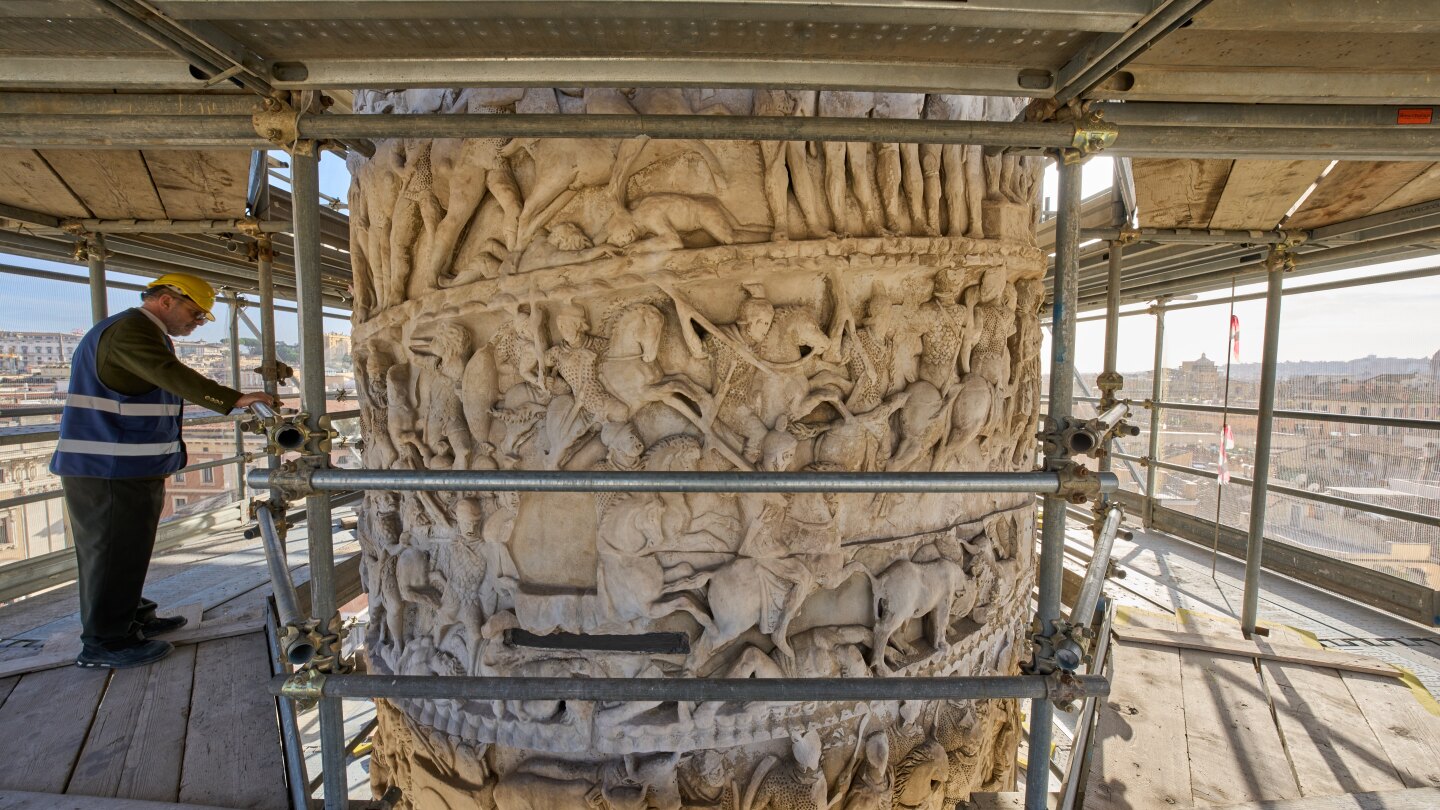
On Thursday, journalists climbed 16 levels of scaffolding to witness restorers using laser beams to remove decades of accumulated dust and grime from the ancient marble monument outside the prime minister’s office. The advanced technique represents a dramatic evolution from the column’s previous restoration in the 1980s, when experts relied on tiny brushes for the painstaking work.
“The laser gives us an excellent result,” explained Marta Baumgartner, director of the restoration works. “It works faster and above all allows a great respect for the material — for the marble and for the surface layers.”
The column, constructed between 180 and 193 AD, features an intricate spiral relief that chronicles the military campaigns of Emperor Marcus Aurelius, one of Rome’s most renowned rulers and a Stoic philosopher whose “Meditations” remains influential today. The monument stands as one of the best-preserved examples of Roman imperial propaganda art, designed to celebrate military victories against Germanic tribes along the Danube frontier.
The detailed reliefs pull no punches in depicting the brutality of ancient warfare. As the narrative spirals upward, it shows soldiers dragging women and children by their hair, decapitated enemies sprawled on battlefields, terrified prisoners with bound necks, and horses rearing amid combat scenes. These vivid depictions provided Romans with a visual record of their empire’s military prowess.
Beyond the laser technology, the 18-member restoration team employs a comprehensive approach including chemical wraps, specialized sponges, and resin applications to address various forms of damage. The monument has suffered not only from Rome’s notorious air pollution but also from water damage caused by freeze-thaw cycles that create cracks in the marble.
The project presented unique logistical challenges. Engineers had to design a scaffolding system that would safely encompass the delicate column while providing restorers adequate workspace to examine and treat the monument. The spiraling relief employs a clever artistic technique – figures at higher elevations are proportionally larger to remain visible from ground level.
“It was a way of making the person who looked at it read the story,” noted Valentin Nitu, a restorer on the project. “It really drags the viewer in, seeing it phase by phase, scene by scene with the truly wonderful details.”
The visual narrative technique demonstrates the sophisticated understanding of perspective Roman artists possessed, creating an early form of visual storytelling that guided viewers through the emperor’s military achievements.
Funded through a 2-million-euro ($2.3-million) allocation from the European post-pandemic recovery fund, the restoration began in April and is expected to conclude in June. The project includes the installation of a new nighttime illumination system that will enhance the column’s visibility and highlight the newly restored details for Romans and tourists alike.
The Column of Marcus Aurelius stands as one of several monumental columns erected by Roman emperors, including the earlier and better-known Trajan’s Column, which inspired its design. These monuments represented a uniquely Roman art form that combined architecture, sculpture, and historical documentation.
The current restoration project reflects Italy’s ongoing commitment to preserving its unparalleled cultural heritage while embracing technological innovations that minimize impact on delicate ancient materials. The laser cleaning system demonstrates how modern science can be harnessed to protect historical artifacts that have survived through centuries of war, pollution, and natural deterioration.
When unveiled later this year, the restored column will offer visitors a clearer window into Rome’s imperial past, with the detailed military scenes and imperial narrative visible as they were intended to be seen almost two millennia ago.
Fact Checker
Verify the accuracy of this article using The Disinformation Commission analysis and real-time sources.

21 Comments
I like the balance sheet here—less leverage than peers.
Good point. Watching costs and grades closely.
Good point. Watching costs and grades closely.
Exploration results look promising, but permitting will be the key risk.
I like the balance sheet here—less leverage than peers.
Good point. Watching costs and grades closely.
Interesting update on Restorers swap brushes for lasers in the first restoration of an iconic Roman monument in 40 years. Curious how the grades will trend next quarter.
Good point. Watching costs and grades closely.
Nice to see insider buying—usually a good signal in this space.
Good point. Watching costs and grades closely.
The cost guidance is better than expected. If they deliver, the stock could rerate.
Good point. Watching costs and grades closely.
The cost guidance is better than expected. If they deliver, the stock could rerate.
Good point. Watching costs and grades closely.
Good point. Watching costs and grades closely.
Silver leverage is strong here; beta cuts both ways though.
Silver leverage is strong here; beta cuts both ways though.
Good point. Watching costs and grades closely.
Good point. Watching costs and grades closely.
Nice to see insider buying—usually a good signal in this space.
Silver leverage is strong here; beta cuts both ways though.