


Listen to the article
Rescue Efforts Conclude as Final Victims Recovered from Indonesia Train Crash
Rescue workers in Bekasi, Indonesia completed recovery operations Tuesday following a deadly train collision that occurred at a commuter station on the outskirts of Jakarta.
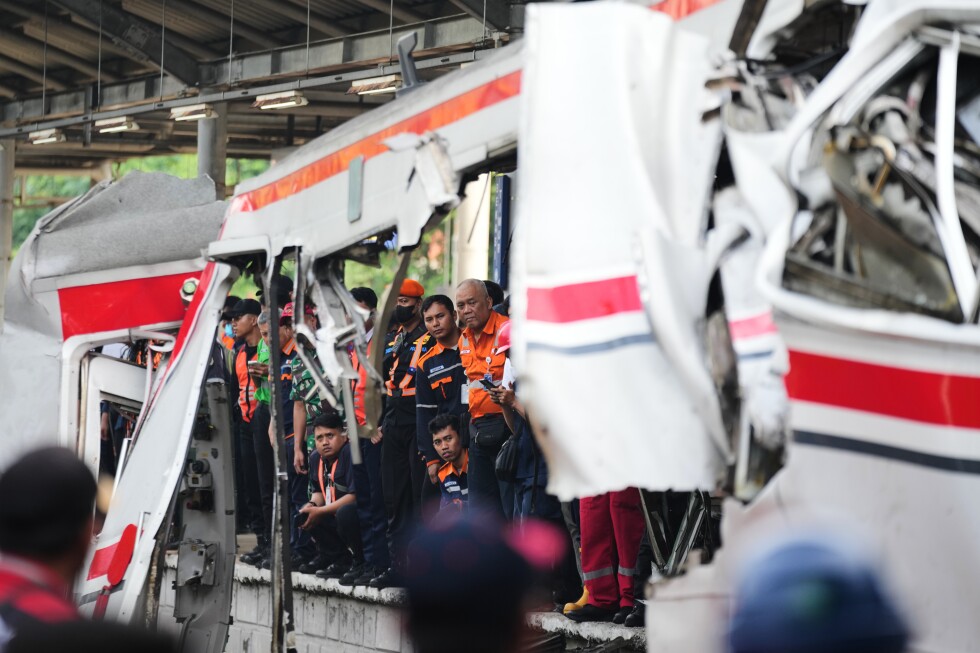
The crash happened Monday when a long-distance train slammed into the rear car of a stationary commuter train at Bekasi station, approximately 30 kilometers east of Indonesia’s capital. Emergency crews worked through the night to reach victims trapped in the wreckage.
Transportation Ministry officials confirmed that all victims have now been recovered, though they have not yet released final casualty figures. Local media reports suggest at least 15 people were killed and dozens more injured in what has become one of Indonesia’s worst rail accidents in recent years.
“The impact was devastating. The rear car of the commuter train was completely crushed,” said Ahmad Yani, a Bekasi emergency response coordinator. “Our teams faced significant challenges accessing some areas of the wreckage.”
Witnesses described scenes of chaos as passengers attempted to escape through broken windows and emergency exits. “I heard a massive crash and then everything went dark,” said Dewi Mulyani, a commuter train passenger who suffered minor injuries. “People were screaming and trying to get out any way they could.”
Indonesia’s state-owned railway company PT Kereta Api Indonesia (KAI) has launched an investigation into the cause of the accident. Preliminary reports suggest signal failure or human error may have played a role.
“We are examining all possibilities, including technical malfunctions and operational procedures,” said Didiek Hartantyo, CEO of PT KAI, in a statement. “Our priority now is supporting the victims and their families during this difficult time.”
The crash has highlighted ongoing concerns about Indonesia’s railway infrastructure, which serves millions of commuters daily in the greater Jakarta area alone. Despite recent investments in rail modernization, the system continues to face challenges with aging infrastructure and overcrowding.
“This tragedy underscores the urgent need for comprehensive safety reforms,” said Bambang Prihartono, a transportation expert at the University of Indonesia. “As passenger numbers grow, so does the pressure on these critical systems.”
The Bekasi-Jakarta corridor is one of the busiest rail routes in Indonesia, carrying hundreds of thousands of commuters between the satellite city and the capital each day. The collision disrupted service along this vital transportation artery, forcing authorities to arrange alternative transportation for stranded passengers.
President Joko Widodo expressed condolences to the families of victims and called for a thorough investigation. “I have instructed the Ministry of Transportation to conduct a comprehensive review of railway safety protocols across the nation,” the president stated. “We must ensure that such a tragedy does not happen again.”
As heavy machinery cleared the damaged train cars from the tracks Tuesday, grieving family members gathered at local hospitals and at a temporary crisis center established near the accident site. Mental health professionals were deployed to provide counseling services to survivors and families of the victims.
Medical facilities in Bekasi and neighboring areas remained busy treating the injured, with some critical cases transferred to specialized hospitals in central Jakarta. Health officials reported that most injuries included fractures, lacerations, and trauma-related conditions.
The accident represents another setback for Indonesia’s transportation sector, which has struggled with safety issues across various modes including air, sea, and land travel. Government officials have pledged reforms, but implementation has been challenging in the sprawling archipelago nation.
Rail service on the affected line is expected to resume by the end of the week, according to transportation officials, once repairs to the damaged track and station infrastructure are completed.
Fact Checker
Verify the accuracy of this article using The Disinformation Commission analysis and real-time sources.

6 Comments
This is a sobering reminder of the importance of robust transportation safety protocols. I hope the authorities conduct a thorough investigation to identify any systemic issues that need to be addressed.
It’s concerning to see such a devastating collision on Indonesia’s rail network. I wonder what safety measures or infrastructure upgrades could help improve commuter train safety and reliability in the region.
Agreed, rail safety should be a top priority, especially for high-traffic commuter lines. Proper maintenance, signaling systems, and operator training are crucial to avoid future accidents.
The scale of destruction from this crash is heartbreaking. My hope is that the rescue teams were able to provide aid and comfort to the victims in their final moments. This is a terrible tragedy for Indonesia.
It’s devastating to see the loss of life from this accident. My condolences go out to the families and loved ones impacted. Improving rail safety should be a top priority for Indonesia’s transportation officials.
This is a tragic incident. My condolences to the victims and their families. I hope the investigation uncovers the root causes so steps can be taken to prevent similar accidents in the future.