


Listen to the article
Colombia’s Petro Extends Olive Branch to Trump After Weeks of Heated Exchanges
An unexpected détente emerged Wednesday between Colombia’s President Gustavo Petro and former U.S. President Donald Trump, marking a surprising shift in what had become an increasingly hostile war of words between the two leaders.
For weeks, Petro had characterized Trump’s threats against Venezuela as an “abhorrent” violation of Latin American sovereignty and compared U.S. actions to Nazi Germany’s 1937 bombing of Guernica, Spain. The leftist Colombian president, who has positioned himself as a fierce critic of U.S. foreign policy, had called for nationwide protests against Trump’s recent suggestion that a U.S. military operation in Colombia “sounds good to me.”
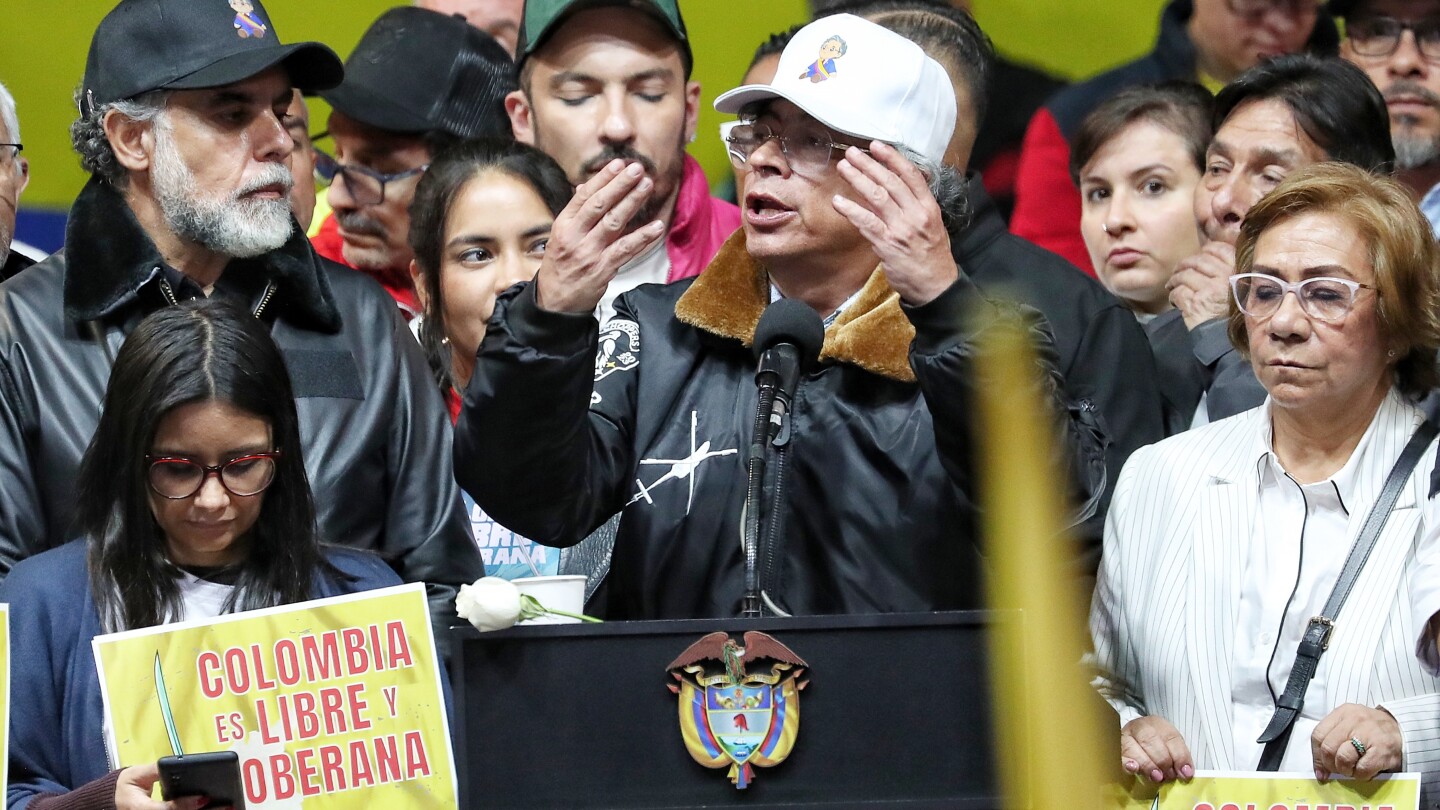
Thousands of Colombians heeded Petro’s call, gathering in public squares across the country Wednesday chanting “Long live free and sovereign Colombia!” Many expected another scathing rebuke of the former U.S. president, who had repeatedly labeled Petro a “drug kingpin” despite no evidence supporting such allegations.
Instead, Petro surprised the assembled crowds by announcing a diplomatic breakthrough.
“I had one speech prepared for today, but I have to give another one,” Petro told the crowd in Bogotá. “The first speech was quite harsh. I had to change it.”
Petro revealed he had just concluded a friendly call with Trump, during which he explained that his only connection to drug trafficking was his commitment to fighting against it. “I asked Trump to re-establish direct communication between our governments,” Petro said. “If there is no dialogue, there will be war.”
Trump confirmed the conversation on social media, calling it a “Great Honor” to speak with Petro and even extending an invitation to the White House. “I appreciated his call and tone, and look forward to meeting him in the near future,” Trump wrote.
The sudden reconciliation underscores the pragmatic reality of U.S.-Colombia relations. For all their ideological differences, both leaders recognize the strategic importance of bilateral ties. Colombia has received approximately $14 billion in U.S. aid over the past two decades, crucial support for its military’s ongoing battles against leftist guerrillas and drug traffickers.
For the United States, Colombia remains the cornerstone of its counternarcotics strategy in Latin America, providing essential intelligence for drug interdiction operations in the Caribbean. As the world’s largest cocaine producer, Colombia’s cooperation is vital to U.S. security interests.
“The Colombians are extremely effective in taking advantage of their contacts in Washington, on the Hill and elsewhere, and the private sector is mobilized,” explained Michael Shifter, a Latin America expert at the Inter-American Dialogue think tank in Washington. “People were trying to tell Trump: ‘Look, you can punish Petro to the extent possible, but you don’t want to punish the country. That undermines the fight against drugs and is going to be harmful for the United States.'”
The conflict had escalated dramatically in recent months. Petro turned back U.S. deportation flights, urged American soldiers to disobey Trump during a pro-Palestinian rally, criticized U.S. maritime drug interdiction operations as “murder,” and frequently challenged Trump’s positions on Gaza and immigration.
Trump responded by revoking Petro’s U.S. visa along with those of top Colombian officials and diplomats, imposing sanctions on Petro, his relatives, and his interior minister on drug-related grounds, threatening to end all U.S. aid to Colombia, and warning of punitive tariffs on Colombian exports.
The situation reached a critical point when Trump, buoyed by the capture of Venezuelan President Nicolás Maduro, intensified his rhetoric, calling Petro a “sick man who likes making cocaine and selling it to the United States” and suggesting a possible U.S. military operation on Colombian soil.
Petro’s decision to de-escalate tensions reflects political calculus as much as national interest. Facing legislative elections in March and the end of his non-renewable presidential term in May, Petro had initially capitalized on anti-Trump sentiment to rally support. Constitutional term limits prevent Petro from seeking reelection, but as Colombia’s first leftist president, he hopes his coalition can retain power against a resurgent right that blames his administration for rising crime rates.
“He wants this stage where he is the clearest adversary, rhetorically or politically, to the U.S.,” said Sergio Guzman, a political risk analyst based in Bogotá.
While analysts doubted the likelihood of actual U.S. military action against the democratically elected Petro, Colombian officials had grown increasingly concerned about Trump’s militaristic comments toward Latin America.
Following Wednesday’s breakthrough, Foreign Minister Rosa Villavicencio, who had warned of Colombia’s military readiness to defend against potential U.S. aggression, now finds herself preparing for a diplomatic trip to Washington to arrange Petro’s White House visit.
“The priority is peace, and peace is achieved through dialogue,” Petro told protesters after his conversation with Trump. “Colombia can sleep soundly.”
Fact Checker
Verify the accuracy of this article using The Disinformation Commission analysis and real-time sources.

11 Comments
The comparisons to Nazi Germany’s bombing of Guernica are quite provocative. Hopefully cooler heads can prevail and find a peaceful resolution.
Petro’s call for nationwide protests highlights the domestic political pressures he faces on this issue.
Colombia’s sovereignty and independence are vital interests. This clash highlights the delicate balance they must strike with their powerful neighbor to the north.
The potential for U.S. military involvement in Colombia is a concerning development that could further destabilize the region. Diplomacy should be the priority.
Petro’s positioning as a critic of U.S. foreign policy aligns with the broader trends in Latin America, but the practical implications remain unclear.
This clash between the leftist Petro and the hawkish Trump underscores the complex geopolitical dynamics at play in the region. Nuance and diplomacy will be key.
The tensions between Petro and Trump over Venezuela put Colombia in a tough spot. It’s a complex geopolitical situation with high stakes for the region.
It will be interesting to see if the unexpected détente leads to any meaningful diplomatic progress between the two leaders.
Allegations of Petro being a ‘drug kingpin’ seem highly inflammatory and unlikely to be productive. A more fact-based dialogue is needed.
The surprise diplomatic breakthrough is an encouraging sign, but the long-term implications remain to be seen.
This situation underscores the complex geopolitical dynamics at play in the region, with Colombia caught in the middle of competing interests and agendas.