


Listen to the article
The Vatican has returned 62 Indigenous artifacts from its extensive ethnographic collection to Canada, marking a significant step in the Catholic Church’s efforts to reconcile with Indigenous peoples. The items, which include a historically significant Inuit kayak, were handed over to the Canadian Conference of Catholic Bishops during a ceremony in Vatican City on Saturday.
Pope Leo XIV presented the artifacts along with supporting documentation to Canadian church representatives, who described the transfer as a “concrete sign of dialogue, respect and fraternity.” The items are expected to arrive in Montreal on December 6 and will initially be housed at the Canadian Museum of History in Ottawa before being reunited with their originating communities.
The artifacts had been part of the Vatican Museum’s ethnographic collection, now known as the Anima Mundi museum, for approximately 100 years. Most were sent to Rome by Catholic missionaries for a 1925 exhibition in the Vatican gardens, supposedly as “gifts” to Pope Pius XI, who wanted to showcase the church’s global reach and missionary work.
However, historians and Indigenous groups have long questioned whether these items were truly given freely, given the significant power imbalances that existed in Catholic missions at that time. During this period, Catholic religious orders were actively participating in the Canadian government’s forced assimilation policy, which the Truth and Reconciliation Commission has characterized as “cultural genocide.”
This policy included the confiscation of ceremonial items used in Indigenous spiritual and traditional rituals, such as those prohibited under the 1885 potlatch ban. Many confiscated items ended up in museums across North America and Europe, as well as in private collections.
Canadian Foreign Minister Anita Anand welcomed the Vatican’s decision, describing it as “an important step that honours the diverse cultural heritage of Indigenous peoples and supports ongoing efforts toward truth, justice, and reconciliation.”
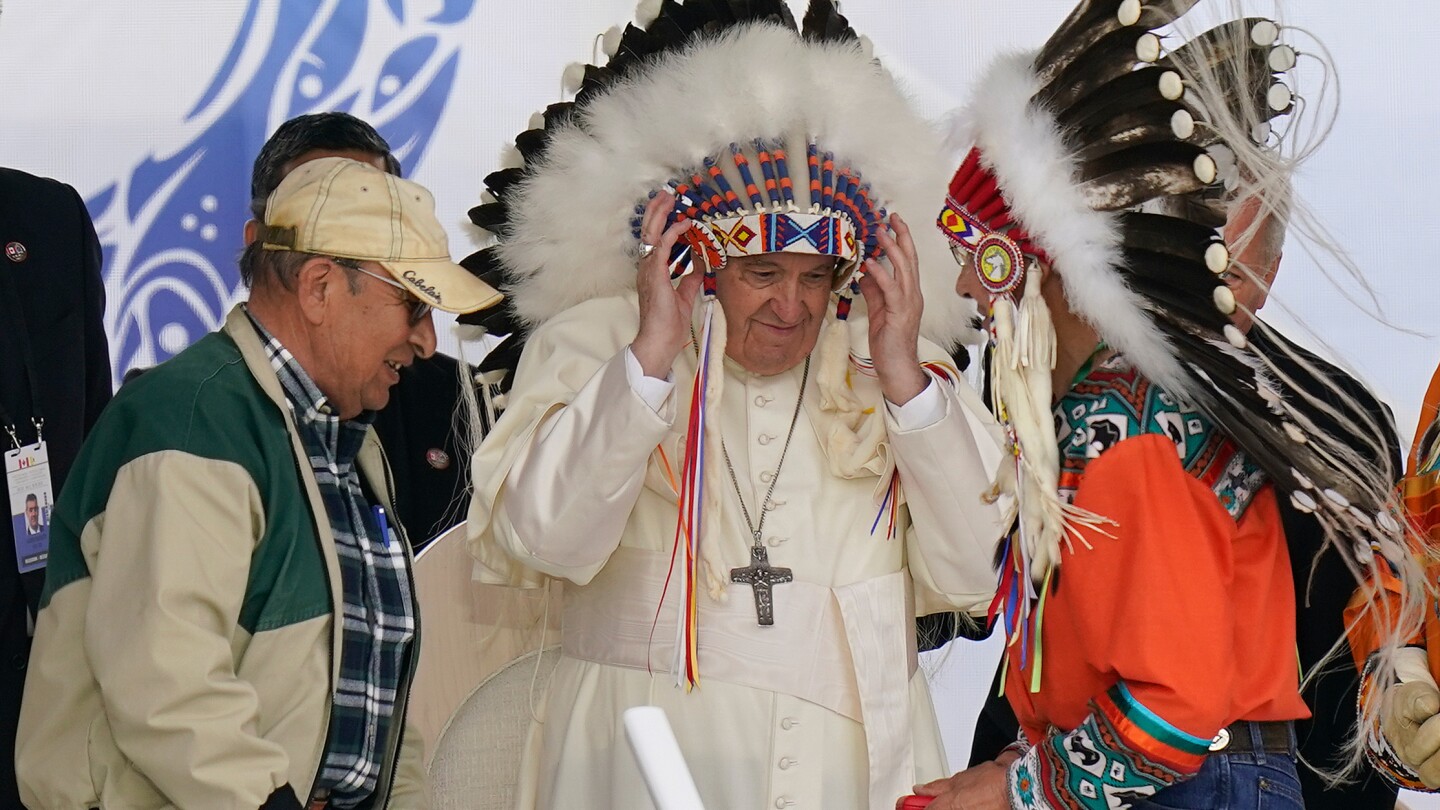
Negotiations regarding the return of these artifacts gained momentum after Pope Francis met with Indigenous leaders in 2022. The delegation had traveled to the Vatican to receive the Pope’s apology for the church’s role in Canada’s residential school system. During their visit, they were shown various objects from the collection and requested their return.
Francis later expressed support for returning items from the Vatican collection on a case-by-case basis, stating: “In the case where you can return things, where it’s necessary to make a gesture, better to do it.”
The Vatican emphasized that the timing of the return was deliberate, coinciding with the Holy Year and marking exactly 100 years since the 1925 exhibition. The joint statement from the Vatican and the Canadian church described the gesture as “an act of ecclesial sharing.”
The “church-to-church” model used for this transfer mirrors the approach taken by the Holy See in 2023 when it returned Parthenon Marbles to the Orthodox Christian Church in Greece. In both cases, the items were described as “donations” rather than state-to-state repatriations.
This characterization has drawn criticism from some historians. Gloria Bell, an associate professor of art history at McGill University who has conducted extensive research on the 1925 exhibition, argues that “the papal narrative needs correction” regarding how these artifacts originally came into Vatican possession.
“We need to remember that thousands of Indigenous ancestors remain in the Vatican Museums that need to be returned home and brought back into Indigenous care and Indigenous hands,” said Bell, who is of Metis ancestry.
The Inuvialuit Regional Corporation, representing the region where the kayak originated, is coordinating the transportation of the artifacts to Canada. For items with uncertain provenance, the Canadian Museum of History will hold them in trust while Indigenous-led research determines their origins.
This repatriation represents part of the Vatican’s broader process of reckoning with the Catholic Church’s colonial past. In 2023, the Vatican formally repudiated the “Doctrine of Discovery,” acknowledging the church’s complicity in colonial-era abuses perpetrated by European powers.
Bishop Pierre Goudreault, president of the Canadian bishops conference, described the return as an important milestone in reconciliation efforts that “represents the church’s ongoing friendship with Indigenous as well as our desire to support Indigenous communities in accompanying younger generations in passing on and valuing their heritage.”
Fact Checker
Verify the accuracy of this article using The Disinformation Commission analysis and real-time sources.

23 Comments
Production mix shifting toward World might help margins if metals stay firm.
Good point. Watching costs and grades closely.
Silver leverage is strong here; beta cuts both ways though.
Good point. Watching costs and grades closely.
Silver leverage is strong here; beta cuts both ways though.
The cost guidance is better than expected. If they deliver, the stock could rerate.
I like the balance sheet here—less leverage than peers.
Good point. Watching costs and grades closely.
Good point. Watching costs and grades closely.
Silver leverage is strong here; beta cuts both ways though.
Exploration results look promising, but permitting will be the key risk.
Good point. Watching costs and grades closely.
Nice to see insider buying—usually a good signal in this space.
Good point. Watching costs and grades closely.
If AISC keeps dropping, this becomes investable for me.
Good point. Watching costs and grades closely.
Nice to see insider buying—usually a good signal in this space.
Uranium names keep pushing higher—supply still tight into 2026.
Good point. Watching costs and grades closely.
The cost guidance is better than expected. If they deliver, the stock could rerate.
Good point. Watching costs and grades closely.
Production mix shifting toward World might help margins if metals stay firm.
Good point. Watching costs and grades closely.