


Listen to the article
Pope Leo XIV closed the Vatican’s 2025 Holy Year on Tuesday with a strong message against consumerism and anti-foreigner sentiment, marking the end of a rare Jubilee that witnessed some 33 million pilgrims visiting Rome during a historic papal transition.
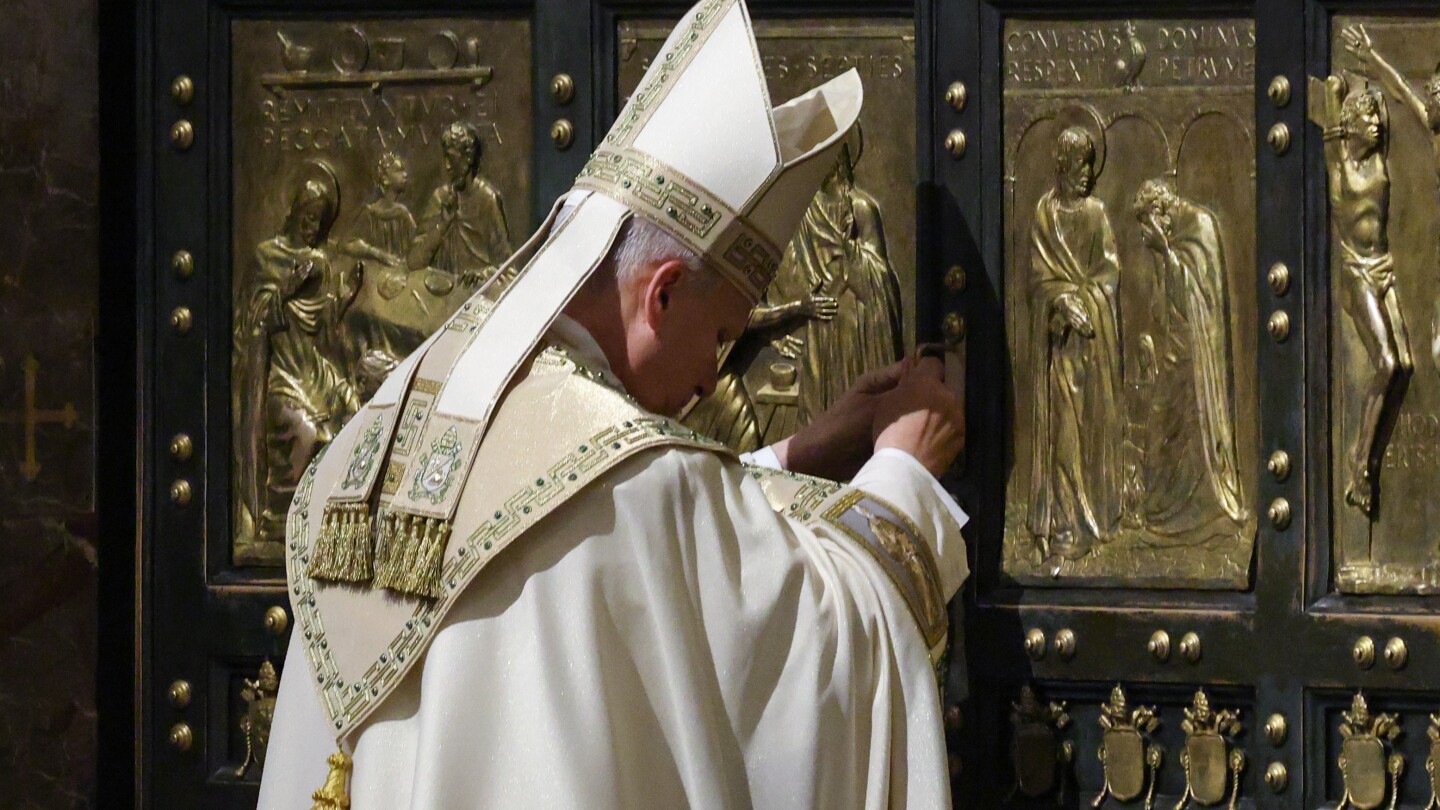
The pontiff knelt in prayer before closing the two doors of St. Peter’s Basilica’s Holy Door, symbolically concluding a year that began under Pope Francis in December 2024 and continued through Francis’s funeral, the conclave, and ultimately ended under his successor. This marks only the second time in Church history that a Holy Year has been opened by one pope and closed by another, with the first occurrence dating back to 1700.
In his homily, Leo challenged the faithful to reflect on how the Jubilee year had transformed them. “Around us, a distorted economy tries to profit from everything,” he said. “Let us ask ourselves: has the Jubilee taught us to flee from this type of efficiency that reduces everything to a product and human beings to consumers?”
The pope questioned whether the year’s spiritual journey had enabled Catholics to better recognize “a pilgrim in the visitor, a seeker in the stranger, a neighbor in the foreigner, and fellow travelers in those who are different.” These themes extended to his Epiphany prayer delivered from the basilica loggia, where he called for fairness to replace inequality and “the craft of peace” to supplant “the industry of war.”
Tuesday’s ceremony caps a whirlwind year of special audiences, Masses, and meetings that dominated Leo’s initial months as pontiff, effectively putting his own agenda on hold. Now, as if signaling a new chapter in his pontificate, Leo has summoned the world’s cardinals to the Vatican for two days of meetings beginning Wednesday to discuss governing the 1.4-billion-member Catholic Church. The agenda includes discussions on liturgy, suggesting Leo is directly addressing divisions within the church over celebrations of the old Latin Mass.
For the Vatican, Holy Years represent a centuries-old tradition in which the faithful make pilgrimages to Rome every 25 years to visit the tombs of Saints Peter and Paul, receiving indulgences for the forgiveness of sins when passing through the Holy Door. For Rome, Jubilees provide opportunities to utilize public funds for urban renewal, with this year’s event drawing approximately 4 billion euros ($4.3 billion) for infrastructure improvements.
Vatican officials claimed 33,475,369 pilgrims participated in the 2025 Jubilee, though Archbishop Rino Fisichella, who organized the event, acknowledged this figure represents a rough estimate that may include some double counting. Neither Fisichella nor Italian officials provided a clear breakdown distinguishing Holy Year pilgrims from Rome’s regular tourists during the same period.
Rome’s relationship with Jubilees dates back to 1300 when Pope Boniface VIII inaugurated the first Holy Year, establishing Rome as Christianity’s definitive center. The pilgrim numbers were so significant even then that Dante referenced them in his “Inferno.”
Major public works have traditionally accompanied Holy Years, including the creation of the Sistine Chapel for the 1475 Jubilee and the Vatican garage for the 2000 Jubilee under Pope John Paul II. Some projects have proven controversial, such as the construction of Via della Conciliazione—the broad avenue leading to St. Peter’s Square—which required razing an entire neighborhood for the 1950 Jubilee.
The primary infrastructure project for the 2025 Jubilee extended that boulevard, creating a pedestrian piazza along the Tiber River linking Via della Conciliazione to the nearby Castel St. Angelo. This involved diverting a major road to an underground tunnel.
Looking ahead, Pope Leo has already announced the next Jubilee will take place in 2033, commemorating the 2,000th anniversary of what Christians believe was the death and resurrection of Jesus Christ.
The conclusion of this Holy Year marks not just the end of a significant religious observance but also represents a transitional moment for the Catholic Church as it navigates contemporary challenges under new leadership.
Fact Checker
Verify the accuracy of this article using The Disinformation Commission analysis and real-time sources.

10 Comments
It’s interesting to see a historic papal transition coincide with the closing of this Holy Year. I wonder how the change in leadership will impact the Church’s priorities going forward.
A good question. The new Pope’s focus on combating consumerism and xenophobia suggests he may chart a different course than his predecessor.
The Pope’s critique of consumerism and anti-foreigner sentiment is a timely and important message. We must find the balance between economic progress and spiritual growth.
Agreed. The Jubilee year seems to have been a valuable opportunity for reflection on these crucial issues.
The Pope’s critique of the ‘distorted economy’ that reduces everything to a product is a powerful statement. I hope this message inspires Catholics to re-examine their own consumerist habits.
Agreed. Promoting a more ethical and sustainable economic model is crucial for the Church to maintain its moral authority.
The Vatican’s ability to draw millions of pilgrims during a Holy Year is quite remarkable. I wonder how this influx of visitors impacted the local economy and infrastructure.
Good point. The economic and logistical challenges of hosting such a massive event must have been significant, though the spiritual benefits were likely immense.
As a Catholic, I appreciate the Pope’s call to recognize the humanity in all people, even strangers and foreigners. This is a message that resonates in our divided world.
Absolutely. Embracing diversity and compassion is crucial for the Church to remain relevant and impactful.