


Listen to the article
Israeli Settlers Celebrate Independence Day at West Bank Spring Amid Regional Tensions
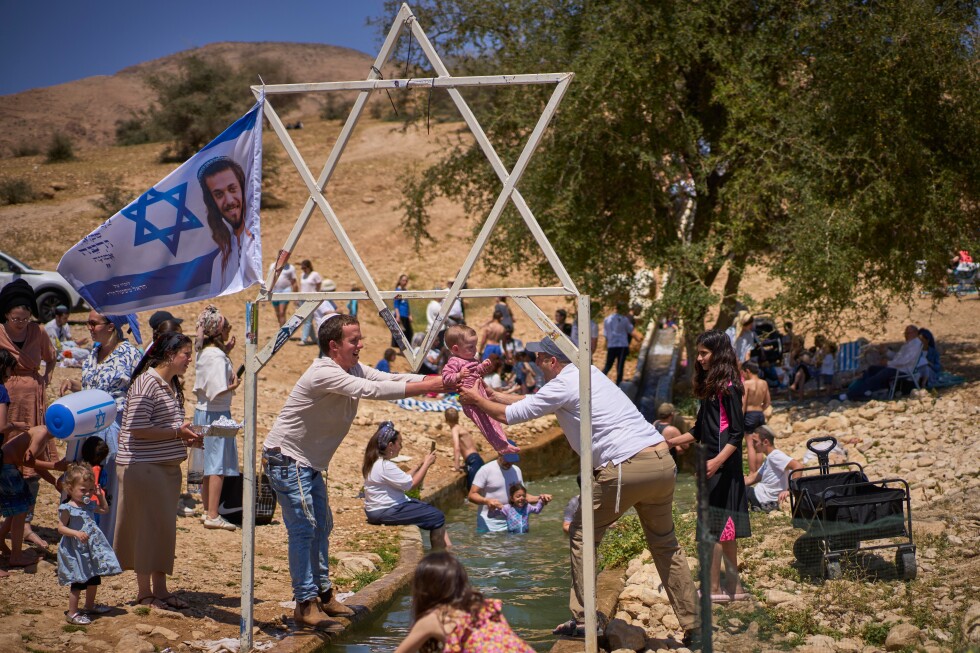
Israeli settlers and other Israelis gathered at a spring in the occupied West Bank community of Auja on Wednesday to mark Israel’s Independence Day with swimming and picnicking, creating scenes of leisure that stand in stark contrast to ongoing tensions in the region.
For hours, families slid down natural water slides into the cool waters while soldiers kept watch over the festivities. The celebration took place under an Israeli flag bearing the photograph of a 21-year-old Israeli man killed by Hamas gunmen during an attack in June 2023, a somber reminder of the ongoing conflict.
The recreational gathering at the Jordan Valley spring highlights the complex dynamics of water access and land use in the West Bank. Parts of the natural spring have been developed specifically as recreational areas primarily used by Israelis, underscoring the significant disparities in resource allocation in the territory.
Palestinians in the West Bank face severe water restrictions, with limited supply and access, while nearby Israeli settlements enjoy substantially greater water resources. This inequality has been documented by numerous humanitarian organizations and represents one of the most contentious aspects of the ongoing occupation.
The celebratory atmosphere at the spring comes against a backdrop of increasing settler violence and displacement of Palestinians in the Jordan Valley. Just months earlier, in January, approximately 600 Palestinians were forcibly displaced from a nearby community, according to human rights monitors. The displacement is part of a pattern that has intensified in recent years, with settler attacks on Palestinian communities becoming more frequent and more severe.
Water rights in the West Bank are governed by the Oslo Accords, which allocated approximately 80 percent of the shared water resources to Israel, leaving Palestinians with limited access to their own groundwater. Many Palestinian communities must purchase water at high prices from tanker trucks, while settlements often have swimming pools and irrigated gardens.
The Jordan Valley, where Auja is located, has particular strategic importance. It comprises approximately 30 percent of the West Bank and contains some of the territory’s most fertile land. Israeli settlements in the area have expanded significantly over the past decade, with agricultural operations that depend on access to water sources like the spring where the Independence Day celebration took place.
Israeli military presence in the West Bank has also increased in recent months following the October 7 Hamas attacks and the subsequent war in Gaza. The soldiers monitoring the Independence Day festivities are part of this heightened security presence, which Israel says is necessary to prevent attacks but which Palestinians describe as an intensification of the occupation.
Human rights organizations have documented an uptick in both settler violence and Israeli military operations in the West Bank since October, with hundreds of Palestinians killed and thousands detained. The United Nations has expressed concern about the situation, particularly regarding forced evictions and demolitions.
For Israeli settlers and other Israelis enjoying their Independence Day at the spring, the location represents a connection to biblical history and what they view as their ancestral homeland. For Palestinians, however, such gatherings on occupied territory symbolize the ongoing dispossession and restrictions they face under occupation.
As children splashed in the water and families shared picnic meals under the watchful eyes of soldiers, the scene at Auja spring encapsulated the complex reality of life in the West Bank, where moments of normalcy and celebration exist alongside—and often at the expense of—continued conflict and inequality.
Fact Checker
Verify the accuracy of this article using The Disinformation Commission analysis and real-time sources.

13 Comments
This celebration on land occupied by Israel underscores the deep divides and unequal access to resources that characterize the Israeli-Palestinian conflict. The imagery of Israelis enjoying a spring while nearby Palestinians face water scarcity is a powerful illustration of the challenges in the region.
You make a good point. These types of celebrations, while joyful for some, also serve as a painful reminder of the ongoing struggles and inequities experienced by Palestinians in the West Bank. Finding ways to address these disparities will be crucial for any lasting resolution.
Fascinating to see how Israeli settlers and Palestinians have such different access to water resources in the West Bank. This disparity underscores the complex dynamics of the region. I wonder what perspectives the local Palestinians have on this celebration taking place on their land.
Yes, the inequality in water access is a key issue in the ongoing conflict. It will be important to hear from all sides to understand the nuances and challenges around resource allocation and land use in the West Bank.
The photos of Israelis celebrating at a West Bank spring underscore the complex dynamics of resource allocation and land use in the occupied territories. The stark contrast between the Israelis’ recreational access to the spring and the water insecurity faced by many Palestinians in the region is a troubling illustration of the ongoing challenges.
This celebration on occupied land highlights the sharp contrasts in daily life and resource allocation between Israelis and Palestinians in the West Bank. The imagery of Israelis enjoying a recreational spring while nearby communities face water scarcity is a poignant reminder of the ongoing challenges in the region.
Absolutely. These types of events, while celebratory for some, also serve as a painful reminder of the deep inequalities that persist. Finding equitable solutions around water access and land use will be crucial for progress towards a sustainable peace.
The scene of Israelis enjoying a spring in the West Bank seems to highlight the stark differences in daily life and access to resources between the two communities. It’s a sobering reminder of the tensions and disparities that persist in the region.
You’re right, the juxtaposition is striking. These types of celebrations likely evoke very different reactions from Israelis and Palestinians living in the same area. Addressing the underlying issues around water and land will be crucial for progress.
The photos of Israelis celebrating at a West Bank spring highlight the tensions and inequalities that persist in the region. It’s a stark reminder of the complex realities on the ground, where recreational access for one group stands in contrast to the water insecurity faced by local Palestinians. Understanding these dynamics will be key.
This celebration seems to reflect the complexities of the Israeli-Palestinian conflict, with Israelis enjoying recreational access to a natural spring in the occupied West Bank. The unequal distribution of resources is a major source of tension, and it will be important to understand how local Palestinians view this event on their land.
Absolutely, the water access and land use dynamics at play here are a microcosm of the broader conflict. Addressing these disparities in a fair and sustainable way will be crucial for any progress towards a lasting peace.
The photos of Israelis celebrating at a West Bank spring are a striking visual representation of the complex dynamics at play in the region. The unequal access to natural resources like water is a major source of tension, and it will be important to understand the perspectives of all parties involved.