


Listen to the article
Pakistan’s Field Marshal Emerges as Key Mediator Between Trump and Iran
President Donald Trump publicly praised Pakistani Prime Minister Shehbaz Sharif and military chief Field Marshal Asim Munir in a Truth Social post on Friday, referring to them as “two fantastic people!!!” Sharif promptly responded on X, expressing “deep and profound appreciation” for Trump’s comments.
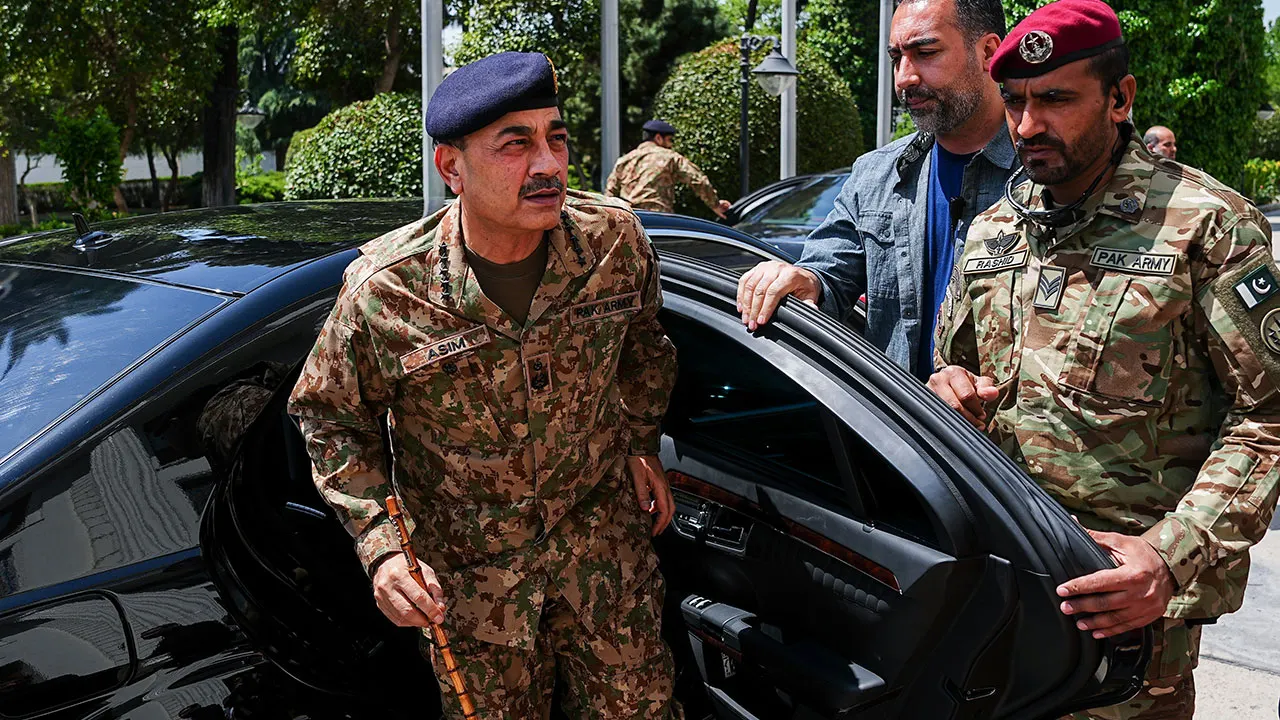
This exchange highlights the remarkable rise of Field Marshal Munir, who has become one of the few foreign officials enjoying trust from both the Trump administration and Iran’s security establishment during a period of heightened tensions.
Munir recently became the first foreign military leader to visit Iran since the latest escalation between the United States and Iran. Arriving in full military uniform, he received a warm welcome from Iranian Foreign Minister Abbas Araghchi and held meetings with senior Iranian military officials.
According to retired Pakistani General Ahmed Saeed, Munir has for months served as an informal back channel between Washington and Tehran as the Trump administration attempts to negotiate an end to the conflict, address Iran’s nuclear program, and resolve the naval blockade in the Persian Gulf.
“He has been interacting with the leadership. He has been interacting with the intelligence community. He has been interacting with the IRGC,” Saeed told Fox News Digital, referring to Iran’s Islamic Revolutionary Guard Corps.
Saeed noted that Munir built relationships not only with the IRGC but also with Iran’s regular army and intelligence apparatus. These connections reportedly include longstanding contact with former IRGC Quds Force commander Qassem Soleimani, who was killed in a U.S. strike in 2020, and commander Hossein Salami, killed in an Israeli strike in June 2025.
Munir’s relationship with Trump dates back to the India-Pakistan crisis of May 2025, where he played a key role in de-escalation efforts. Following this, Pakistan formally nominated Trump for the Nobel Peace Prize, a move widely seen as encouraged by Munir.
Since then, Trump has repeatedly praised Munir, calling him an “exceptional man,” a “great fighter,” and “my favorite field marshal.” Pakistani officials report that the two men now speak directly.
Pakistani analyst Raza Rumi explained Munir’s appeal to Trump: “Trump has long shown a preference for strong, decisive leaders. Munir fits that mold as a centralized authority figure who can deliver outcomes.”
Munir’s background provides context for his diplomatic effectiveness. He studied at prestigious institutions including Japan’s Fuji School, Malaysia’s Armed Forces College, and Pakistan’s National Defence University, where he earned a master’s degree in public policy and strategic security management. He was the first Pakistani army chief to receive the Sword of Honour, the military’s highest distinction for a cadet.
Additionally, Munir is a Hafiz-e-Quran, having memorized the entire Quran. As former head of both Pakistan’s Military Intelligence and Inter-Services Intelligence agencies, he spent years managing Pakistan’s sensitive regional relationships with Iran, Afghanistan, and India.
After the India-Pakistan crisis in 2025, Munir was elevated to field marshal, becoming the first Pakistani officer to hold that rank since former military ruler Ayub Khan. Later that year, he reportedly received the newly created title of chief of defense forces, further consolidating his authority over Pakistan’s military branches.
While Munir rarely gives interviews, his public statements suggest a worldview emphasizing order and centralized authority. At the Margalla Dialogue in Islamabad in November 2024, he stated that “absence of proper regulations for freedom of expression is leading to the deterioration of moral values in societies worldwide.”
However, critics argue his rise has come at a cost to Pakistan’s democracy. After becoming army chief in 2022, Munir focused heavily on domestic politics, which critics described as including crackdowns on political opposition and an unprecedented concentration of military power. Key negotiations with the United States and Iran have reportedly been coordinated not from Pakistan’s civilian capital Islamabad, but from Rawalpindi, the headquarters of the military.
Bill Roggio of the Foundation for Defense of Democracies expressed concerns about Munir’s role, telling Fox News Digital, “Trump should not trust the Pakistanis. Pakistan was a perfidious ‘ally’ in Afghanistan, backing the Taliban while pretending to be our friends. Munir’s ties to the IRGC should be a massive red flag for the Trump admin.”
As negotiations continue, Munir’s unique position of trust on both sides appears crucial. General Saeed expressed confidence in Munir’s determination: “Knowing our field marshal, and from my own personal knowledge of him, he is relentless. He would not give up.”
Fact Checker
Verify the accuracy of this article using The Disinformation Commission analysis and real-time sources.

14 Comments
General Munir’s rise to power as Pakistan’s army chief is certainly an intriguing development. His ability to navigate relations between the US and Iran is quite remarkable, especially during these tense times. It will be interesting to see how he leverages his influence to promote stability in the region.
Yes, Munir’s diplomatic skills and intelligence ties make him a key player in the complex geopolitics of the region. His role as a mediator between the US and Iran could prove crucial in easing tensions.
The news about General Munir’s diplomatic efforts is a fascinating development. His willingness to engage with both the US and Iran, despite their strained relations, demonstrates a nuanced understanding of the geopolitical landscape. It will be interesting to see how his interventions unfold.
Absolutely. Munir’s position as a respected military leader with deep intelligence ties gives him a unique vantage point to navigate these complex negotiations. His success in this role could have far-reaching implications for the region.
The profile on General Munir highlights the importance of military leadership in shaping international relations, especially in sensitive areas like the US-Iran conflict. His experience and connections will be valuable assets as he navigates this delicate situation.
Absolutely. Munir’s deep intelligence ties and ability to engage with both the US and Iran administration will be critical in finding a diplomatic solution to the ongoing tensions.
It’s intriguing to see a Pakistani military leader emerge as a key intermediary between the US and Iran. General Munir’s background in intelligence and his rapport with both sides could make him an influential figure in the region.
Agreed. Munir’s role as a mediator is quite significant, given the longstanding tensions between the US and Iran. His ability to maintain open channels of communication could be invaluable in de-escalating the situation.
General Munir’s rise to power in Pakistan and his involvement in the US-Iran conflict is a testament to the influential role of military leaders in shaping international relations. His ability to maintain open channels with both sides is particularly noteworthy during these volatile times.
Agreed. Munir’s diplomatic skills and his willingness to engage with adversaries like the US and Iran make him a key figure in the regional geopolitics. His influence could be crucial in finding a peaceful resolution to the ongoing tensions.
The profile on General Munir highlights the importance of military intelligence and diplomatic skills in navigating complex international conflicts. His role as a mediator between the US and Iran is a testament to his strategic acumen and the influence of Pakistan’s military establishment.
Absolutely. Munir’s ability to bridge the gap between the US and Iran, despite their longstanding enmity, is a remarkable achievement. His experience and connections will be valuable assets as he continues to shape the regional dynamics.
General Munir’s rise to power in Pakistan and his involvement in the US-Iran conflict is a fascinating development. His diplomatic skills and intelligence ties make him a key player in the region’s geopolitics, with the potential to influence the trajectory of the ongoing tensions.
Agreed. Munir’s willingness to engage with both the US and Iran administration, despite their strained relations, demonstrates his strategic acumen and the important role of military leadership in international affairs.