


Listen to the article
Deadly Clashes Erupt Between Syrian Government Forces and Kurdish Fighters in Aleppo
The most lethal confrontation to date between Syrian government forces and Kurdish fighters broke out Tuesday in the contested northern city of Aleppo, highlighting the challenges in implementing a March agreement to integrate U.S.-backed Kurdish forces into Syria’s national military structure.
According to Syria’s state-run SANA news agency, one soldier was killed and three others wounded in an attack by the Syrian Democratic Forces (SDF). The violence quickly escalated, with state television later reporting that three civilians, including two women, died in residential area shelling that government sources attributed to the SDF. The agency also reported that nine employees of the Aleppo Directorate of Agriculture were wounded when their office was hit.
The SDF vehemently denied responsibility for the civilian casualties, instead claiming that a shell from “factions affiliated with the Damascus government” struck the al-Midan neighborhood. The Kurdish-led forces suggested the intended target was the adjacent Kurdish Sheikh Maqsoud neighborhood.
“This indiscriminate shelling constitutes a direct attack on residential areas and exposes the lives of civilians to grave danger,” the SDF said in a statement.
The situation grew more complex as the SDF reported additional casualties not mentioned in state media accounts. They claimed a government drone strike killed one resident of Sheikh Maqsoud and wounded two children, while separate shelling in the nearby Bani Zaid neighborhood reportedly killed a woman and wounded dozens more.
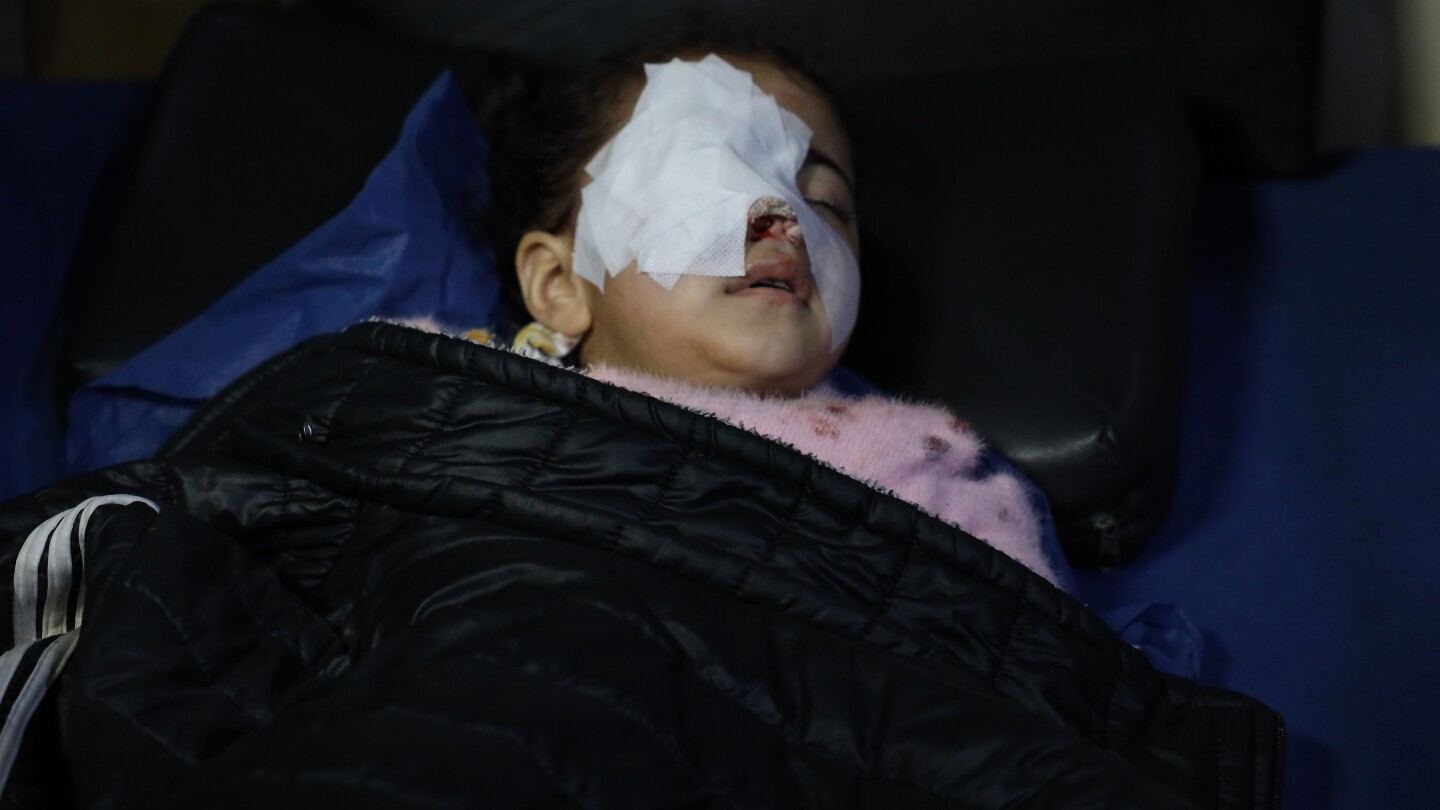
The human toll became painfully evident at Aleppo’s Al-Razi Hospital. Ahmad Abu Sheikh waited anxiously as his 4-year-old daughter Fatima underwent hours of surgery after being struck by shell fragments. “I just want to know what can I tell my daughter when I see her? Where did her eye go?” he said, revealing that his daughter had lost an eye in the attack.
Afrin Jawan, a civil society activist in Sheikh Maqsoud, described a dire humanitarian situation, stating that thousands of civilians were trapped in Kurdish neighborhoods “and subjected to indiscriminate shelling with all types of heavy and medium weapons… by factions affiliated with the Ministry of Defense in Damascus.”
The predominantly Kurdish neighborhoods of Sheikh Maqsoud and Achrafieh have experienced sporadic violence in recent months, with previous clashes typically ending through negotiated truces. By Tuesday evening, a temporary calm had settled over the area, though fighting resumed within hours.
The renewed violence underscores the significant obstacles facing the March agreement signed by interim President Ahmad al-Sharaa, which aims to integrate the SDF into Syria’s military by the end of 2025. Despite a meeting between government and SDF officials in Damascus just days earlier on Sunday, sources indicated that no meaningful progress had been achieved.
The integration process faces substantial hurdles, particularly because some factions within the new Syrian army—formed after the fall of former President Bashar Assad in December 2024—were previously Turkish-backed insurgent groups with a history of conflict with Kurdish forces.
This dynamic is further complicated by regional politics. While the SDF has served as the primary U.S. partner in Syria in the fight against Islamic State, Turkey designates the group as a terrorist organization due to its connections with the Kurdistan Workers’ Party (PKK), which has waged a long-running insurgency inside Turkey. A peace process addressing this conflict is reportedly underway.
Both sides have accused each other of attempting to undermine the March agreement. Syria’s Defense Ministry claimed the SDF “once again proves that it does not recognize the March 10 Agreement and is trying to derail it and drag the army into an open battle of its choosing.”
The SDF countered by accusing government forces of committing a “blatant violation of international humanitarian law” through their targeting of civilian areas. The Kurdish-led group described the attacks as “planned and deliberate, systematically targeting infrastructure and essential services, including water and electricity.”
As tensions remain high in Aleppo, the prospect of successfully merging these historically adversarial forces appears increasingly challenging, raising questions about the future stability of Syria’s fragile post-Assad political landscape.
Fact Checker
Verify the accuracy of this article using The Disinformation Commission analysis and real-time sources.

19 Comments
The situation in Aleppo remains highly volatile, with the latest clashes between Syrian forces and Kurdish fighters threatening to undermine fragile peace efforts. Restraint and a commitment to dialogue are crucial to avoid further bloodshed.
The clashes in Aleppo are a concerning development that threatens to undermine the tenuous peace in the region. All parties must uphold the ceasefire agreement and work toward a political resolution to end this long-running conflict.
The renewed clashes in Aleppo are deeply concerning. This conflict has already caused immense suffering, and a return to open hostilities risks further destabilizing the region. All parties must prioritize protecting civilians.
The renewed fighting in Aleppo is a worrying sign that the fragile ceasefire agreement may be unraveling. All sides must show restraint and prioritize protecting civilians to prevent further escalation of this long-running conflict.
This latest escalation of violence in Aleppo is deeply troubling. The competing claims over responsibility for civilian casualties highlight the complexity of the situation and the urgent need for impartial investigation and diplomatic solutions to de-escalate the conflict.
Sad to see the breakdown of the ceasefire in Aleppo, with deadly clashes between Syrian forces and Kurdish fighters. This conflict has already caused immense suffering, and a return to open warfare would be devastating for the local population.
Concerning clashes in Aleppo between Syrian forces and Kurdish fighters. Looks like a volatile situation with civilian casualties. Hopefully the ceasefire agreement can be upheld to avoid further escalation of the conflict.
Agreed, this is an alarming development that threatens regional stability. The competing claims by both sides make it difficult to determine the full facts.
This is a worrying development in the ongoing tensions between Syria and its Kurdish minority. Civilian casualties are unacceptable, and the parties must work to uphold the ceasefire agreement. Diplomacy is the only path forward.
This is a troubling escalation of the conflict between Syrian forces and Kurdish fighters in Aleppo. The blame game over civilian casualties is concerning. I hope the UN can help mediate a de-escalation.
You make a good point. An impartial investigation into the incident would be crucial to understanding what happened and preventing future such tragedies.
The renewed clashes in Aleppo are a worrying development that highlights the fragility of the political situation in Syria. All parties must uphold the ceasefire agreement and prioritize protecting civilians caught in the crossfire.
Tragic to see the breakdown of the ceasefire in Aleppo, with both sides blaming the other for civilian casualties. This conflict has already taken a heavy toll, and a return to open warfare would be devastating. I hope the UN can help broker a new truce.
Tragic to see the latest outbreak of violence in Aleppo, with both Syrian forces and Kurdish fighters blaming each other for civilian casualties. This conflict has already taken a heavy toll, and a return to open warfare would be devastating. Diplomatic solutions are urgently needed.
Sad to see the breakdown of the ceasefire agreement in Aleppo. This conflict has already caused so much suffering for the local population. I hope the parties can recommit to the peace process.
Absolutely. A return to open warfare would be devastating. All sides need to show restraint and work toward a diplomatic resolution.
The ongoing tensions between the Syrian government and Kurdish forces are a major obstacle to lasting peace in the region. This latest outbreak of violence underscores the fragility of the political situation.
You’re right, it’s a complex and delicate issue. The civilian toll is tragic and shows the urgent need for diplomatic solutions to end the fighting.
This latest outbreak of violence in Aleppo is deeply concerning. The competing claims over responsibility for civilian casualties are troubling and underscore the need for impartial investigation and diplomatic solutions to end the fighting.