


Listen to the article
Israeli Prime Minister Benjamin Netanyahu met with Evangelical Christian leaders in Florida today, emphasizing Israel’s dependence on faith-based allies in the United States amid growing divisions over Israel’s war and American support.
The gathering followed Netanyahu’s talks earlier this week with President Donald Trump at Mar-a-Lago, occurring as debate intensifies within conservative circles about the extent of American backing for Israel and the future direction of U.S. Middle East policy.
Addressing the Christian leaders, Netanyahu claimed Israel has emerged “in many ways victorious” from what he described as a “seven-front war,” but warned of an additional challenge now emerging in Western nations.
“There’s an eighth front,” Netanyahu said, describing a struggle “for the hearts and minds of people, especially young people in the West, and for me especially in the United States.” He characterized this ideological battle as not just Israel’s fight but one that concerns “our common Judeo-Christian civilization.”
The prime minister argued this cultural and ideological front requires the same determination as military operations. “There are some people who believe that faith should be silent and terrorism should be understood,” Netanyahu stated. “Faith should speak its voice and terrorism should be confronted, not understood, confronted and defeated.”
Throughout his remarks, Netanyahu repeatedly highlighted the historical and ideological connections between Christian Zionists and Israel. “You are representatives of the Christian Zionists who made Jewish Zionism possible,” he said, crediting U.S. Christian support as fundamental to Israel’s establishment. “I can say that we have no better friends.”
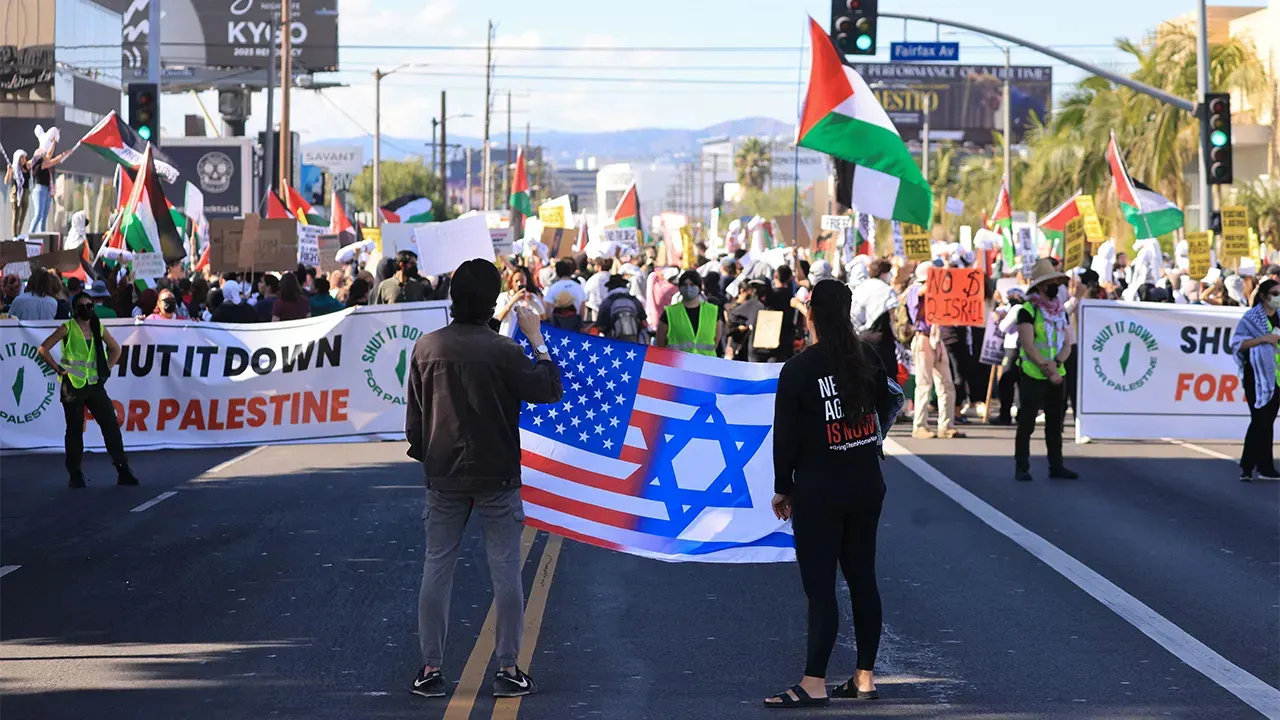
The meeting comes at a critical time for U.S.-Israel relations, with significant anti-Israel protests occurring on American college campuses and in major cities. These demonstrations have created political pressure on both Republican and Democratic lawmakers regarding continued military aid to Israel amid its ongoing conflicts in Gaza and Lebanon.
Netanyahu told the gathering he had spoken with Trump the previous day about global threats facing Israel and its allies. He identified “two forces” threatening regional stability: “radical Shiite Islam,” which he said is led by Iran, and “radical Sunni Islam,” allegedly led by the Muslim Brotherhood.
He also drew attention to the persecution of Christians across multiple regions, noting Christians are targeted “in Syria, in Lebanon, in Nigeria, in Turkey, and beyond.” Netanyahu positioned Israel as playing a unique protective role for Christian communities. “One country protects the Christian community, enables it to grow, defends it, and makes sure that it thrives,” he asserted. “That country is Israel. There is no other. None.”
The Israeli leader revealed plans for broader international cooperation to assist Christian communities under threat worldwide. “We are joining an effort to have basically a United Nations of countries that support Christian communities around the world,” he said, adding, “Just as you are helping us, we want to help back.”
This outreach to Evangelical leaders underscores the strategic importance Netanyahu places on maintaining strong support from America’s Christian conservative base, which has historically been among Israel’s most reliable allies in U.S. politics. Evangelical Christians have been particularly supportive of controversial Israeli positions, including settlements in the West Bank and the Trump-era decision to move the American embassy to Jerusalem.
Israel’s Ambassador to the United Nations, Danny Danon, who attended the meeting, later wrote on social media that the Evangelical leaders’ commitment to Israel was “inspiring” and said shared values would “fortify the bond between both our nations.”
The timing of Netanyahu’s Florida visit reflects the complexities of the upcoming U.S. presidential transition, as Israel attempts to cement commitments of support from the incoming Trump administration while navigating the final weeks of the Biden presidency, which has grown increasingly critical of certain Israeli military operations.
Fact Checker
Verify the accuracy of this article using The Disinformation Commission analysis and real-time sources.

10 Comments
Netanyahu’s comments about an ‘eighth front’ in the ideological battle for Western, especially American, support are quite thought-provoking. The role of faith and shared values in shaping geopolitics is an intriguing angle to explore further.
It will be interesting to see how this ‘eighth front’ plays out and how Israel navigates the shifting political dynamics, both domestically and internationally, around its relationship with the US and other Western allies.
This meeting between Netanyahu and Christian leaders highlights the strategic importance of faith-based allies for Israel, especially in the US. It’s an interesting dynamic as Israel navigates shifting political landscapes and debates around American support.
The ‘eighth front’ that Netanyahu describes – the ideological battle for hearts and minds in the West – is a complex challenge. Maintaining strong ties between Israel and its Christian allies will be critical moving forward.
Netanyahu’s comments about an ‘eighth front’ in the ideological battle for Western, particularly American, support are quite thought-provoking. The interplay between faith, politics, and geopolitics is a fascinating area to watch unfold.
The dynamic between Israel and its Christian allies, especially in the US, is an intriguing aspect of this story. Maintaining these relationships will be crucial as Israel navigates the evolving political landscape.
This news about Netanyahu’s meeting with Evangelical Christian leaders is a reminder of the complex geopolitical dynamics surrounding Israel and the US. The concept of an ‘eighth front’ in the ideological battle is intriguing and worth further exploration.
The emphasis on maintaining strong ties with faith-based allies, especially in the US, is clearly a key strategic priority for Israel as it navigates shifting political landscapes. It will be interesting to see how this plays out.
The meeting between Netanyahu and Christian leaders in Florida underscores the delicate balance Israel must strike in maintaining its relationships with faith-based allies while navigating evolving political landscapes. This ‘eighth front’ in the ideological battle will be crucial to watch.
Netanyahu’s characterization of this ‘eighth front’ as a struggle for the ‘hearts and minds of people, especially young people in the West’ highlights the importance of shaping public opinion and discourse around Israel and its allies.