


Listen to the article
Labor Unrest Escalates at Venice’s La Fenice Over Political Appointment
Venice’s historic La Fenice opera house has become the epicenter of growing tension between cultural institutions and Italy’s government, as workers protest what they see as politically motivated leadership appointments undermining artistic independence.
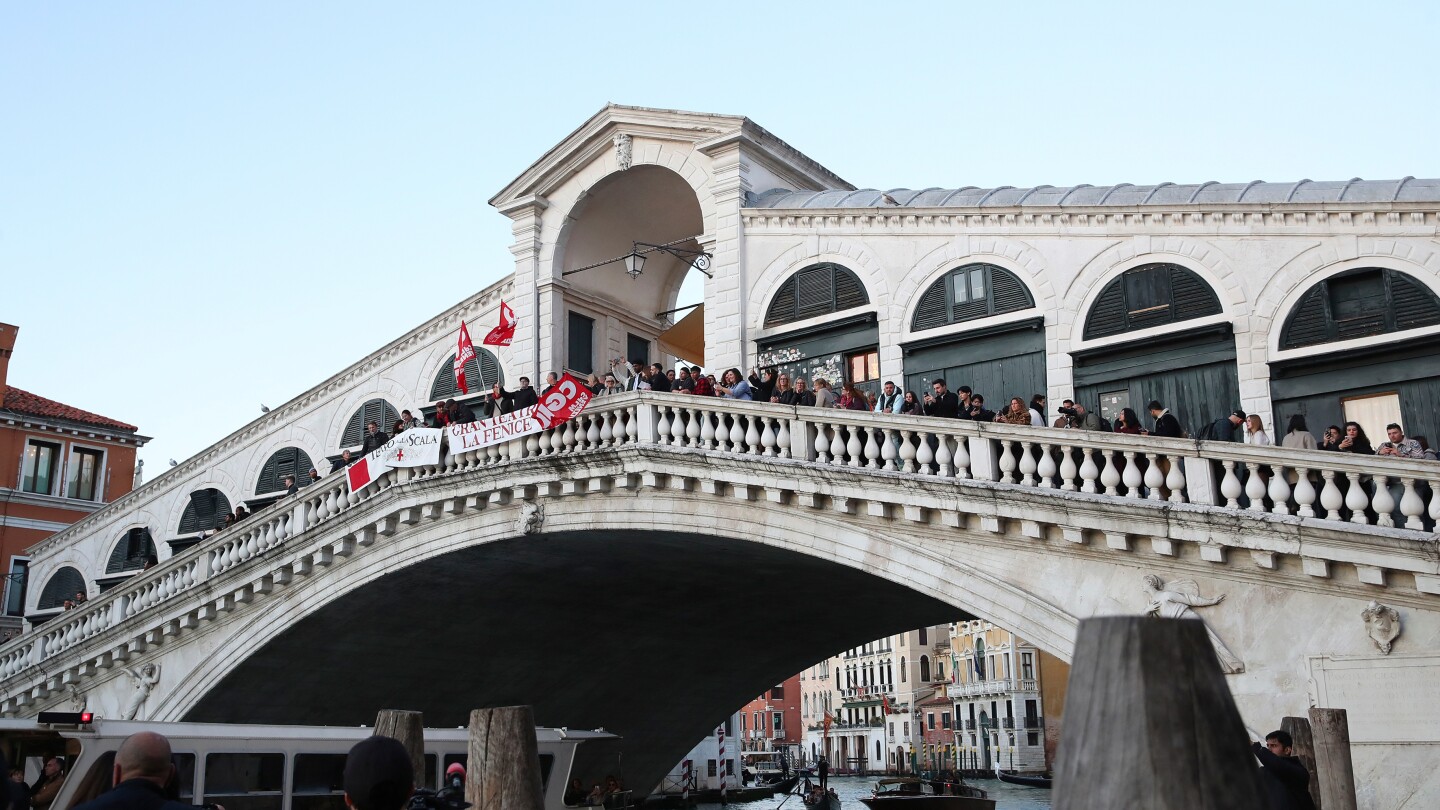
On Monday, musicians, singers and backstage staff from La Fenice marched through Venice’s winding streets alongside colleagues from other prestigious Italian opera houses, including Milan’s Teatro alla Scala, Verona’s Arena and Turin’s Regio Teatro. Season-ticket holders, music students and concerned Venetians joined what has evolved from a labor dispute into a broader protest against perceived governmental interference in Italy’s cultural institutions.
The controversy began when 35-year-old conductor Beatrice Venezi was appointed as La Fenice’s new music director on September 22, a position she will assume next October. Critics point to Venezi’s close ties to Prime Minister Giorgia Meloni and her far-right Brothers of Italy party as evidence of political favoritism.
“The scandal we’ve uncovered here in Venice shows that, unfortunately, once again, politics wants to meddle heavily in culture, with appointments that have no artistic justification, but are purely political,” said Marco Trentin, a union organizer and cellist in La Fenice’s orchestra.
The fallout has been substantial. Striking workers have already forced the cancellation of an opera premiere, and unions have called for the resignation of La Fenice’s general manager, Nicola Colabianchi, who made the appointment without consulting the orchestra.
Colabianchi, who took over theater operations in March, defends his choice, citing Venezi’s youth and media profile as assets that can attract new audiences to the venerable institution where Giuseppe Verdi premiered “Rigoletto” and “La Traviata” more than 170 years ago.
“She’s young and dynamic, she’s already written several books and she’s conducted many orchestras. She’s a person who attracts a great deal of media attention,” Colabianchi said. “We can’t think the theater can survive with 80-year-old season ticket holders.”
However, protestors argue that Venezi lacks the necessary experience to lead a theater of La Fenice’s caliber, which has previously been directed by legendary conductors like Arturo Toscanini, Claudio Abbado, and Riccardo Muti. They also express concerns that her appointment signals the beginning of broader political control over cultural institutions across Italy.
Many artists point to a new theater code being discussed by the government that they fear threatens artistic independence. “The draft raises considerable concerns, as it moves toward a centralization of appointments and artistic choices, increasing the risk that these may become the prerogative of national party politics,” said Giulia Pancheri, a violinist with Milan’s I Pomeriggi Musicali orchestra.
Venezi’s background has fueled the controversy. She is the daughter of a prominent member of Forza Nuova, another hard-right party, and has aligned herself with conservative values. She told the daily La Stampa in 2023 that she was “offended when they call me a little fascist.” After her appointment, Culture Minister Alessandro Giuli called Venezi “a thoroughly deserving choice.” Meloni has repeatedly praised Venezi and named her counselor for music shortly after taking power in 2022.
La Fenice’s unions maintain that their protest isn’t about Venezi’s youth, gender, or political leanings, but rather about the lack of consultation with the musicians she will lead. “The musical director gives the theater its musical imprint,” explained Paolo Bertoldo, a percussionist and union representative. “If your soccer coach doesn’t work well with the players, the team won’t have results.”
Union representatives have proposed that Colabianchi revoke Venezi’s appointment and restart a selection process that would allow musicians time to work with potential candidates, including Venezi herself.
Colabianchi has apologized for the lack of consultation but remains committed to his choice. “I chose Beatrice Venezi because I had invited her, while I was the general manager in Cagliari, for three separate operas, and she was a huge success,” he said, noting her broad repertoire of more than 50 operas. “She is young, and we need to promote the young; she is a woman, and we need to promote women.”
The general manager has no plans to resign and intends to bring Venezi to the theater once protests subside. Her first scheduled appearance with the full orchestra would be a July concert in St. Mark’s Square, though earlier engagements could be added.
Protesters, who concluded their march with union flags flying triumphantly on La Fenice’s steps, show no signs of backing down. They’ve threatened further actions, including disruptions at the November 20 season premiere, if “a shared solution” isn’t found.
“We are not willing to give in,” Trentin declared, setting the stage for what appears to be a prolonged standoff between artistic integrity and political influence in one of Italy’s most prestigious cultural institutions.
Fact Checker
Verify the accuracy of this article using The Disinformation Commission analysis and real-time sources.

10 Comments
The appointment of the new music director with political ties is certainly raising eyebrows. I’ll be interested to see if the opera house can adequately address the workers’ concerns and restore public trust.
The workers’ protest highlights the critical role cultural workers play in preserving the independence and quality of the arts. I hope their concerns are taken seriously by the opera house’s leadership.
While I understand the need for cultural institutions to engage with government on certain matters, any hint of political interference in artistic decisions is worrying. I hope a constructive solution can be found here.
This situation underscores the importance of maintaining a clear separation between politics and the arts. I hope the La Fenice can find a way forward that prioritizes artistic freedom and integrity.
I’m curious to learn more about the specific ties between the new music director and the Italian government. Maintaining the integrity of cultural institutions is so important, and this situation warrants close scrutiny.
I agree. Any hint of political influence over artistic decisions is highly concerning and needs to be investigated thoroughly. The public deserves transparency on this matter.
It’s heartening to see the solidarity among the different opera houses in Italy. United, their voices will be harder to ignore. I hope this leads to a resolution that upholds artistic integrity.
This is a complex issue that touches on the delicate balance between politics and the arts. I’ll be following this story closely to see how it unfolds and whether the musicians’ demands are met.
This seems like a concerning situation where politics may be inappropriately influencing cultural institutions. I hope the concerns of the musicians and staff can be addressed in a fair and transparent manner.
It’s crucial that artistic independence is protected, especially at renowned venues like La Fenice. Hopefully the workers’ voices will be heard and a resolution can be found.