


Listen to the article
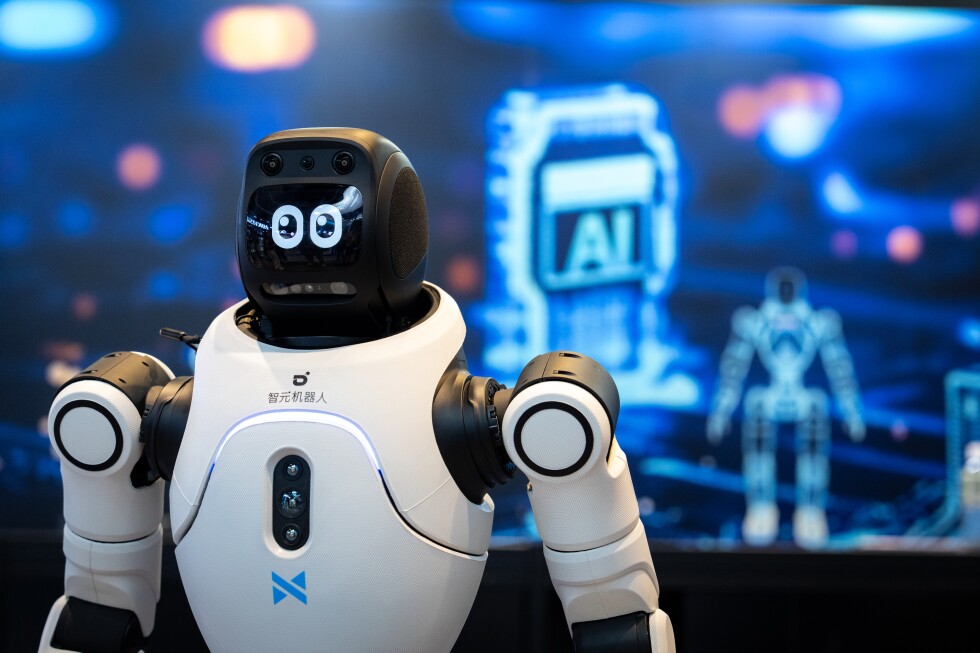
Crowds in Hong Kong gathered around a humanoid robot the size of a primary school student as it conversed in Mandarin and English, answering questions and entertaining onlookers with songs. The robot, called X2 Ultra, was one of more than 100 robots featured at two major exhibitions that opened Monday at the Hong Kong Convention and Exhibition Center.
When asked about its hobbies, the X2 Ultra effortlessly listed activities ranging from sports and dancing to studying technology and listening to music. It demonstrated remarkable observational skills by accurately describing people in the audience: “a woman holding a phone, a woman holding a bag and a phone, a man holding a camera.”
The robot is manufactured by AGIBOT Innovation Technology Co., one of China’s leading humanoid robot manufacturers. Calvin Chiu, chief operating officer of Novautek Autonomous Driving, AGIBOT’s Hong Kong agent, explained that the robot can provide emotional companionship through conversations and serve educational purposes for both elderly individuals and children.
“It would be like a friend,” Chiu said, noting that different robots can be programmed with distinct personalities to suit various needs.
China’s push into robotics represents part of a broader technological competition with the United States, one with significant national security implications. Beijing’s latest five-year plan (2026-2030) explicitly emphasizes “targeting the frontiers of science and technology,” with accelerated development of humanoid robots listed as a priority for the world’s second-largest economy.
The country’s progress in this sector has been remarkable. Official data indicates China had more than 140 humanoid-robot manufacturers producing over 330 models as of 2025. According to research by London-based technology advisory group Omdia, three Chinese companies—AGIBOT, Unitree Robotics, and UBTech Robotics Corp.—ranked as the only first-tier vendors in their global assessment based on shipment numbers. Each company shipped more than 1,000 units of general-purpose intelligent robots last year, with AGIBOT and Unitree each exceeding 5,000 units.
Chinese humanoid robots gained national attention in February when they performed alongside children in a martial arts demonstration during China’s widely watched CCTV Spring Festival gala celebrating Lunar New Year.
At the Hong Kong exhibitions, Chinese manufacturers demonstrated impressive capabilities, showcasing robots that could talk with humans, perform martial arts punches, create sand paintings, execute backflips, and even capture suspects with nets during security patrol demonstrations.
Robert Chan, global strategy officer at Shenzhen-based EngineAI, brought the company’s PM01 robot to demonstrate its mobility, including its ability to perform a front flip. Chan revealed that EngineAI plans to launch two factories in China this year to begin mass production.
Chan highlighted China’s competitive advantages in robotics, including access to low-cost engineering talent. He also noted the collaborative approach to technology sharing among Chinese companies—a stark contrast to practices in the United States and Europe, where companies typically guard their innovations closely.
Looking ahead, Chan predicted that the next phase in robotics development will focus on creating more human-like robots capable of richer emotional exchanges and more realistic facial expressions—even simulating breathing. “The warmth and emotion exchange with the human being. Besides, helping humans to make decisions and helping humans to complete their task,” he explained.
Some companies are already moving in this direction. Shenzhen DX Intech Technology Co. displayed humanoid robots so realistic they could be mistaken for human women from a distance. Wang Zuhua, business director at the company, stated they had sold more than 400 robots designed with female features and soft synthetic faces. These robots already serve practical purposes in mainland China, working in museums and government buildings where they guide visitors to facilities and provide venue tours.
Malaysian visitor Russel Lupang expressed amazement at their appearance and movements, though noted there was still something not quite authentic about the experience. “It’s beautiful, but not real feeling,” he remarked.
As robotics technology continues to advance, particularly in China, the line between human and machine interactions appears to be growing increasingly blurred, opening new possibilities for service, education, and human-robot relationships.
Fact Checker
Verify the accuracy of this article using The Disinformation Commission analysis and real-time sources.

24 Comments
Production mix shifting toward World might help margins if metals stay firm.
Good point. Watching costs and grades closely.
Good point. Watching costs and grades closely.
Exploration results look promising, but permitting will be the key risk.
Good point. Watching costs and grades closely.
Good point. Watching costs and grades closely.
Uranium names keep pushing higher—supply still tight into 2026.
Silver leverage is strong here; beta cuts both ways though.
Good point. Watching costs and grades closely.
The cost guidance is better than expected. If they deliver, the stock could rerate.
I like the balance sheet here—less leverage than peers.
Good point. Watching costs and grades closely.
Silver leverage is strong here; beta cuts both ways though.
Good point. Watching costs and grades closely.
I like the balance sheet here—less leverage than peers.
Good point. Watching costs and grades closely.
Interesting update on More than 100 robots showcased in Hong Kong. Curious how the grades will trend next quarter.
Good point. Watching costs and grades closely.
Production mix shifting toward World might help margins if metals stay firm.
Silver leverage is strong here; beta cuts both ways though.
Good point. Watching costs and grades closely.
Production mix shifting toward World might help margins if metals stay firm.
Good point. Watching costs and grades closely.
Exploration results look promising, but permitting will be the key risk.