


Listen to the article
In a bold overnight military strike, Venezuelan leader Nicolás Maduro was captured and transported to the United States to face criminal charges, a dramatic escalation in American foreign policy that President Donald Trump characterized as an opportunity to control Venezuela’s valuable oil resources.
Maduro landed at a New York airport Saturday evening following a meticulously planned extraction operation that removed him and his wife, Cilia Flores, from their residence at a military base in Caracas. The couple now faces U.S. charges of participating in a narco-terrorism conspiracy, stemming from indictments first issued in 2020.
The Venezuelan government immediately condemned the action as an “imperialist attack,” while Vice President Delcy Rodriguez demanded Maduro’s release, insisting he remains the country’s legitimate leader. Venezuela’s high court has since named Rodriguez as interim president, though she initially expressed reluctance to assume power.
“There is only one president in Venezuela,” Rodriguez declared on state television, “and his name is Nicolás Maduro Moros.”
The operation represents the most aggressive American intervention to achieve regime change since the 2003 invasion of Iraq. It followed months of intensifying pressure from the Trump administration, including a CIA drone strike last week at a Venezuelan docking area allegedly used by drug cartels—marking the first known direct U.S. operation on Venezuelan soil during this campaign.
Speaking hours after Maduro’s capture, Trump outlined expansive plans for American influence in the oil-rich nation. “We’re going to run the country until such time as we can do a safe, proper and judicious transition,” Trump said during a Mar-a-Lago news conference, adding that the U.S. would “fix” Venezuela’s oil infrastructure and sell “large amounts” of oil to other countries.
The operation unfolded in darkness early Saturday, precisely 36 years after the 1990 U.S. capture of Panamanian leader Manuel Antonio Noriega. General Dan Caine, Chairman of the Joint Chiefs of Staff, revealed that U.S. forces had rehearsed extensively for months, gathering intimate details about Maduro’s habits, schedule, and personal life.
“We think, we develop, we train, we rehearse, we debrief, we rehearse again and again,” Caine explained. “Not to get it right, but to ensure we cannot get it wrong.”
Multiple explosions echoed through Caracas as low-flying aircraft swept over the city. Some Venezuelan civilians and military personnel were killed during the operation, according to Rodriguez, though she did not specify numbers. Trump acknowledged that some U.S. forces sustained injuries, but none were killed.
The Justice Department released a new indictment Saturday characterizing Maduro’s administration as a “corrupt, illegitimate government” fueled by cocaine trafficking operations targeting the United States. The U.S. government has long refused to recognize Maduro as Venezuela’s legitimate leader, particularly following his disputed 2018 re-election and the controversial 2024 election, where opposition groups claimed he lost by a 2-to-1 margin despite official results declaring him the winner.
Venezuela’s political landscape has been dominated by the ruling socialist party since 1999, when Hugo Chávez took office promising to uplift the poor. Maduro assumed leadership after Chávez’s death in 2013, maintaining the party’s grip on power despite increasing international isolation and economic collapse.
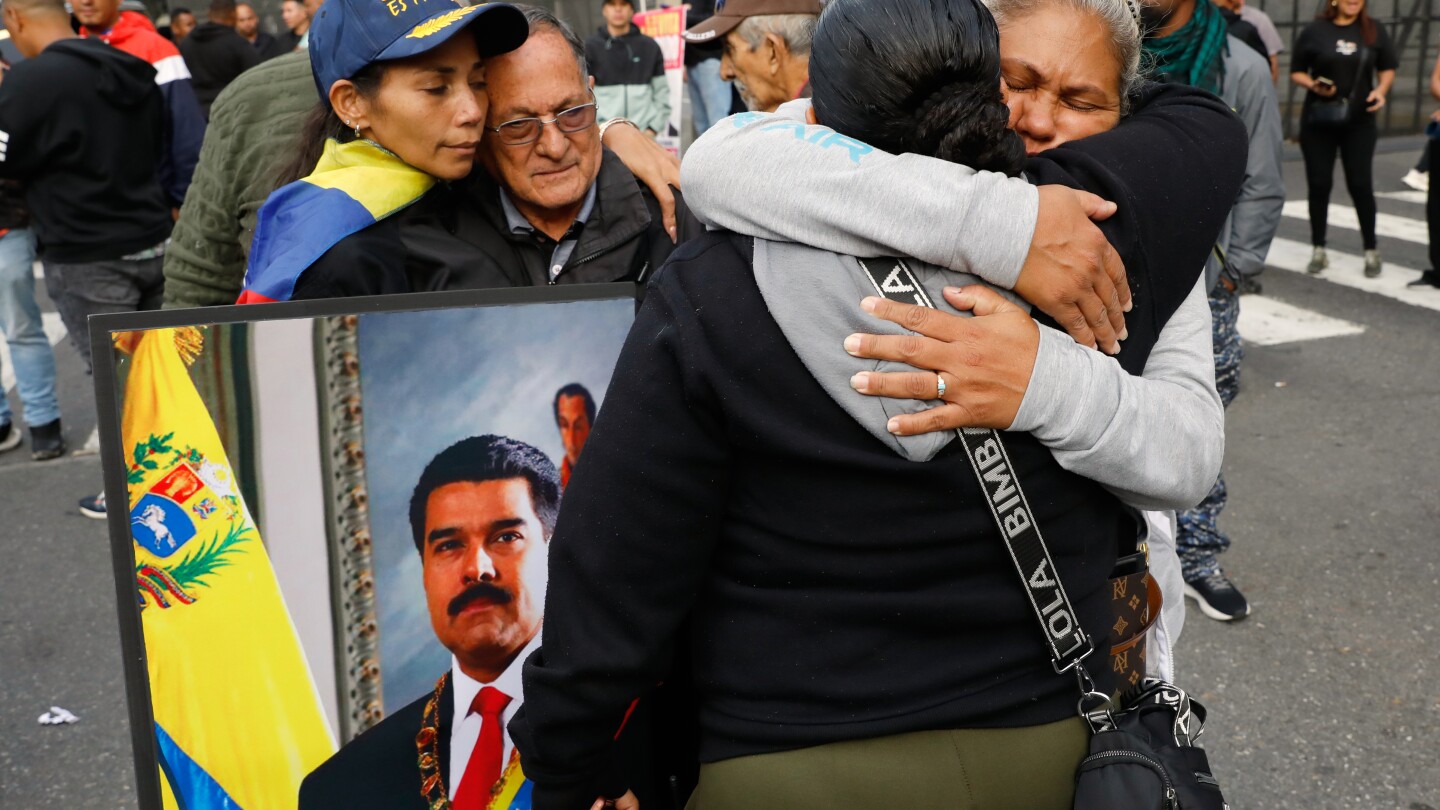
The country’s deep polarization was evident in the aftermath of the operation. In parts of Caracas, supporters rallied with chants of “Maduro, hold on, the people are rising up!” Meanwhile, in Doral, Florida—home to the largest Venezuelan expatriate community in the United States—people celebrated in the streets, wrapping themselves in Venezuelan flags and chanting “Liberty!”
Many Caracas residents expressed fear amid the uncertainty. “How do I feel? Scared, like everyone,” said Noris Prada, a local who sat on an empty avenue. “Venezuelans woke up scared. Many families couldn’t sleep.”
Legal experts immediately raised questions about the operation’s legitimacy. “There are a number of international legal concepts which the United States might have broken by capturing Maduro,” noted international law analyst Ilan Katz. The United Nations Security Council has scheduled an emergency meeting for Monday morning to address the U.S. actions.
American lawmakers from both parties have expressed concerns about the operation’s legality, noting that Congress had not authorized military force in the region. Representative Jim Himes, the top Democrat on the House Intelligence Committee, demanded an immediate briefing on the administration’s legal justification and plans for regional stability.
As Venezuela enters a period of profound uncertainty, the international community watches closely to see whether this dramatic American intervention will lead to democratic restoration or deeper instability in a nation already suffering from years of political and economic turmoil.
Fact Checker
Verify the accuracy of this article using The Disinformation Commission analysis and real-time sources.

5 Comments
This is a complex situation that goes beyond just mining and resources. The political and humanitarian implications will also need to be considered carefully.
Interesting development in Venezuela. This could have significant implications for the country’s mining and energy sectors, depending on how things unfold. I wonder what this means for foreign investment and control of Venezuela’s natural resources.
The capture of Maduro is certainly a dramatic event. While it may open up opportunities for the US to access Venezuela’s resources, it also raises concerns about sovereignty and self-determination. The geopolitical fallout could be significant.
This seems like a bold move by the US to try to gain more influence in Venezuela. It will be important to see how the situation plays out and what impact it has on the mining and commodity markets that rely on Venezuelan resources.
From an investment perspective, this development could create both risks and opportunities in the mining and energy sectors tied to Venezuela. Careful analysis will be needed to understand the implications.