


Listen to the article
Israeli Forces Level Lebanese Border Villages During Ceasefire
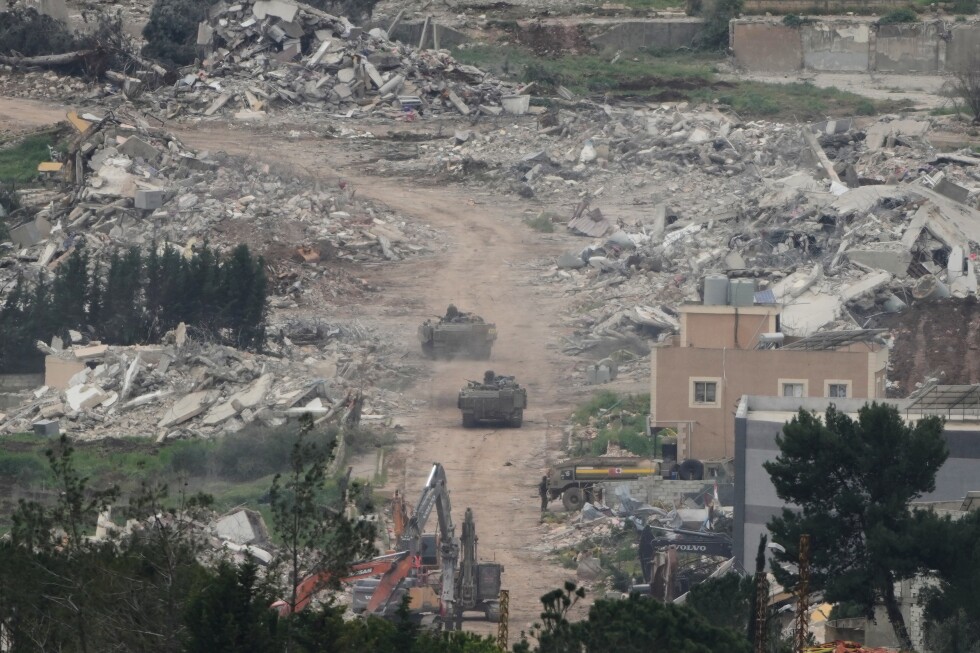
The tiny village of Beit Lif in southern Lebanon now lies in ruins, reduced to piles of concrete rubble on a once-populated hillside. Nearly every house in the village that was once home to thousands has been systematically demolished by Israeli military operations.
“They were demolishing it gradually until they reached the main square and now, as you can see, there are no more houses,” said Hassan Sweidan, a resident of a neighboring village who observed the destruction from a nearby hill, approximately 4 kilometers (2.5 miles) north of Lebanon’s border with Israel.
Since agreeing to a ceasefire with Hezbollah last week, the Israeli military has been systematically leveling neighborhoods in towns and villages near the Lebanese-Israeli border. The military justifies these actions by stating they destroy buildings that served as outposts for the Iran-backed militant group Hezbollah.
However, in many cases like Beit Lif, the demolition appears nearly complete. The widespread destruction has Lebanese officials and residents increasingly concerned that large numbers of people displaced by the recent conflict will have nowhere to return if the fragile truce holds.
Due to security concerns and limited access, neither United Nations peacekeepers nor Lebanese officials have been able to conduct comprehensive assessments of the affected villages. Nevertheless, observers report entire residential neighborhoods in multiple villages being systematically destroyed.
The demolitions in southern Lebanon mirror similar destruction in the Gaza Strip, where Israeli bulldozers and controlled explosions have nearly completely razed the city of Rafah and other towns under Israeli control. In Gaza, Israel maintains it is removing structures used by Hamas.
Ceasefire Talks and Continued Tensions
Lebanese officials plan to address the issue of widespread demolitions on Thursday during ceasefire talks with their Israeli counterparts in Washington—part of the first direct negotiations between the two countries in decades.
The current 10-day ceasefire, which began last Friday, has temporarily halted major combat operations but remains fragile. Both sides have carried out strikes since the truce began, with Hezbollah justifying its attacks in part by pointing to Israel’s continued destruction of houses.
The latest round of conflict began on March 2, two days after the U.S. and Israel launched a war with Iran, when Hezbollah fired missiles into northern Israel. The group had previously refused Lebanese government pressure to disarm following an earlier war with Israel in 2024.
Israel responded with an intense bombing campaign and ground invasion that forced hundreds of thousands of people to flee southern Lebanon. The fighting has killed approximately 2,300 people in Lebanon, including hundreds of women and children.
Israeli “Forward Defense Line”
Israeli officials have stated their intention to occupy parts of southern Lebanon and have issued maps of a “forward defense line” extending several miles into Lebanese territory. This zone encompasses dozens of villages whose residents have not been permitted to return.
Following the ceasefire announcement, Israeli Defense Minister Israel Katz declared this area had been “cleared of terrorists and weapons and is empty of citizens, and will continue to be cleared of terrorists’ infrastructure, including the destruction of houses in Lebanese villages that border Israel and have become terrorists outposts in every sense.”
Eyewitness Accounts of Systematic Destruction
After the ceasefire took effect, Sweidan returned to check on his home in the southern Lebanese village of Yater, which remains intact. From there, he could observe Israeli operations in neighboring Beit Lif.
“We would come each day to see how much of the village was demolished,” he said, noting that despite damage from airstrikes during the war, most of Beit Lif was still standing when the ceasefire began. But on the second day of the truce, Israeli forces arrived with bulldozers, jackhammers, and tanks.
Tilak Pokharel, spokesperson for the United Nations peacekeeping force in southern Lebanon (UNIFIL), confirmed that peacekeepers “have observed demolitions taking place in several areas” since the truce began.
The Israeli military maintains that Hezbollah, not Lebanese civilians, is the target of these operations. In a statement, they said they “operate in accordance with international law and do not destroy civilian property unless required by imperative military necessity.”
The current demolitions compound damage from the previous Israel-Hezbollah war in 2024, from which many border areas had not yet recovered. While some homeowners could afford repairs after that conflict, there had been no large-scale reconstruction effort.
As Lebanese and Israeli officials meet for negotiations aimed at extending the truce and establishing a framework for lasting peace, the fate of these devastated communities remains a critical point of contention.
Fact Checker
Verify the accuracy of this article using The Disinformation Commission analysis and real-time sources.

10 Comments
While security concerns are understandable, the systematic destruction of homes and displacement of families is an unacceptable violation of human rights. All sides must work toward a peaceful resolution that protects innocent lives.
Absolutely. The ceasefire should have ushered in a period of de-escalation and rebuilding, not further demolition. The international community must intervene to stop these abuses.
Destroying homes and displacing families during a ceasefire is an alarming escalation that risks further inflaming tensions. All parties must show restraint, respect human rights, and prioritize the well-being of the local population.
This is a tragic situation. Demolishing homes during a ceasefire seems like an excessive and disproportionate response, even if some were used by Hezbollah. The Lebanese people caught in the crossfire deserve better protection and support from all sides.
I agree, the civilian population is bearing the brunt of this conflict. Israel should exercise greater restraint and focus on security measures that minimize harm to innocent residents.
While security is a valid concern, the systematic leveling of homes during a ceasefire seems like a disproportionate and counterproductive response. All sides must work to uphold human rights and find a peaceful resolution to this conflict.
This is a complex and sensitive conflict, but the reported scale of home demolitions during a ceasefire is very concerning. I hope the relevant authorities take immediate steps to investigate, protect civilians, and find a diplomatic solution.
The reported demolition of entire villages near the border raises serious questions about Israel’s compliance with international law and its commitment to the ceasefire. Urgent action is needed to prevent further suffering of Lebanese civilians.
Leveling entire villages during a ceasefire is a concerning and heavy-handed tactic. I hope the international community closely monitors the situation and pressures all parties to respect human rights and avoid further escalation.
Agreed, this kind of collective punishment against civilians is deeply troubling. A balanced, diplomatic approach is needed to find a just and lasting solution.