


Listen to the article
Latin American Political Landscape Shifts as Countries Divide Over Maduro’s Capture
A significant political realignment across Latin America has emerged in the wake of Venezuelan leader Nicolás Maduro’s capture by U.S. forces, with regional powers taking sharply divided positions on the American operation.
The divisions became apparent over the weekend at a summit of the Community of Latin American and Caribbean States (CELAC), where several leftist governments attempted to push through a joint statement condemning Maduro’s detention. The effort failed after a bloc of nine countries—Argentina, Bolivia, Paraguay, Peru, Ecuador, El Salvador, Panama, the Dominican Republic, and Trinidad and Tobago—blocked consensus, preventing the traditionally left-leaning forum from issuing a unified defense of the Venezuelan leader.
This breakdown carried over into Monday’s United Nations Security Council meeting, where Latin American nations presented dramatically opposing viewpoints on the U.S. action.
Argentina emerged as one of the strongest regional supporters of the operation, with representative Francisco Fabián Tropepi praising President Donald Trump’s “decision and determination” and framing Maduro’s capture as a decisive blow against organized crime. The Argentine delegation described Maduro as “leader of the Cartel of the Suns,” arguing his regime posed threats to both Venezuelan citizens and the entire region through drug trafficking networks.
Paraguay echoed this sentiment, stating Maduro’s continued presence “was a threat to the region” and suggesting his removal could lead to the restoration of democracy and rule of law in Venezuela.
However, other regional powers took opposite positions. Brazil “categorically and firmly” rejected what it called armed intervention on Venezuelan territory, describing the capture as “a very serious affront to the sovereignty of Venezuela and an extremely dangerous precedent for the entire international community.”
Mexico similarly denounced the operation as a violation of the UN Charter, arguing that external efforts to impose political change historically worsen conflicts. Chile, Cuba, and Nicaragua also condemned the U.S. action, with the latter two delivering particularly sharp criticisms of what they called American imperialism.
Melissa Ford Maldonado, director of the Western Hemisphere Initiative at the America First Policy Institute, described the split as evidence of a “regional awakening” across Latin America.
“The failure of socialism, communism and narco-authoritarian rule has become impossible to ignore,” Maldonado told Fox News Digital. “We are witnessing a growing alignment around core principles of freedom, liberty, personal responsibility, national sovereignty and prosperity.”
This ideological shift is increasingly visible at the ballot box. In recent months, voters in several countries—including Chile and Honduras—have moved away from entrenched left-wing governments toward right-of-center leaders campaigning on themes of security, sovereignty, border control, and law and order.
“The fact that several governments blocked a collective defense of Nicolás Maduro shows how divided the authoritarian left has become,” Maldonado noted. “Venezuela has become a cautionary tale.”
The operation against Maduro marks a significant departure from decades of U.S. restraint in the region. While critics at the UN warned that such unilateral action undermines international law, supporters argue the status quo had already collapsed under Venezuela’s humanitarian and security crisis.
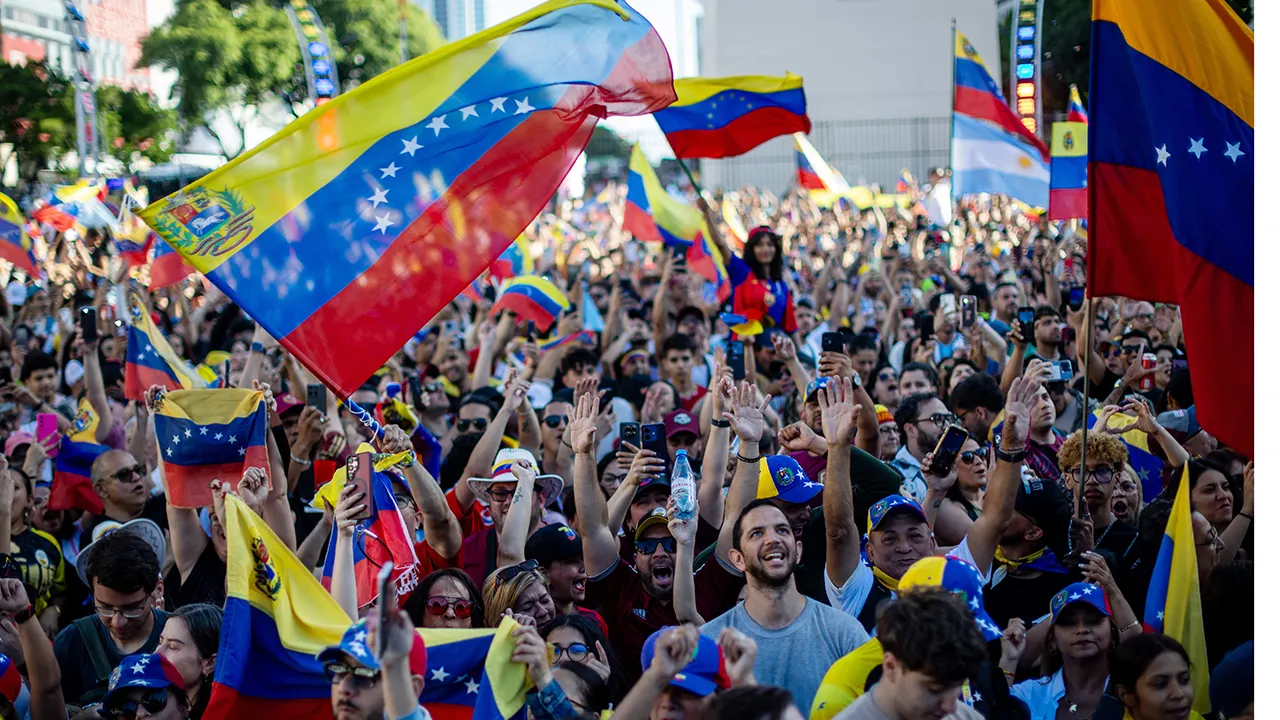
Venezuelans living in Argentina were seen celebrating Maduro’s capture in the streets of Buenos Aires, highlighting the complex regional reactions to the operation. More than seven million Venezuelans have fled their homeland in recent years, creating the largest refugee crisis in the Western Hemisphere.
The evolving situation reflects deeper questions about sovereignty, security, and governance in the region. As Maldonado observed, “Governments are increasingly forced to choose between defending failed autocracies, corruption and repression or responding to their own citizens. More governments are unwilling to carry that burden.”
Whether this political realignment represents a durable shift or temporary response to extraordinary circumstances remains to be seen, but it suggests the traditional ideological blocs of Latin American politics may be eroding in favor of more pragmatic and security-focused approaches.
Fact Checker
Verify the accuracy of this article using The Disinformation Commission analysis and real-time sources.

14 Comments
The breakdown in regional consensus at CELAC and the UN Security Council meeting highlights the complex web of alliances and rivalries in Latin America. This could make it difficult for mining and energy firms to operate effectively in the region.
Investors in mining and commodities will be closely watching how this situation unfolds, as the political shifts could open up new opportunities but also introduce significant risks.
This is a significant geopolitical shift that could impact the investment climate for mining and commodities companies in the region. Firms will need to carefully navigate the changing political landscape.
The divisions among Latin American countries over Maduro’s detention suggest the region’s political future remains highly uncertain and volatile, which could create challenges for companies in the extractive industries.
The failure of CELAC to issue a unified statement condemning Maduro’s detention shows the deep rifts in the region. This could have significant implications for regional cooperation and integration going forward.
Argentina’s vocal support for the U.S. operation is notable, given its traditionally more leftist leanings. It will be worth watching if this signals a broader shift in the country’s foreign policy orientation.
The political realignment in Latin America is an important development that will likely impact commodity markets and the investment climate for mining and energy firms in the region. Careful analysis will be required to navigate this shifting landscape.
As the region becomes more politically divided, mining and commodities companies may need to re-evaluate their strategies and diversify their exposure across Latin American countries to mitigate risks.
This is a complex geopolitical issue with Latin American countries taking very different positions. It will be interesting to see how the region’s political dynamics evolve in the wake of Maduro’s capture.
The divisions reflect the broader ideological shifts happening across Latin America as some countries move more to the right while others maintain leftist leanings.
This seems to be a significant turning point in Latin American politics, with major implications for the region’s economic and investment landscape, especially in sectors like mining and energy.
The lack of a unified regional response to Maduro’s capture suggests that mining and commodities companies will need to adopt a more nuanced, country-specific approach when operating in Latin America going forward.
The political realignment in Latin America is an important development that will likely have ramifications for commodity markets, particularly in the mining and energy sectors. Investors will be closely monitoring the situation.
Capturing Maduro was a bold move by the U.S. administration. The fallout across the region could create both opportunities and challenges for mining and energy companies operating in Latin America.