


Listen to the article
Kurdish Forces Poised to Strike Against Iran as U.S. and Israeli Pressure Intensifies
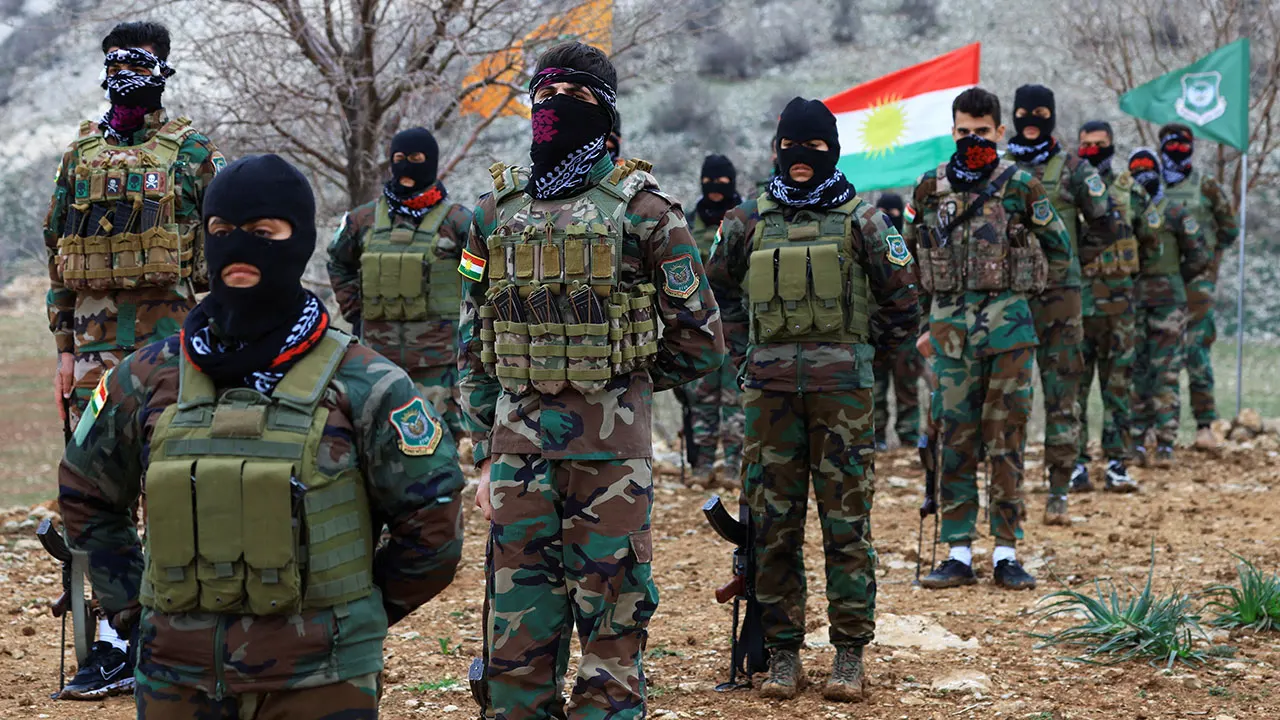
Kurdish opposition groups along Iran’s western frontier are closely monitoring escalating tensions, looking for an opportunity to strike back against the Islamic Republic they’ve battled for decades. This development comes as U.S. and Israeli military pressure on Iran intensifies and President Donald Trump signals support for Kurdish forces.
“Kurds have been waiting for a moment to do something,” said Kako Aliyar, a member of the leadership committee of the Kurdish opposition party Komala. “We believe that those moments are not far from us.”
Despite their readiness, Aliyar explained that Kurdish forces cannot yet move against the regime because Iran still retains significant military capabilities. “Our camps, the Kurdish political parties, are still under attack by the Iranian regime,” he said, noting that Iran continues to target Kurdish opposition bases across the border in Iraq’s Kurdistan region.
The key obstacle remains Iran’s missile and drone capabilities. “I believe those missile and drone abilities have to be more weakened or totally removed because we are not able to defend ourselves against them,” Aliyar explained. “They can still launch missiles and they can still kill people.”
President Trump recently expressed support for Kurdish fighters potentially launching an offensive against Iran. “I think it’s wonderful that they want to do that — I’d be all for it,” Trump told Reuters in a telephone interview. When asked whether the United States would provide air cover for such an offensive, Trump declined to elaborate, saying, “I can’t tell you that.”
This potential Kurdish mobilization comes amid efforts to present a united front against Tehran. In February, several Kurdish factions formed the Coalition of Political Forces of Iranian Kurdistan, bringing together parties including Komala, the Democratic Party of Iranian Kurdistan (PDKI), PJAK, and the Kurdistan Freedom Party.
“Politically, it’s a huge message for the Kurdish people inside the country and the international community that Kurds are united,” Aliyar said. “We are working together, and we are trying to reach our goals together.”
The Kurdish resistance in Iran has deep historical roots. Armed clashes between Kurdish militants and Iranian forces date back to the years following the 1979 Islamic Revolution, when Kurdish factions sought autonomy and were violently suppressed by Tehran. Today, many Kurdish opposition groups operate from neighboring Iraqi Kurdistan, where they maintain political offices and limited military forces.
Kurds in Iran represent one of the country’s largest ethnic minorities and have historically maintained organized opposition movements with armed wings and political networks established decades ago. This gives them a level of organizational structure that many other Iranian opposition movements lack.
Jino Victoria Doabi, an international political analyst focused on Iran and Kurdistan, noted that Kurdish forces are unlikely to move without clear backing from Washington. “For that to happen, they need assurance from America, both politically but also security-wise,” Doabi said. “Kurds have learned that they cannot just do it for the good cause anymore, because that’s going to cause civilians a lot of pain and destruction and killings.”
According to Doabi, discussions about potential Kurdish involvement have likely been underway for some time. “I don’t think this has happened overnight. I think this has been discussed for a long time.”
Despite the growing attention on Kurdish groups, Aliyar emphasized that Iraqi Kurdish authorities are not directly involved in any potential campaign. “Iraqi Kurds are not part of it,” he said. “I am not Iraqi, so I cannot comment on that.”
Military analysts suggest that Kurdish insurgents alone would be unlikely to topple the Iranian regime. However, if internal unrest spreads and Kurdish forces coordinate with broader opposition movements, Iran’s western frontier could become a significant vulnerability for Tehran’s leadership.
For Aliyar and other Kurdish leaders, their objective remains unchanged after decades of opposition to the Islamic Republic. “We have had this desire for 47 years,” he said. “If we get an opportunity, we will use it.”
The potential for Kurdish action comes at a time of increased regional volatility, with U.S. and Israeli strikes targeting Iranian military capabilities and infrastructure. Should Iran’s missile and drone capabilities be sufficiently degraded, Kurdish opposition forces may find the opening they’ve been waiting for to advance their long-standing cause.
Fact Checker
Verify the accuracy of this article using The Disinformation Commission analysis and real-time sources.

6 Comments
This situation highlights the complex and often volatile relationships in the Middle East. While the Kurds may feel empowered by Trump’s support, they must weigh the risks and potential consequences of any attack against Iran. Restraint and diplomacy are needed to prevent further instability in the region.
Interesting geopolitical dynamics at play. It’s concerning to see the potential for escalation between Iran and the Kurdish forces, especially with the added US and Israeli pressure. I hope all sides can find a peaceful resolution that respects the rights and security of the Kurdish people.
The Kurdish forces’ readiness to strike against Iran is understandable given their history of conflict, but the potential for escalation is concerning. I hope all parties involved can work towards a diplomatic solution that addresses the legitimate concerns and rights of the Kurdish people.
The Kurdish groups seem ready to strike back against Iran, but are rightly cautious given Iran’s missile and drone capabilities. This is a delicate situation that requires careful diplomacy to prevent further conflict and protect civilian lives.
You raise a good point. The military capabilities of Iran pose a significant challenge for the Kurdish forces. De-escalation and diplomatic solutions should be the priority to avoid a potentially devastating confrontation.
The strategic positioning of the Kurdish forces along Iran’s western border gives them a potential advantage, but they must be prudent in their actions to avoid provoking a strong response from Iran. Maintaining open communication and finding common ground will be crucial.