


Listen to the article
Kurdish Fighters Evacuated From Contested Aleppo Neighborhood as Violence Subsides
Kurdish fighters have been evacuated from the contested Sheikh Maqsoud neighborhood in Aleppo, Syria, potentially ending days of intense clashes with government forces, officials announced early Sunday. According to Syria’s state-run news agency SANA, buses transported the last fighters to northeastern Syria, an area controlled by the Kurdish-led Syrian Democratic Forces (SDF).
“Through international mediation to halt the attacks and violations against our people in Aleppo, we have reached an understanding leading to a ceasefire and the safe evacuation of martyrs, the wounded, trapped civilians, and fighters,” SDF commander Mazloum Abdi stated on social media. He urged mediators to “uphold their promises to stop the violations and work towards the safe return of the displaced to their homes.”
An Associated Press journalist at the location witnessed buses departing on Sunday with approximately 360 fighters, according to officials. Additional buses carrying civilians and detained fighters had departed a day earlier.
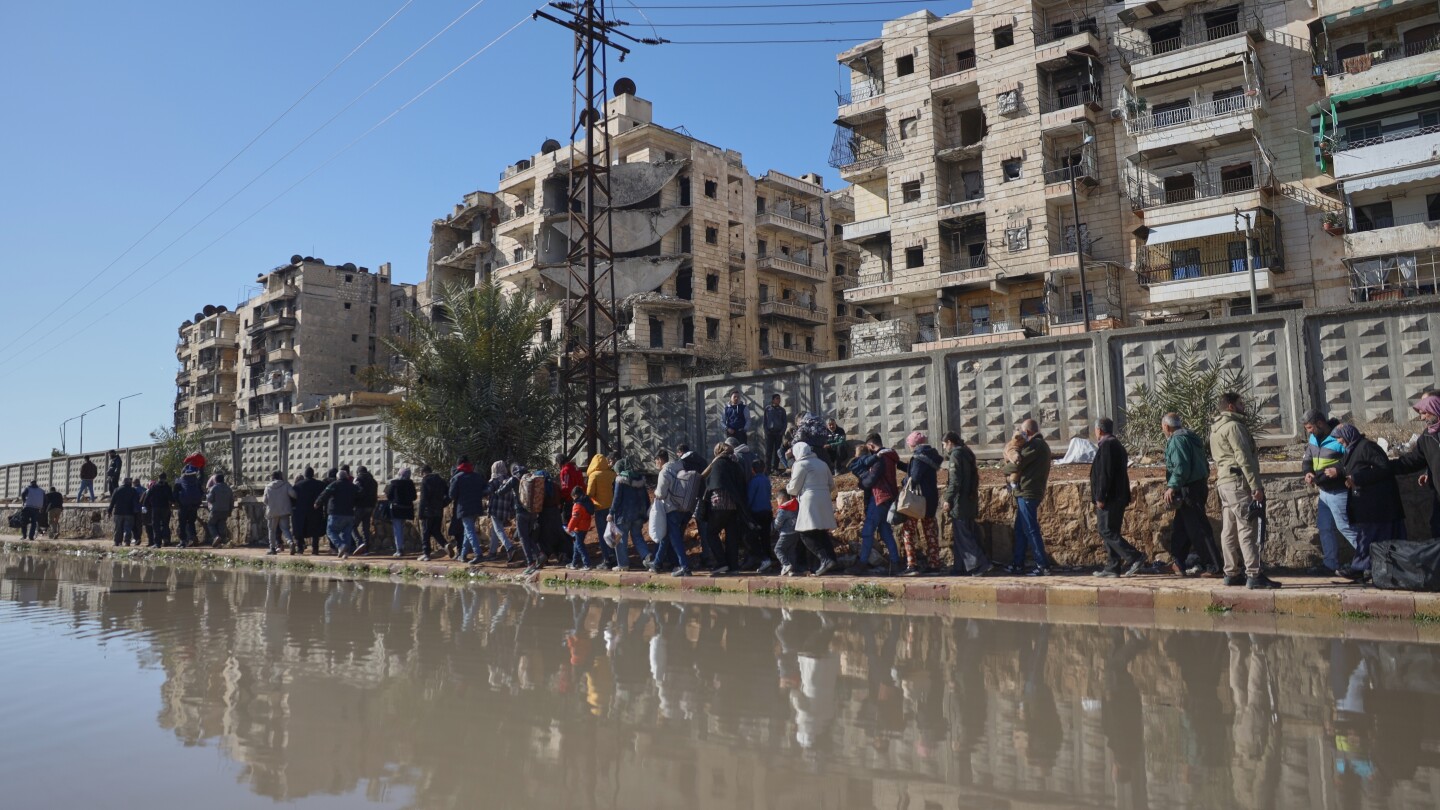
Syrian security forces deployed throughout Sheikh Maqsoud on Saturday following nearly a week of clashes that resulted in at least 22 deaths and displaced more than 140,000 people. The violence represents the most significant confrontation between government forces and Kurdish fighters since President Bashar Assad’s fall in December 2024.
During the height of tensions on Saturday, several drone strikes targeted areas in Aleppo, Syria’s largest city, prompting authorities to suspend civilian flights at Aleppo International Airport. In a particularly brazen attack, an explosive drone struck the Aleppo Governorate building shortly after two Cabinet ministers and a local official held a press conference about the situation. Syrian state television blamed Kurdish fighters for the attack, a charge the SDF promptly denied.
The confrontation began Tuesday in the predominantly Kurdish northern neighborhoods of Sheikh Maqsoud, Achrafieh, and Bani Zaid after the government and SDF failed to make progress on integrating their forces into the national army. Security forces subsequently captured Achrafieh and Bani Zaid, leaving Sheikh Maqsoud as the final contested area.
U.S. Special Envoy to Syria Tom Barrack held high-level meetings in Damascus on Saturday, including talks with President Ahmad al-Sharaa, calling for all parties to cease hostilities. “Violence risks undermining the progress achieved since the fall of the Assad regime and invites external interference that serves no party’s interests,” Barrack stated. He emphasized that the fighting threatens to undermine the agreement reached in March between the government and Kurdish leadership.
The humanitarian toll has been significant. Kurdish forces reported at least 12 civilians killed in Kurdish-majority neighborhoods during the five days of fighting, while government officials counted at least 10 civilian deaths in surrounding government-controlled areas. Both sides have accused each other of initiating the violence and deliberately targeting civilian infrastructure, including hospitals and ambulance crews.
Syria’s Information Minister Hamza al-Mustafa alleged that Kurdish fighters used civilian buildings, including medical facilities, as fighting positions. Meanwhile, the Kurdish-led Democratic Autonomous Administration of North and East Syria accused government forces of targeting Khaled Fajr Hospital in Sheikh Maqsoud, endangering patients and medical personnel.
The Syrian military had declared Sheikh Maqsoud a “closed military zone” since Friday night as it launched what it termed a “clearing operation.” Throughout Saturday, government-deployed surveillance drones flew over the neighborhood as sporadic gunfire continued.
On Friday, Barrack discussed the situation with Jordan’s Foreign Minister Ayman Safadi in Amman, noting that Jordan had offered support for efforts to consolidate the ceasefire and ensure the peaceful withdrawal of Kurdish fighters from Aleppo.
The evacuation agreement may provide temporary relief, but tensions remain high in a country still recovering from years of civil war and adjusting to post-Assad governance. The conflict highlights the ongoing challenges of integrating diverse military factions and establishing lasting stability in Syria’s complex political landscape.
Fact Checker
Verify the accuracy of this article using The Disinformation Commission analysis and real-time sources.

8 Comments
This news is a reminder of the complex and ever-changing dynamics of the Syrian conflict. While the evacuation may provide temporary relief, it is crucial that the international community remains engaged and continues to work towards a lasting political solution that addresses the root causes of the conflict.
While the evacuation may temporarily ease tensions, the underlying issues in the region remain unresolved. I’m curious to see how the various parties involved, including the Kurds, the Syrian government, and international mediators, will work to find a lasting political solution to the conflict.
While the evacuation may provide temporary relief, the broader implications of this development are concerning. The Kurdish forces have played a significant role in the fight against extremism in the region, and their displacement could have wider strategic implications.
The situation in Aleppo remains highly volatile, and I hope the ceasefire and evacuation efforts can pave the way for a more sustainable resolution to the conflict. Achieving lasting peace in Syria will require a comprehensive political solution that addresses the concerns of all stakeholders.
This is a concerning development in the ongoing conflict in Syria. The evacuation of Kurdish fighters from Aleppo highlights the complex and fragile situation on the ground. I hope the ceasefire and safe return of civilians can be achieved through effective mediation efforts.
This news highlights the ongoing challenges faced by civilians caught in the crossfire of the Syrian conflict. I’m glad to see efforts being made to ensure their safety, but more must be done to protect vulnerable populations and find a political solution.
The clashes in Aleppo have been particularly violent, and I’m glad to see a ceasefire agreement reached that will allow for the safe evacuation of those trapped. Maintaining stability in the region is crucial, and I hope the displaced civilians can return to their homes soon.
The situation in Syria continues to be highly complex and volatile. I hope the safe evacuation of Kurdish fighters from Aleppo can pave the way for further dialogue and negotiation between the parties involved.