


Listen to the article
Ancient Tunisian Jewish Pilgrimage Cautiously Rebounds After 2023 Attack
The annual Jewish pilgrimage to Tunisia’s El-Ghriba Synagogue has witnessed a modest but significant return of international visitors this year, as worshippers gathered under heightened security following last year’s deadly attack that shook the small but historic Jewish community.
Approximately 500 people attended the week-long celebration of the Lag B’Omer Jewish holiday from April 30 to May 6 on the Mediterranean island of Djerba, home to the 26-century-old synagogue. Visitors arrived from France, China, Ivory Coast and Italy, including France’s ambassador to Tunisia, whose presence carried special significance after two French citizens were among those killed in the 2023 attack.
“We are back, and we are proud to be Tunisian Jews,” said Redj Cahen, a Tunisian-Italian pilgrim who returned after missing last year’s gathering. “It is a feeling you cannot explain. Only those who come here understand.”
Inside the ancient stone walls of El-Ghriba, worshippers engaged in traditional practices amid an atmosphere both devotional and social. Pilgrims lit candles, read sacred texts, and participated in the custom of writing wishes on eggs that were then placed in a sacred cave within the complex – a ritual believed to bring blessings and good fortune.
The event marks a cautious recovery after a national guardsman shot and killed five people at the synagogue shortly after last year’s festival. The attack sent shockwaves through Tunisia’s Jewish population, which has maintained a continuous presence in the country since Roman times despite dwindling to just over 1,000 members in recent decades.
Security measures remained highly visible throughout this year’s pilgrimage. Police checkpoints and barricades controlled access to Djerba, with authorities conducting thorough vehicle searches and document inspections. Additional security forces concentrated in Hara Seghira and Hara Kebira, the island’s main Jewish quarters, though their presence appeared calibrated to reassure rather than intimidate.
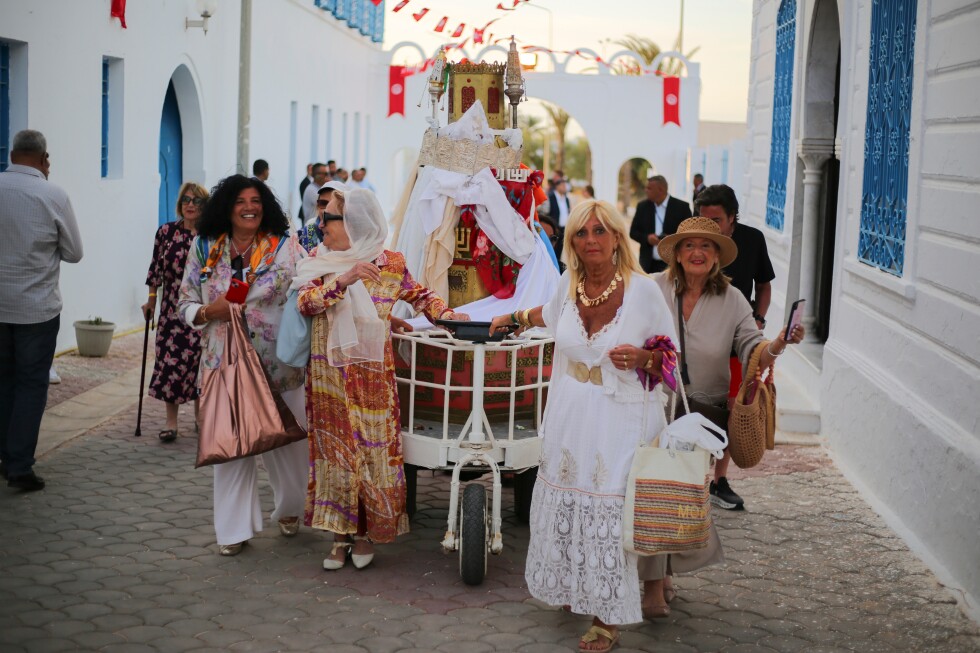
In a significant milestone, organizers revived the traditional “Minara” procession for the first time since the 2023 attack. This centerpiece ritual involves a pyramid-shaped tower of gold and silver that women adorn with colorful scarves – gestures associated with fertility, good fortune, and marriage. Following a symbolic auction of paintings and religious items to raise funds for synagogue maintenance, the scarf-laden Minara is paraded outside to the sounds of traditional darbuka drums and celebratory singing before returning to the synagogue.
“This year’s Ghriba pilgrimage marks a gradual return,” noted René Trabelsi, Tunisia’s former Tourism Minister. “We are returning little by little.”
The El-Ghriba pilgrimage holds deep historical significance as one of the oldest Jewish pilgrimages in Africa. At its peak, the event drew thousands of visitors from around the world, serving as both a religious occasion and a crucial economic driver for the island. However, attendance has fluctuated following security incidents, including a devastating 2002 al-Qaida truck bombing that killed approximately 20 people.
Beyond its religious importance, the pilgrimage has long symbolized Tunisia’s tradition of religious coexistence, attracting Muslim visitors alongside Jewish worshippers. This multicultural aspect remains a source of national pride for many Tunisians, even as the country navigates complex political and economic challenges.
Khedir Hnaia, who has worked at the synagogue for more than three decades, expressed hope that this year’s event would help restore the pilgrimage’s former prominence. “We would like to reflect a good image to the world, to bring back the glory of Ghriba and make it even better than how it used to be,” he said.
For Tunisia’s tourism sector, still recovering from the impacts of political instability and the COVID-19 pandemic, the pilgrimage represents an important opportunity to showcase the country’s cultural heritage and security improvements.
“We need to stand up for our country,” said Haim Haddad, a member of the pilgrimage organizing committee from the coastal town of Zarzis. “We love Tunisia very much and in the same way our country stood up for us, we will always stand up for it.”
Fact Checker
Verify the accuracy of this article using The Disinformation Commission analysis and real-time sources.

10 Comments
The description of the traditional practices, like lighting candles and reading sacred texts, paints a vivid picture of the devotional and communal atmosphere at the El-Ghriba Synagogue. It’s heartening to see these rituals continue.
Agreed, the preservation of these timeless customs is crucial for maintaining the cultural and spiritual identity of the Tunisian Jewish community. It’s a testament to their resilience.
The presence of the French ambassador carries symbolic weight after the 2023 attack. Showing solidarity with the Tunisian Jewish community is a powerful gesture. I hope this event continues to grow in a safe and meaningful way.
Agreed, diplomatic support can go a long way in healing and rebuilding trust. This pilgrimage serves as an important cultural bridge between Tunisia and the international community.
It’s heartening to see the diverse group of international visitors, including from France, China, Ivory Coast and Italy, coming together to celebrate the Lag B’Omer holiday at this sacred site. Cultural exchange and understanding are so important.
You’re right, this pilgrimage brings people together across borders and faiths. Fostering that sense of unity is vital, especially after such a devastating incident.
Glad to see the Jewish pilgrimage to the historic El-Ghriba Synagogue in Tunisia has cautiously resumed after last year’s tragic attack. Maintaining security while preserving this longstanding cultural tradition is crucial.
Absolutely, the resilience of this community is inspiring. Even in the face of adversity, they continue to honor their heritage and faith.
It’s wonderful to hear the sentiment from the Tunisian-Italian pilgrim, Redj Cahen, about the unique feeling of being part of this tradition. Preserving these ancient practices is crucial for maintaining cultural heritage.
Absolutely, his words capture the profound connection people feel to this sacred site. Celebrating one’s roots and faith is so meaningful, especially after periods of adversity.