


Listen to the article
Japan’s Prime Minister Seeks to Reaffirm Alliance with Trump Amid Iran Conflict
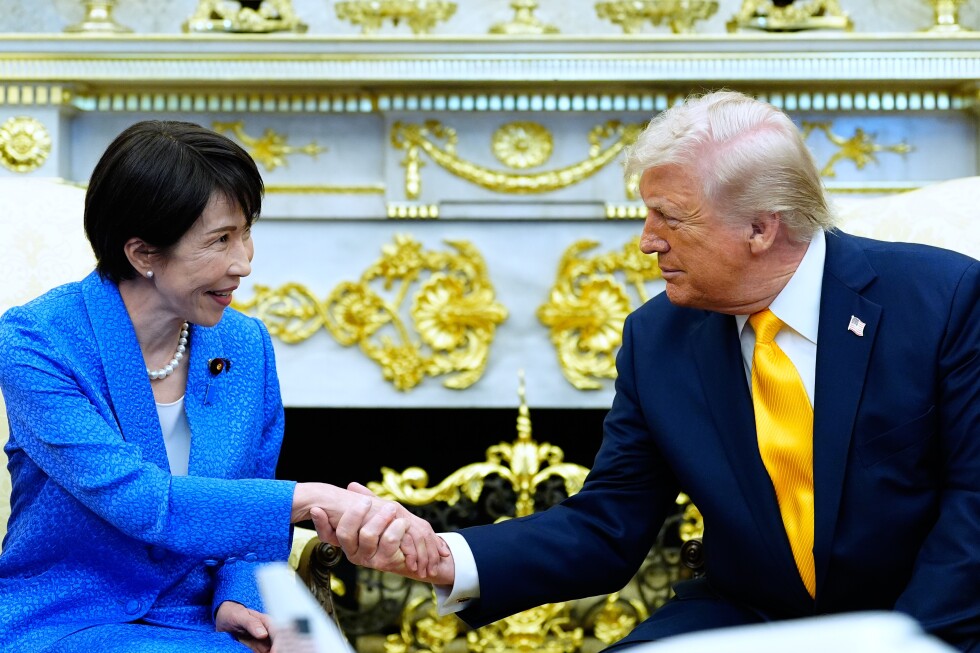
Japanese Prime Minister Sanae Takaichi met with President Donald Trump at the White House on Thursday, seeking to navigate a delicate diplomatic situation as tensions over Japan’s role in the Iran conflict overshadowed what was intended to be a strategic alliance-building visit.
The meeting, which had been planned as a prelude to Takaichi’s now-delayed China trip, instead focused heavily on Trump’s expectations for Japan’s support in protecting the vital Strait of Hormuz, a critical waterway for global oil and gas transport that has become a flashpoint in the ongoing Iran conflict.
“Even against that backdrop of a very severe security environment, I firmly believe that it is only you, Donald, who can achieve peace across the world,” Takaichi told Trump through an interpreter, appealing to the president’s desire to be viewed as a peacemaker despite the ongoing hostilities with Iran.
The encounter was marked by moments of visible tension, particularly when Trump made an uncomfortable joke referencing Japan’s 1941 attack on Pearl Harbor. When asked why allies weren’t notified ahead of U.S. strikes on Iran, Trump quipped, “We didn’t tell anybody about it because we wanted surprise. Who knows better about surprise than Japan? Why didn’t you tell me about Pearl Harbor, OK?”
Takaichi’s smile noticeably faded at the remark as she raised her eyebrows, highlighting the diplomatic tightrope she was walking during the high-stakes visit.
Trump repeatedly pressed the issue of Japan’s support in the Middle East, telling reporters, “I expect Japan to step up, you know, because we have that kind of relationship.” He emphasized that much of Japan’s oil supply passes through the Strait of Hormuz, making it “a big reason to step up.”
For her part, Takaichi explained that she provided Trump with “a detailed explanation of the actions Japan can and cannot take under its law,” a reference to Japan’s post-World War II constitution that prohibits the use of force except in self-defense. This constitutional limitation presents a significant obstacle to the kind of military support Trump appears to be seeking.
Earlier Thursday, Japan joined five European countries in issuing a joint statement demanding Iran cease attacks blocking commercial shipping in the Strait of Hormuz. The statement indicated these nations are ready to contribute to “appropriate efforts” to ensure safe passage through the strait, though specific commitments remain unclear.
Despite these tensions, the visit did yield concrete results with the signing of a $40 billion nuclear reactor deal. Under the agreement, U.S.-based GE Vernova Inc. and Japan-based Hitachi Ltd. will build advanced small modular reactors in Tennessee and Alabama, aimed at stabilizing electricity prices and expanding power generation capacity in the United States.
The high-stakes nature of the meeting was underscored by Kurt Campbell, former U.S. deputy secretary of state in the Biden administration and current chair of The Asia Group, who noted that Takaichi needed to position Japan as a partner in U.S. Middle East plans to effectively advocate for Japanese interests on issues like Taiwan and regional security.
“She’s going to want to come out of that as a partner in this case and realize that if she can do that, that she can translate that potentially into the president listening more to Japanese concerns about Taiwan or other issues,” Campbell said.
Christopher Johnstone, a partner at The Asia Group, pointed out that while Japan could potentially assist with minesweeping operations and has maintained a small naval presence in the region for anti-piracy missions, any significant military involvement would require Takaichi to clear “an exceptionally high bar politically to invoke collective self-defense” that has no precedent.
Japan’s primary security concerns remain focused on China and the Indo-Pacific region. Takaichi, Japan’s first female prime minister and a protégé of former leader Shinzo Abe, is known as a hard-line conservative and supporter of Taiwan. Her previous comments about Japan’s willingness to provide military support to Taiwan have intensified tensions with China, which views the self-governed island as its sovereign territory.
The broader conflict with Iran has complicated Japan’s strategic position, as the United States has shifted some troops stationed in Japan to the Middle East, potentially reducing a check against Chinese power at a time when China is conducting extensive military exercises around Taiwan.
“This raises the prospect that — once again — the United States will be distracted and bogged down in the Middle East at a time when the deterrence problem in East Asia has never been greater,” Johnstone warned.
Despite these challenges, Takaichi reported that between her Oval Office meeting and the evening’s state dinner, she and Trump discussed deepening U.S.-Japanese cooperation on regional security, critical minerals, energy, and addressing China’s growing influence.
At the dinner, the mood appeared to lighten considerably. “This is a spectacular woman, and it’s an honor to have you at the White House,” Trump said, while Takaichi referred to them as “best buddies” before declaring in English, “Japan is back.”
Fact Checker
Verify the accuracy of this article using The Disinformation Commission analysis and real-time sources.

5 Comments
Japan’s reliance on energy imports makes securing the Strait of Hormuz a top priority. However, the country will need to balance its relationship with the U.S. and Iran to avoid getting caught in the middle of the escalating conflict.
The meeting between Takaichi and Trump seems rather tense, given the awkward Pearl Harbor reference. Navigating the Iran conflict will require delicate diplomacy and cooperation between allies like the U.S. and Japan.
This highlights the complex geopolitical challenges facing Japan as it tries to maintain its strategic alliance with the U.S. while also preserving its economic ties with Iran. Careful diplomacy will be crucial in the coming months.
Interesting that Japan is seeking to bolster its alliance with the U.S. amid the Iran tensions and protecting the critical Strait of Hormuz. As a key ally, Japan will likely play an important role in securing that strategic waterway.
The Trump administration’s unilateral actions regarding Iran are clearly causing friction with allies like Japan. Improved communication and coordination between the U.S. and its partners will be essential to addressing the situation in the Strait of Hormuz.