


Listen to the article
Arctic Climate Change Reshapes Greenland’s Fishing Industry
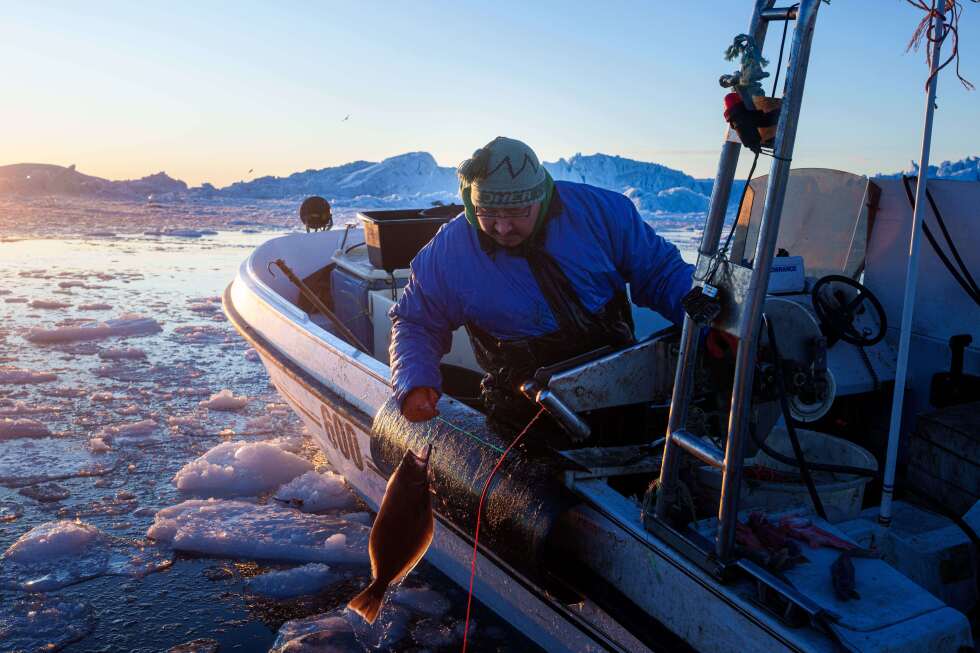
Fisherman Helgi Áargil navigates an increasingly unpredictable environment on Greenland’s fjords, where he spends up to five days at a time with only his dog, Molly, and the northern lights for company. Last year, his boat became trapped in ice that broke off from a nearby glacier. This year, conditions have been unusually wet instead.
The unpredictability extends to his livelihood as well. A single fishing trip could earn him around 100,000 Danish kroner (about $15,700) or nothing at all, depending on what the changing waters yield.
Greenland, a semiautonomous territory of Denmark, faces mounting questions about its future as the Arctic warms faster than any other region on Earth. The rapid climate change, driven by the burning of fossil fuels, is transforming the environment that supports the territory’s primary economic engine – fishing.
The industry accounts for up to 95% of Greenland’s exports, with major markets including China, the United States, Japan and Europe. While the region has drawn international attention, including former U.S. President Donald Trump’s interest in acquiring the territory, the more pressing issue for locals remains how climate change is reshaping their traditional way of life.
“My father was fishing from the sea ice” one and a half meters (almost 5 feet) thick, recalled Karl Sandgreen, head of the Icefjord Center that documents climate change in the region. That sea ice began disappearing around 1997, forcing traditional ice fishermen to transition to boats.
This shift represents a fundamental change in how half the local fishing industry operates. While boats allow fishermen to reach larger areas, they come with added costs and contribute to pollution that further accelerates warming.
Traditional ice fishermen are witnessing the most dramatic changes. As warming temperatures cause sea ice to retreat, these fishermen find themselves in a precarious position – sometimes facing “too much ice to sail, too little to go out on,” according to Toke Binzer, CEO of Royal Greenland, the island’s largest employer.
The company already provides financial assistance to fishermen for boat purchases, which they repay through their catches. But this transition to boat-based fishing brings its own challenges.
Boris Worm, a marine biodiversity expert at Dalhousie University in Canada, warns that if everyone transitions to fishing from boats, it could help economically but lead to overfishing. In Greenland, signs of excessive fishing near the shore are already evident as halibut are becoming smaller – a classic indication that larger fish are being caught, leaving only smaller, younger ones.
This problem could intensify as retreating ice makes fish more accessible. Paradoxically, fish stocks might initially increase as warmer conditions bring more nutrients from rain and melting ice to feed plankton, which fish consume. However, Worm cautions that fish behavior may become less predictable, potentially disrupting established fishing patterns.
On his boat near Nuuk, Áargil has noticed another challenge: “It’s too warm,” he observed, scanning the hills surrounding the fjord. “I don’t know where the fish is going, but there’s not so much.” Some species are diving deeper in search of colder waters, making them harder to catch.
Greenland has few economic alternatives beyond fishing. While tourism is growing, it remains far from making up a significant portion of the economy. Cultural traditions are also at risk – dog sledders, for instance, have already been confined to land in areas where sea ice has disappeared.
“It’s really important for many Greenlanders to have the ability to go out and sail,” said Ken Jakobsen, manager at Royal Greenland’s factory in Nuuk, describing fishing as the “most important” activity. In the capital alone, more than 1,000 boats fill the harbor during summer – a striking number in a territory with a total population of just over 50,000.
As climate change accelerates, Greenland’s fishermen find themselves at the frontline of global warming impacts, adapting their centuries-old traditions to survive in a rapidly changing Arctic environment. Their experience offers a preview of the challenges coastal communities worldwide may face as climate change transforms marine ecosystems and the communities that depend on them.
Fact Checker
Verify the accuracy of this article using The Disinformation Commission analysis and real-time sources.

35 Comments
The cost guidance is better than expected. If they deliver, the stock could rerate.
Good point. Watching costs and grades closely.
Good point. Watching costs and grades closely.
Nice to see insider buying—usually a good signal in this space.
Good point. Watching costs and grades closely.
Good point. Watching costs and grades closely.
The cost guidance is better than expected. If they deliver, the stock could rerate.
Good point. Watching costs and grades closely.
Good point. Watching costs and grades closely.
Exploration results look promising, but permitting will be the key risk.
Good point. Watching costs and grades closely.
Good point. Watching costs and grades closely.
Exploration results look promising, but permitting will be the key risk.
Good point. Watching costs and grades closely.
Good point. Watching costs and grades closely.
Nice to see insider buying—usually a good signal in this space.
Nice to see insider buying—usually a good signal in this space.
Good point. Watching costs and grades closely.
Exploration results look promising, but permitting will be the key risk.
Production mix shifting toward World might help margins if metals stay firm.
Good point. Watching costs and grades closely.
Good point. Watching costs and grades closely.
Silver leverage is strong here; beta cuts both ways though.
Nice to see insider buying—usually a good signal in this space.
Good point. Watching costs and grades closely.
Good point. Watching costs and grades closely.
Interesting update on ‘It’s too warm’: Greenland’s fishermen are under threat from climate change. Curious how the grades will trend next quarter.
Good point. Watching costs and grades closely.
Good point. Watching costs and grades closely.
The cost guidance is better than expected. If they deliver, the stock could rerate.
Good point. Watching costs and grades closely.
Good point. Watching costs and grades closely.
The cost guidance is better than expected. If they deliver, the stock could rerate.
Good point. Watching costs and grades closely.
Good point. Watching costs and grades closely.