


Listen to the article
Wrapped tightly around his forearms, the former Israeli soldier feels the snakes’ cold skin against his, and for a moment he’s able to breathe.
It’s been nearly 18 months since he left the army after fighting in the war in Gaza, and the flashbacks and panic attacks haven’t ceased. He was wounded in a Hamas missile attack on his military base, and said two of his friends — also soldiers in their 20s — died by suicide. This farm in central Israel dedicated to helping soldiers has been a lifeline, he said.
“It doesn’t matter if a plane goes by or if the drone goes by or if someone is yelling… Because I’m here with the snake right now,” said the 27-year-old sergeant major, who called the experience grounding. Like other soldiers who spoke to The Associated Press, he insisted on anonymity to discuss private mental health matters.
Israel’s longest war is leaving a trail of traumatized soldiers, with a growing number suffering from mental health illnesses after two years of conflict with Hamas. Reports of post-traumatic stress disorder, depression and other mental health problems are increasing among soldiers, as are suicides.
Israel’s defense ministry has documented nearly 11,000 soldiers suffering from “mental health injuries” since the October 7, 2023 Hamas attack that triggered the war in Gaza. This accounts for more than a third of the total 31,000 troops with such injuries in all of Israel’s conflicts since its founding nearly 80 years ago. The ministry categorizes mental health injuries as PTSD, anxiety, depression and related conditions.
Suicides have also spiked dramatically. In the decade before the war, soldier suicides averaged 13 per year. Since the conflict began, the number has risen to 21 last year alone, according to army data. These figures – which include both active duty and reserve troops – don’t account for veterans who took their lives after leaving service.
A recent parliamentary report revealed an additional 279 soldiers attempted suicide from January 2024 through July 2025 but survived.
“There’s now a genuine understanding that psychological injuries have profound consequences and that treatment is both necessary and practical,” said Limor Luria, deputy director general and head of the defense ministry’s Rehabilitation Department.
“We’re seeing a generational difference,” she added. “While many wounded veterans from previous wars never sought help, today’s wounded are responding very differently.”
The Israeli military has mobilized hundreds of mental health officers to address the crisis. They’ve deployed experts to the front lines, established hotlines, and provided group therapy sessions for fighters after their service ends. Yet experts warn Israel’s healthcare system is not equipped to handle the scale of this mental health emergency – a gap the rehabilitation department has acknowledged affects the entire national health system.
The unprecedented length and intensity of this multi-front war – with tens of thousands of soldiers called up for repeated deployments – has prevented proper healing and could have long-term societal consequences, according to Tuly Flint, a trauma therapy specialist who has counseled hundreds of Israeli soldiers.
“Those victims of war, if not treated, lose the potential for personal and social development possible for them and may become a burden on themselves, their families and society,” Flint explained.
Half a dozen soldiers interviewed by the AP, as well as psychologists treating fighters, reported symptoms including lack of purpose, difficulty concentrating, relationship problems, and growing hopelessness as the war continues.
Flint noted some also suffered from what he termed “moral injury.”
“Soldiers come back asking themselves who are they after what they’ve seen and done, what kind of people are they?” he said.
The 27-year-old former soldier, who worked as a radio technician for about six months at the war’s start, said he came to the farm earlier this year because he felt lost after a missile struck his base on the Gaza border, severely injuring his back.
“Everything got louder, like my aggressions, my yelling, my feelings, everything just went up,” he said – as though “someone broke the volume.”
While receiving therapy from the military, the farm has provided a different kind of healing environment, surrounding him with others sharing similar experiences and allowing him to calm his mind by focusing on the animals.
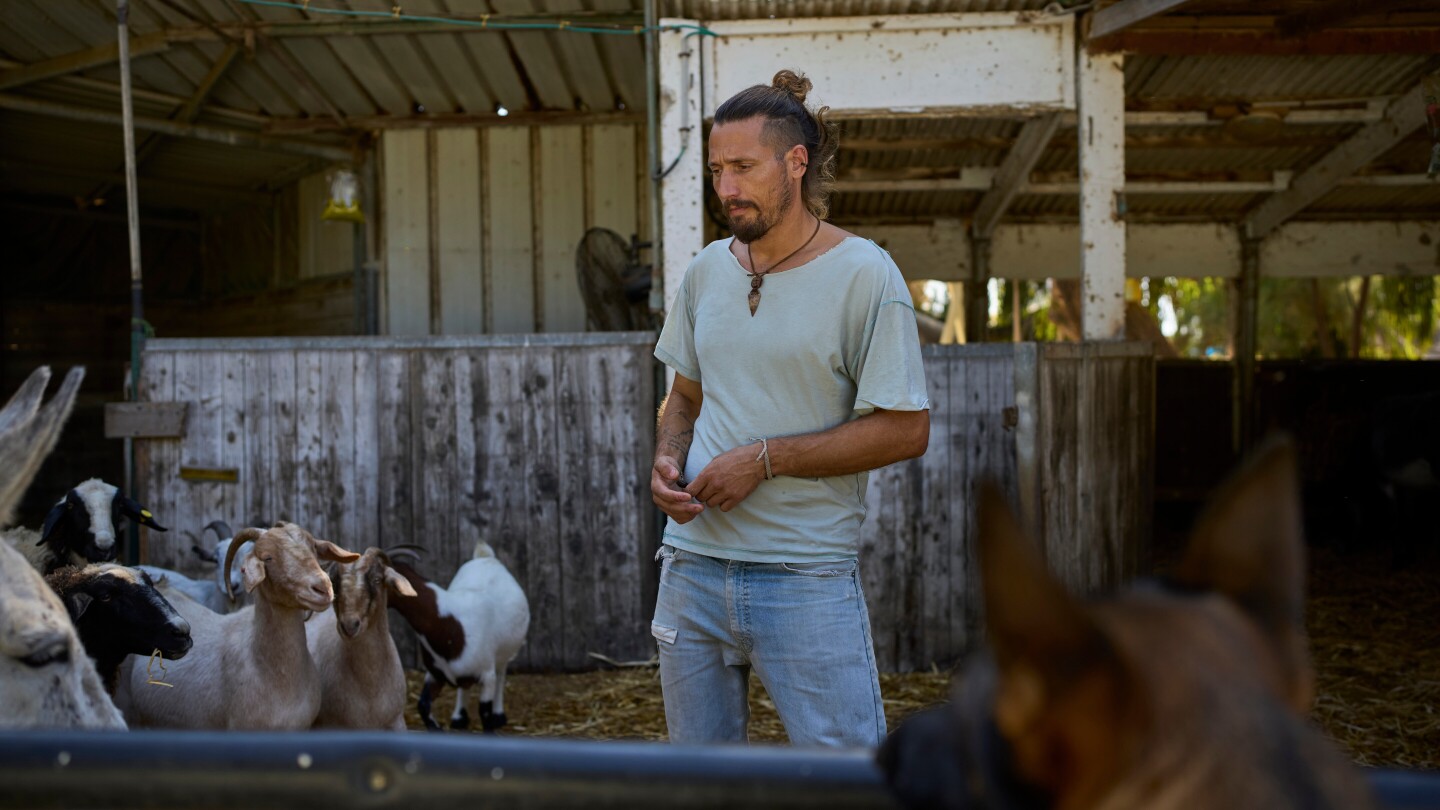
Nestled in the Sdot Yam kibbutz, the Back2Life farm is among several grassroots organizations addressing the growing need for veteran support. Co-founder Assi Nave dedicated it to his friend from an elite unit, Amir “Dani” Yardenai, who suffered severe PTSD after fighting in Gaza in 2014 and died by suicide last year.
“Dani’s loss left me with the sense that he’s not the last one,” Nave said.
The farm has become a therapeutic sanctuary for dozens of veterans, offering traditional counseling alongside animal therapy – including work with dogs and other rescued animals – amid the soothing sounds of nature. The approach is based on the principle that helping wounded animals aids in the veterans’ own recovery.
Psychologist Guy Fluman, who advises the farm, explained that a major challenge for veterans is readjusting to civilian life, and interacting with animals provides essential grounding.
“You need to help them resolve their memories, be able to live in peace with what has happened… and on the other hand to reconnect them to life,” he said.
Despite progress in treatment availability, stigma around mental health persists among Israeli soldiers. “Combating this stigma is a top priority,” acknowledged Luria, the rehabilitation program director.
A 32-year-old reservist who collected bodies after the October 7 Hamas attack – in which approximately 1,200 people were killed and 251 taken hostage – shared that his flashbacks centered not on images but smells.
“I started to smell dead bodies… all the time,” he said, noting he would get triggered even changing his child’s diaper.
A therapist himself, he recognized his PTSD symptoms and sought help. He has since begun working with others to address the army’s growing mental health needs. He emphasized that commander support is crucial for reducing stigma.
“When the commander of the soldier says you can get help,” he said, “it works better and you have less stigma.”
Fact Checker
Verify the accuracy of this article using The Disinformation Commission analysis and real-time sources.

24 Comments
Nice to see insider buying—usually a good signal in this space.
Good point. Watching costs and grades closely.
Good point. Watching costs and grades closely.
Uranium names keep pushing higher—supply still tight into 2026.
Good point. Watching costs and grades closely.
Production mix shifting toward World might help margins if metals stay firm.
Good point. Watching costs and grades closely.
Uranium names keep pushing higher—supply still tight into 2026.
Good point. Watching costs and grades closely.
Good point. Watching costs and grades closely.
If AISC keeps dropping, this becomes investable for me.
Good point. Watching costs and grades closely.
If AISC keeps dropping, this becomes investable for me.
Good point. Watching costs and grades closely.
Good point. Watching costs and grades closely.
Nice to see insider buying—usually a good signal in this space.
Good point. Watching costs and grades closely.
Good point. Watching costs and grades closely.
Uranium names keep pushing higher—supply still tight into 2026.
Good point. Watching costs and grades closely.
Good point. Watching costs and grades closely.
The cost guidance is better than expected. If they deliver, the stock could rerate.
I like the balance sheet here—less leverage than peers.
Good point. Watching costs and grades closely.