


Listen to the article
Iran’s Mass Drone Campaign Creates Asymmetric Warfare Challenge Across Middle East
Iran has unleashed an unprecedented drone offensive across the Middle East, deploying thousands of low-cost attack drones against Western-aligned targets in what experts describe as a deliberate strategy to impose “exponential cost” on the United States and its allies.
The wave of drone strikes comes amid escalating regional tensions following Saturday’s joint U.S.-Israeli strikes on Iran, which targeted nuclear sites, missile facilities, and leadership, resulting in the death of Supreme Leader Ayatollah Ali Khamenei and several military commanders.
“Even a hundred of these drones in the hands of a decentralized unit can cause terror in a neighboring state like never before imagined,” Cameron Chell, CEO of drone manufacturer Draganfly, told Fox News Digital. “The Iranians cannot win the war with these drones, but like the Viet Cong, they have an asymmetric capability that can prolong this war and create political pressure.”
The Iranian drones have already proven lethal, killing six U.S. service members in an attack on a tactical center in Kuwait earlier this week. A CIA station in the U.S. Embassy in Riyadh, Saudi Arabia, was struck Tuesday, causing a fire but no reported injuries. In Bahrain, Iranian Shahed-model drones damaged the Era View Tower in Manama, approximately one mile from a U.S. Navy base.
Additional attacks targeted the U.S. Consulate in Dubai, where a drone struck a parking lot, while the United Arab Emirates reported intercepting multiple Iranian missiles and drones. Based on footage analysis, Chell identified the Dubai consulate attack as likely carried out by a “Shahed 191” drone.
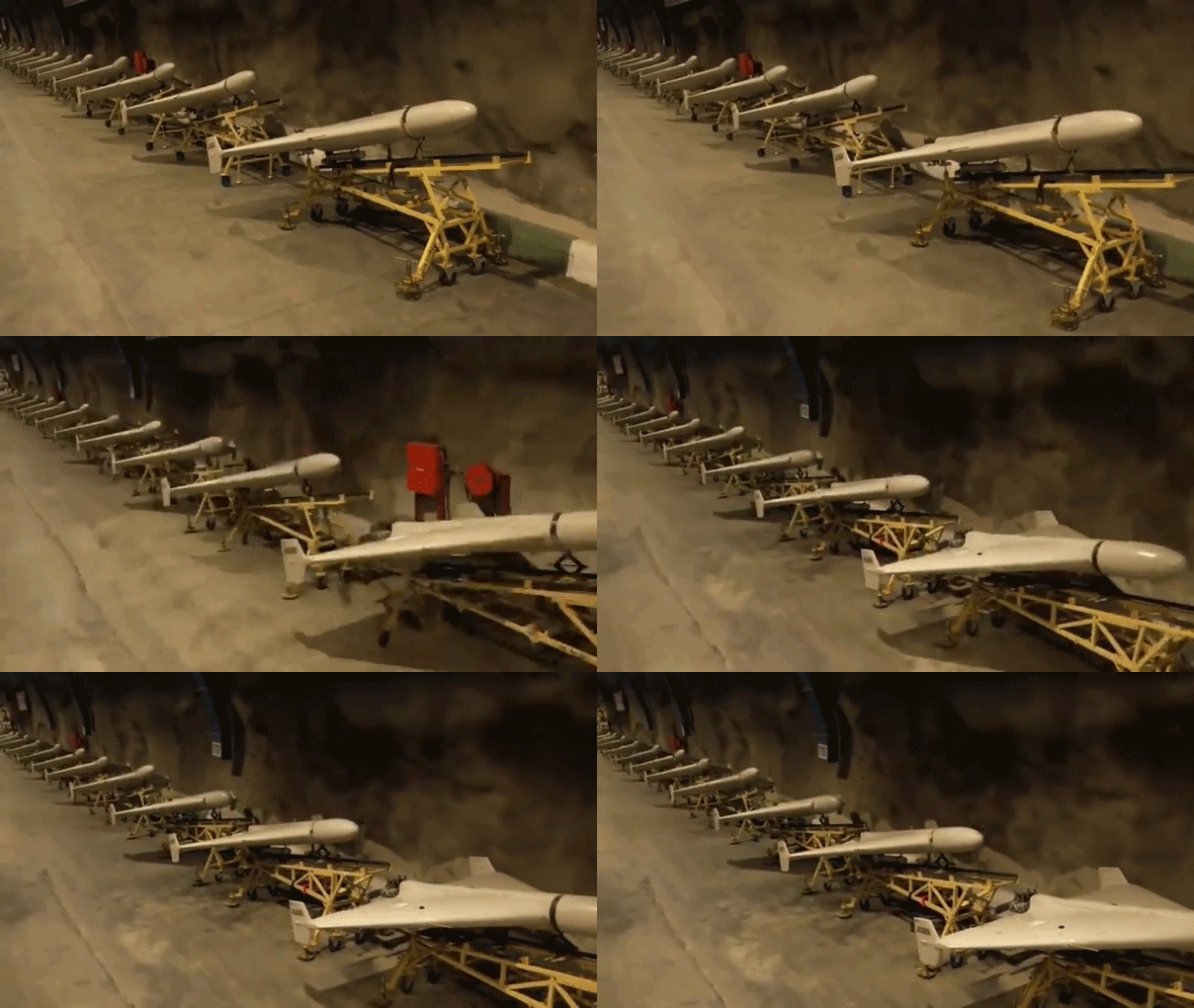
Iranian state-affiliated Fars News Agency released footage purportedly showing vast underground stockpiles of triangular-shaped attack drones on rocket launchers, alongside missiles and propaganda imagery. While the timing and location of the video remain unverified, it represents a concerning demonstration of Iran’s unmanned aerial vehicle (UAV) capabilities.
“It is hard to confirm that Iran has the capability now to produce these drones in these volumes during wartime,” Chell noted. “To the extent they were producing these in those numbers, a more-than-significant portion would have been for delivery to Russia — which does not seem impossible.”
The strategic advantage of Iran’s drone campaign lies in its cost-effectiveness. A report from the Carnegie Endowment for International Peace highlights this asymmetric approach, with senior fellow Dara Massicot explaining: “The methods are effective, but targeting drones in this way is resource-intensive and expensive, and it will drain certain types of interceptors quickly.”
This creates a significant defense challenge, as Western and allied nations must deploy sophisticated, costly air defense systems to counter relatively inexpensive Iranian drones. “Ground-based air defense interceptor missiles are not infinite, and the United States and its partners and allies have had stockpile challenges in this area for years,” Massicot added.
The proliferation of these weapons represents a paradigm shift in modern warfare. Steve Feldstein, another Carnegie senior fellow, noted that “the world is entering a new age of drone war as unmanned aircraft are proliferating on the battlefield in major conflicts and smaller ones.”
Military analysts suggest Iran’s drone strategy mirrors asymmetric warfare tactics used historically by guerrilla forces against conventionally stronger opponents. By forcing the United States and allies to expend disproportionate resources on defensive measures, Iran aims to create unsustainable military and economic pressure.
The recent attacks have prompted increased coordination among Gulf states to counter the Iranian threat, with many deploying air defense systems and issuing joint condemnations alongside the United States. As drone technology continues to evolve and proliferate, military planners worldwide are reassessing defense strategies to address this increasingly common threat vector in modern warfare.
Fact Checker
Verify the accuracy of this article using The Disinformation Commission analysis and real-time sources.

12 Comments
The article highlights how Iran’s drone swarm strategy is a deliberate attempt to impose exponential costs on the US and its allies. It’s a concerning development that demonstrates Iran’s willingness to use unconventional means to pursue its geopolitical goals.
Absolutely, Iran’s drone campaign is a worrying escalation that could prolong the conflict indefinitely. The US will need to find effective countermeasures to mitigate the threat posed by these low-cost, decentralized drone attacks.
It’s interesting to see Iran adapt its military strategy to exploit the vulnerabilities of the US’s technological advantage. While drones may not win the war outright, they provide a way for Iran to prolong the conflict and create political pressure.
You raise a good point. Iran’s use of drones is an asymmetric tactic that aims to shift the dynamics of the conflict and force the US to expend significant resources to counter the threat.
The article highlights how Iran’s drone campaign is a deliberate strategy to impose high costs on the US and its allies. It’s a concerning escalation that demonstrates Iran’s willingness to use unconventional means to pursue its geopolitical goals.
Absolutely, this drone warfare tactic is Iran’s attempt to level the playing field and create an asymmetric challenge for the US forces. It’s a worrying development that could prolong the conflict and lead to further casualties on both sides.
This drone warfare strategy seems to be Iran’s attempt to level the playing field against the US military’s technological superiority. While drones may be asymmetric, they come with high costs for both sides and could prolong the conflict.
You make a good point. Iran’s use of drone swarms is a bold move to offset the US’s conventional military advantages. It’s a concerning development that could lead to an extended and costly conflict.
This drone warfare strategy seems to be Iran’s attempt to level the playing field against the US military’s technological superiority. While drones may be asymmetric, they come with high costs for both sides and could prolong the conflict.
You’re right, the use of swarm drone tactics is Iran’s way to compensate for its conventional military disadvantage. It’s an unconventional approach that aims to stretch US resources and inflict disproportionate damage.
The loss of US personnel in these drone attacks is tragic, but it’s not surprising that Iran is leveraging its drone capabilities to impose a high price on the US military presence in the region. This is a concerning escalation of the conflict.
Absolutely, the human cost of this drone campaign is alarming. Iran seems willing to endure significant losses itself to keep the US bogged down and on the defensive.