


Listen to the article
Anti-Government Protests Expand Across Iran as Currency Crisis Deepens
Protests in Iran entered their third consecutive day on Tuesday, expanding beyond Tehran’s commercial center as demonstrators voiced anger over economic collapse and government policies. The demonstrations gained momentum after Iran’s currency, the rial, plummeted to historic lows of approximately 1.45 million per U.S. dollar on the open market.
Universities have become major hubs for the protests, with rallies reported at Tehran University, Sharif University of Technology, Shahid Beheshti University, Elm-o-Sanat University, and Khajeh Nasir University. Security forces have tightened entry controls at campuses and reinforced offices linked to Supreme Leader Ali Khamenei, according to Iran International.
The unrest has spread to multiple cities, with strikes across Tehran’s Shoush and Molavi districts and into Isfahan’s Naqsh-e Jahan Square. Parts of Tehran’s Grand Bazaar and the gold market have shut down, while mobile phone traders gathered outside major shopping centers after closing their stores.
Demonstrations have turned violent in several locations, with security forces reportedly using tear gas in Tehran and Malard, and witnesses claiming live ammunition was fired in Hamadan. Nighttime protests have been reported from Qeshm Island in the south to Zanjan and Hamadan in the north, with videos showing protesters chanting “death to the dictator.”
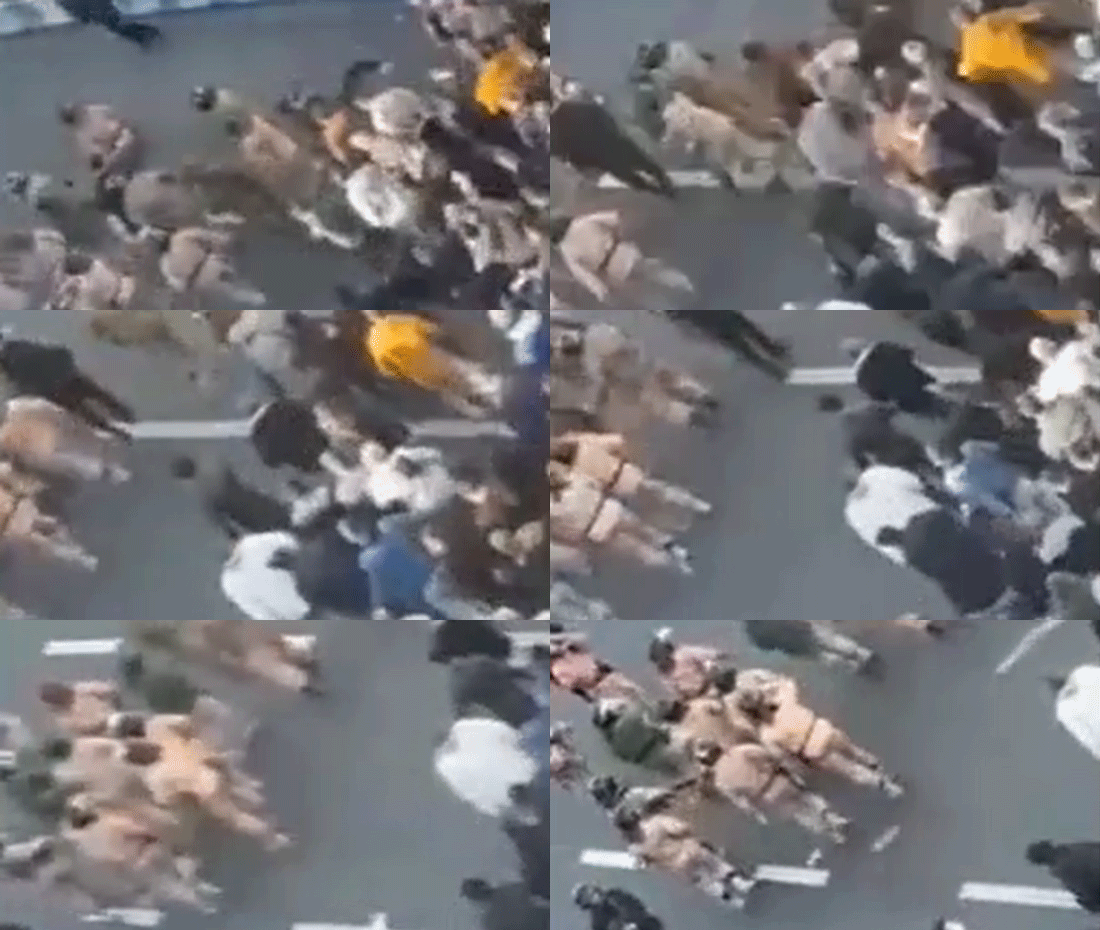
The National Council of Resistance of Iran (NCRI), an exiled opposition coalition, reported widespread strikes and student protests across Tehran and multiple provincial cities. They released footage appearing to show protesters pushing back security forces on Tehran’s Jomhouri Street, forcing them to retreat.
U.S. President Donald Trump voiced support for the demonstrators during a press conference at Mar-a-Lago on Monday, though he stopped short of calling for regime change. “They’ve got tremendous inflation. Their economy is busted, the economy is no good,” Trump said, adding that when Iranians protest, the regime responds with lethal force.
“Every time they have a riot or somebody forms a group, little or big, they start shooting people,” Trump continued. “You know, they kill people. All of a sudden people start getting shot and that group disbanded pretty quickly.”
U.S. Ambassador to the United Nations Mike Waltz issued a direct message of support: “The people of Iran want freedom. We stand with Iranians in the streets of Tehran and across the country as they protest a radical regime that has brought them nothing but economic downturn and war.”
The U.S. government’s Persian-language social media account added that Washington supports the Iranian people’s efforts “to make their voices heard,” urging the Islamic Republic to respect fundamental rights rather than suppress protests.
Iranian officials have acknowledged the unrest while defending the government’s approach. Government spokeswoman Fatemeh Mohajerani stated that Tehran recognizes the protests and would establish a mechanism to engage with protest leaders. President Masoud Pezeshkian has reportedly directed his interior minister to address protesters’ “legitimate demands” and engage in dialogue with their representatives.
Independent analysts warn that the unrest reflects deeper structural problems. The OSINT research group SpecialEurasia said in a Tuesday assessment that Iran’s internal stability has reached a “critical threshold,” citing the convergence of currency collapse, renewed international sanctions, and chronic water and energy shortages.
The participation of bazaar merchants, traditionally a pillar of regime support, signals declining confidence in the state’s economic management and raises the risk of prolonged unrest, according to the assessment.
NCRI leader Maryam Rajavi claimed the protests reflect the anger of “tens of millions” driven to the breaking point by inflation, corruption, and clerical rule. Cameron Khansarinia, vice president of the National Union for Democracy in Iran, said the demonstrations underscore a growing shift in public sentiment, claiming that “Iranians’ desire to be free is increasingly becoming greater than their fear of the regime.”
As protests continue, verification of casualties and arrests remains limited, but the scale and spread of the unrest underscore mounting pressure on Iran’s leadership amid economic freefall and growing public defiance.
Fact Checker
Verify the accuracy of this article using The Disinformation Commission analysis and real-time sources.

10 Comments
The use of tear gas by security forces is concerning, as it could escalate the situation further. I hope the authorities and protesters can find a peaceful way to resolve the crisis.
The Trump administration’s support may not be helpful, as it could be perceived as foreign interference. A more neutral, diplomatic approach may be more constructive.
The collapse of the rial and the economic turmoil appear to be key drivers behind the widespread protests. It will be interesting to see how the Iranian government responds to the growing unrest.
Universities becoming hubs for the protests is a significant development. This suggests the discontent may be broadly shared across Iranian society.
The protests seem to reflect deep-seated discontent with the government’s economic policies and the country’s financial troubles. Resolving this crisis will require a nuanced approach.
The Trump administration’s vocal support could potentially backfire and be used by the Iranian government to portray the protests as foreign-backed.
The spread of protests to multiple cities and the disruption of commercial activities like the Grand Bazaar indicate the depth of public frustration. A resolution will likely require addressing the root economic issues.
This is a concerning development in Iran. The protests seem to be fueled by economic troubles and government policies. It’s important to monitor the situation closely and hope for a peaceful resolution.
The Trump administration’s vocal support could potentially inflame the situation further. A measured, diplomatic approach may be more prudent.
It’s a complex and rapidly evolving situation in Iran. I’ll be following the news closely to see how events unfold and whether the protests lead to meaningful change.