


Listen to the article
Israeli airstrikes hammered the capitals of Iran and Lebanon on Friday, while the U.S. struck an Iranian drone carrier at sea as part of its intensifying military campaign against the Islamic Republic’s naval forces.
The escalating conflict entered a new phase as Iran launched retaliatory attacks targeting U.S. forces in multiple Gulf countries, a week after the initial bombardment that U.S. Defense Secretary Pete Hegseth warned was “about to surge dramatically.”
Israel’s military announced it had begun “a broad-scale wave of strikes” on Tehran early Friday. Witnesses described particularly intense airstrikes shaking homes throughout the capital. Additional explosions were reported around the city of Kermanshah, an area housing multiple missile bases. Israeli forces claimed they had already destroyed most of Iran’s air defenses and missile launchers.
The conflict has rapidly expanded beyond its initial scope, engulfing countries across the Middle East. Early Friday, Iran fired missiles and drones at Kuwait, Qatar, Saudi Arabia, and Bahrain – all nations hosting U.S. military forces. No immediate casualties were reported in these attacks.
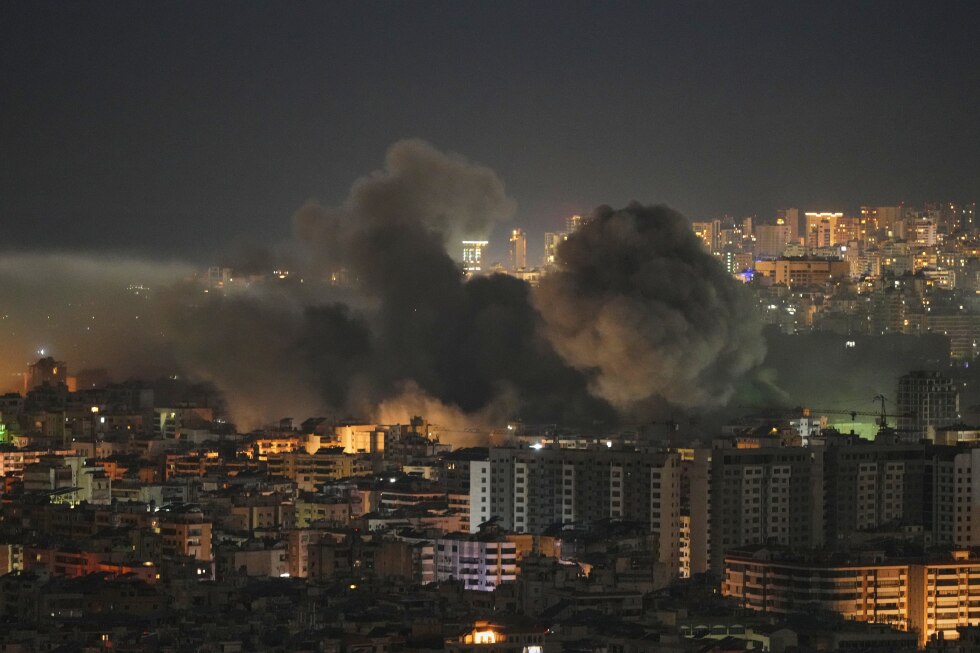
In Lebanon, where fighting between Israel and Iran-backed Hezbollah militants has intensified, Israel conducted a series of airstrikes late Thursday into Friday targeting Beirut’s southern suburbs and other areas. Civilians jammed roadways attempting to flee the bombardment or seek shelter.
The U.S. and Israel have carried out nationwide strikes against Iran, targeting military infrastructure, leadership figures, and Iran’s nuclear program. The expanding conflict has killed at least 1,230 people in Iran, more than 120 in Lebanon, around a dozen in Israel, and six U.S. troops, according to official figures from these countries.
The U.S. military announced early Friday that it had struck an Iranian drone carrier, setting it ablaze. U.S. Central Command released black-and-white footage of the burning vessel, identified as the IRIS Shahid Bagheri, a converted container ship with a 180-meter-long runway for drone operations. The Iranian military did not immediately acknowledge the attack.
Admiral Brad Cooper, head of U.S. Central Command, described the carrier as “roughly the size of a World War II aircraft carrier,” adding, “And as we speak, it’s on fire.”
This attack follows an earlier U.S. operation where an American submarine sank an Iranian frigate off the coast of Sri Lanka as it was returning from an exercise hosted by the Indian navy. The sinking resulted in at least 87 sailor deaths.
Cooper also revealed that B-2 stealth bombers dropped dozens of 2,000-pound “penetrator” bombs on deeply buried ballistic missile launchers inside Iran under cover of darkness Friday morning. “We’ve also struck Iran’s equivalent of Space Command, which degrades their ability to threaten Americans,” Cooper stated.
Iran’s counterattacks targeted multiple U.S. military installations across the Gulf. Qatar’s Defense Ministry reported intercepting a drone attack aimed at Al Udeid Air Base, which hosts the U.S. Central Command’s forward headquarters. Saudi Arabia intercepted and destroyed three ballistic missiles fired toward Prince Sultan Air Base south of Riyadh. Air raid sirens sounded in Bahrain, where Iran reportedly targeted two hotels and a residential building. In Kuwait, where six U.S. soldiers were killed on Sunday, air defenses were activated as missiles and drones breached the country’s airspace.
Cooper noted that Iranian attacks had now struck a dozen countries, stating, “Those 12 countries are none too happy and I look forward to working with all the partners who are willing to join us.”
In Israel, explosions were heard in Tel Aviv Friday morning after warnings about incoming Iranian missiles, as air defense systems worked to intercept the barrage.
In brief remarks at the White House, U.S. President Donald Trump again urged the Iranian people to “help take back your country,” promising them “immunity” amid the conflict. “So you’ll be perfectly safe with total immunity,” Trump said without providing details. “Or you’ll face absolutely guaranteed death.”
However, Cooper and Hegseth cautioned Iranians against protesting while the conflict continues. “It’s common sense, don’t go out and protest while bombs are dropping,” Hegseth said, with Cooper adding, “The best thing for them to do now is just to lay low.”
Iranian state television reported Friday that a leadership council had begun discussing how to convene the country’s Assembly of Experts, which will select a new supreme leader following the death of Ayatollah Ali Khamenei in the opening strikes of the war. The council includes President Masoud Pezeshkian, judiciary chief Gholam Hossein Mohseni Ejehi, and cleric Ayatollah Ali Reza Arafi.
As the multi-front conflict intensifies, casualties continue to mount, and regional stability remains in jeopardy as major powers escalate their military operations across the Middle East.
Fact Checker
Verify the accuracy of this article using The Disinformation Commission analysis and real-time sources.

11 Comments
Hitting Iran and Lebanon with intense airstrikes is a major escalation. The region is already unstable, and this could spark a wider regional war. I hope both sides can be persuaded to step back from the brink and pursue negotiations to defuse tensions.
Agreed, this is an extremely dangerous situation. Restraint and diplomacy are critical to prevent this conflict from spiraling further out of control and engulfing the entire region.
This rapid escalation of airstrikes and missile attacks is deeply worrying. Innocent civilians will pay the price if this conflict continues to intensify. All parties need to return to the negotiating table before the situation deteriorates even further.
The US warning of a ‘dramatic surge’ in the bombardment is ominous. This conflict risks drawing in more countries and drawing the US further into another Middle East quagmire. Diplomatic solutions should be the priority to avoid even greater instability.
These escalating strikes between Israel, Iran, and their regional proxies are deeply concerning. Civilians are at risk, and this conflict could rapidly spiral out of control. I hope diplomatic efforts can de-escalate the situation before more lives are lost.
I agree, the stakes are incredibly high. Diplomatic solutions are crucial, but the parties seem unwilling to compromise so far. This conflict could have devastating regional consequences if not handled carefully.
Intensifying airstrikes and missile attacks between Israel, Iran, and their proxies is extremely dangerous. Civilians are at grave risk, and this conflict could spiral into an all-out regional war. Urgent diplomatic efforts are needed to pull the parties back from the brink.
The US warning of a ‘dramatic surge’ in bombardment is alarming. This conflict risks drawing in more countries and embroiling the US in another protracted Middle East conflict. Diplomatic solutions should be the priority to prevent further destabilization.
I share your concern. Reckless military action could have devastating consequences for the entire region. De-escalation through negotiations is the only responsible path forward at this point.
Striking Iranian and Lebanese targets is a dangerous escalation that could provoke retaliation. I worry this tit-for-tat cycle of violence will only intensify. All sides should exercise maximum restraint to avoid further destabilization of the region.
You’re right, this seems like a reckless spiral of attacks and counterattacks. Cooler heads need to prevail, and the international community must pressure all parties to de-escalate before this spirals out of control.