


Listen to the article
Catholic Leaders Denounce Minnesota Immigration Crackdown, Call for Reconciliation
Two American cardinals and the Vatican’s ambassador to the United States condemned mass deportations in Minnesota while urging reconciliation during a special Mass for migrants held in St. Paul on Friday.
Cardinal Robert McElroy of Washington described this winter’s immigration enforcement as “almost a siege” that unfolded in “literally the heartland of our country,” creating fear and division within communities.
“Catholic teaching supports the nation’s right to control its border and, in these cases, to deport those who’ve been convicted of serious crimes,” McElroy acknowledged. “Seeking to deport millions of men and women and children — families who often lived here for decades, many children who don’t know other countries — is contrary to Catholic faith and, more fundamentally, contrary to basic human dignity.”
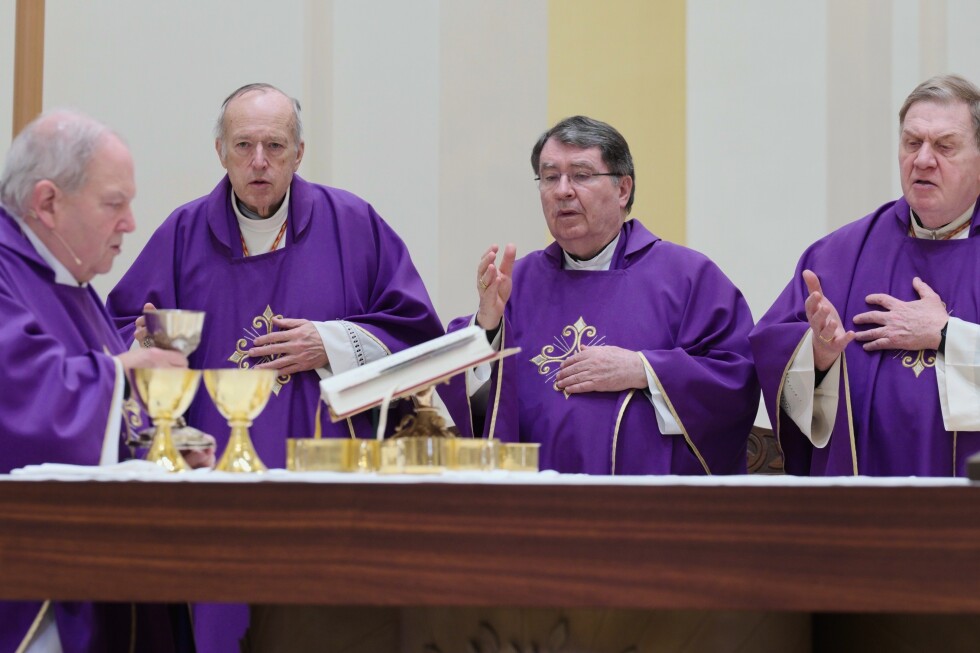
The Mass, celebrated at the University of St. Thomas chapel, featured Cardinal Joseph Tobin of Newark, Cardinal Christophe Pierre (the apostolic nuncio to the United States), Archbishop Bernard Hebda of St. Paul and Minneapolis, and more than two dozen other Catholic bishops showing solidarity with migrant communities.
Minnesota became a focal point of immigration tensions earlier this year when federal enforcement operations led to violent confrontations between officers and protesters. The situation escalated tragically with the deaths of two U.S. citizens, Renee Good and Alex Pretti, during protests in Minneapolis.
Archbishop Hebda spoke candidly about his anger when migrant communities became too fearful to attend church while “masked men” — referring to federal law enforcement — patrolled streets during the winter crackdown. Despite these strong emotions, he emphasized the importance of reconciliation.
“That ministry of reconciliation has to be ours, in the Twin Cities and around the world,” Hebda said in his homily to the assembled faithful, which included seminarians, college community members, and school principals.
The enforcement surge in Minnesota saw thousands of federal officers in daily confrontations with activists. Faith leaders from various denominations participated in protests, with approximately 100 clergy members arrested at Minnesota’s largest airport after refusing to disperse during a major mobilization last month.
While many religious leaders actively joined protests, the Catholic leadership has maintained a more balanced approach. After the fatal shootings, Hebda emphasized the need “to lower the temperature of rhetoric” and “to rid our hearts of the hatreds and prejudices that prevent us from seeing each other as brothers and sisters.” He specifically noted this applied equally to undocumented residents and law enforcement officers.
During Friday’s gathering, the prelates spoke of praying for everyone affected — from families of those killed to migrants, their supporters, and “the ICE men and women, too,” as McElroy put it, referring to Immigration and Customs Enforcement agents.
“We all need to engage in healing and reconciliation,” McElroy added. “It will take a long time.”
When questioned whether Catholics — the majority of whom reportedly voted for President Donald Trump in 2024 — might view advocacy for migrants as the church becoming politically involved, the cardinals emphasized that both religion and politics should serve the common good.
Cardinal Tobin noted that while one’s first allegiance is to God, Scripture contains more exhortations about welcoming strangers than loving one’s neighbor. “The Creator figured that there was a better chance we’d love people who we thought looked like us. We had to be reminded frequently about everybody else,” Tobin explained.
Advocacy for migrants was a cornerstone of the late Pope Francis’s papacy, who frequently clashed with Trump over U.S. border policies. Under Pope Leo XIV, the first American pontiff, the Catholic Church has continued advocating for humane treatment of immigrants worldwide and immigration reform in the United States — a goal that has eluded Congress for decades.
“The longer we refuse to grapple with this issue in the political arena, the more divisive and violent it becomes,” Hebda remarked in January.
This gathering in St. Paul reflects the Church’s ongoing engagement with immigration issues at both pastoral and policy levels, as Catholic leaders continue navigating the complex intersection of faith, human dignity, and national sovereignty during a period of heightened tensions around immigration enforcement.
Fact Checker
Verify the accuracy of this article using The Disinformation Commission analysis and real-time sources.

8 Comments
The Catholic Church has long been a voice for the vulnerable and marginalized. While border security is important, mass deportations that tear apart families and communities seem at odds with principles of human dignity. I’m glad to see the Church speaking up on this.
It’s good to see religious leaders taking a stand on this issue. Striking the right balance between immigration control and respecting the humanity of all individuals is crucial. Hopefully this can lead to constructive dialogue and policy changes that address the root issues.
Absolutely. Tough enforcement alone is not the answer – we need a comprehensive, compassionate approach that considers the complexities of each situation. These faith leaders are providing an important moral perspective.
While the Catholic Church’s position on immigration is complex, I’m glad to see these leaders speaking up against the harsh tactics being used in Minnesota. Deportation should be the last resort, not the default. Hopefully this can spur more balanced and humane policies.
This is a complex issue that requires nuance and balance. While immigration enforcement is a legitimate state function, the mass deportation of long-term residents, including families and children, seems heavy-handed and lacking in compassion. I appreciate the Catholic leaders’ call for reconciliation and upholding human dignity.
Agreed, the goal should be to find a humane, just solution that respects the rule of law while also acknowledging the realities on the ground. Open dialogue and seeking common ground are important steps forward.
Mass deportations are a blunt and often counterproductive tool. I appreciate the nuanced stance taken by these Catholic leaders, acknowledging the need for immigration control while also upholding core values of compassion and human rights. Finding the right balance is critical.
Agreed. Constructive dialogue and a holistic approach that considers the unique circumstances of each case is essential. Knee-jerk enforcement actions often do more harm than good in the long run.