


Listen to the article
Hungary to Declassify Security Report in Escalating Political Battle
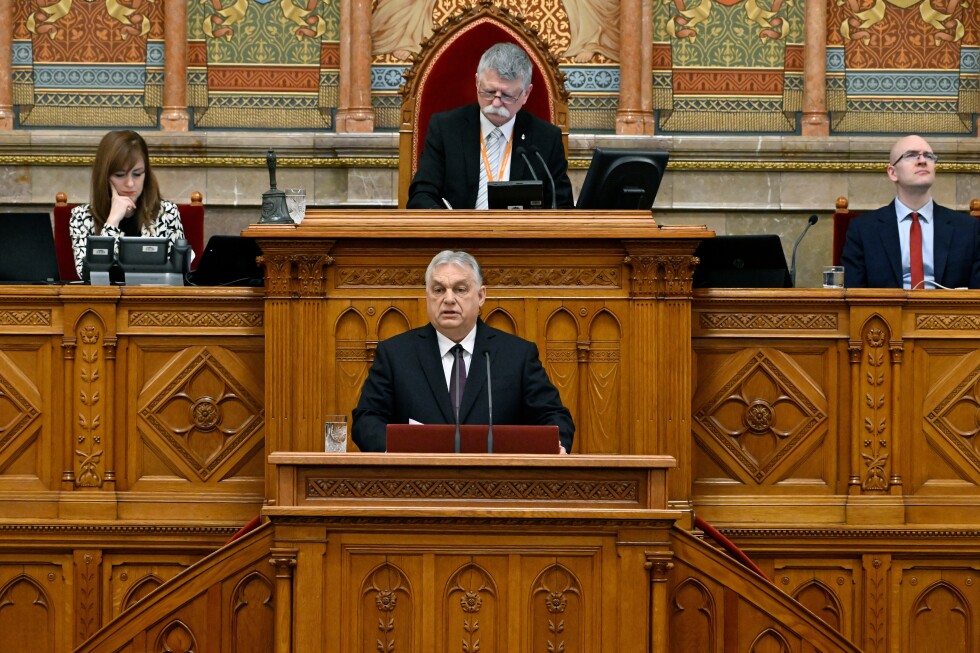
Hungary’s government announced Thursday it will declassify a national security report that Prime Minister Viktor Orbán claims will prove his main political challenger received illegal financing from Ukraine, intensifying a contentious campaign ahead of next month’s elections.
The move comes as Orbán faces what analysts describe as the most serious political challenge of his lengthy tenure. Recent polls show the populist leader trailing behind center-right opponent Péter Magyar and his Tisza party ahead of the April 12 vote.
“The declassification process is underway,” Orbán’s chief of staff, Gergely Gulyás, told reporters at a news conference, adding that the report would be released “in the foreseeable future.”
Orbán has repeatedly alleged that Ukraine is financing Magyar’s Tisza party without providing concrete evidence. In a recent interview with commercial broadcaster ATV, the nationalist leader claimed “significant” sums had been channeled from Ukraine to Tisza for IT applications and voter mobilization efforts.
“I don’t think the state would withhold this information from you,” Orbán told journalists, encouraging them to request the report’s declassification. Magyar has categorically denied these allegations.
The accusations form part of an increasingly aggressive anti-Ukraine campaign by Orbán’s government, which has maintained cordial relations with Moscow throughout Russia’s invasion of Ukraine. The Hungarian leader’s messaging suggests a conspiracy involving Kyiv, the European Union, and Tisza to oust his government and install one more favorable to Ukrainian interests.
With just four weeks until the election, Orbán has framed the vote as existential for Hungary’s future amid growing voter dissatisfaction with economic stagnation, deteriorating public services, and widespread corruption allegations. His campaign’s central message warns that a new government would bankrupt Hungary by supporting Ukraine against Russia and would send Hungarian youth to die on the front lines.
The government has deployed controversial tactics, including public-funded billboards featuring AI-manipulated images of Ukrainian President Volodymyr Zelenskyy with a sinister smile and the caption: “We won’t let Zelenskyy have the last laugh!” Campaign materials have frequently utilized AI-generated imagery and videos, which critics have labeled as disinformation.
Magyar, a 44-year-old lawyer and former insider within Orbán’s Fidesz party, has countered by warning of possible Russian intelligence efforts to influence the election in Orbán’s favor. The Tisza party did not immediately respond to requests for comment on the latest developments.
Orbán’s government has consistently opposed EU financial and military assistance to Ukraine while pledging to veto any steps toward Ukrainian EU membership. Hungary recently blocked a new round of EU sanctions against Russia and obstructed a major €90 billion ($104 billion) loan for Kyiv, citing interrupted Russian oil shipments through Ukraine as justification.
Tensions escalated dramatically last week when Hungarian counter-terrorism forces detained seven Ukrainian state bank employees and seized two armored vehicles carrying approximately $82 million in cash and gold. Although the employees were later deported to Ukraine, Hungarian authorities retained the assets.
The incident sparked outrage in Kyiv, with Ukraine’s foreign minister accusing Hungary of “state terrorism” and “taking hostages.” Ukrainian officials maintained that the shipment, traveling from Austria to Ukraine through Hungary, was part of routine operations between state banks.
Orbán has also deployed military forces to key energy infrastructure sites across Hungary, claiming to prevent potential Ukrainian disruptions.
The upcoming election represents a critical juncture for Hungary’s democratic trajectory and its position within the European Union, where Orbán’s government has frequently clashed with Brussels over rule of law issues and democratic backsliding concerns.
Fact Checker
Verify the accuracy of this article using The Disinformation Commission analysis and real-time sources.

5 Comments
Interesting development in the Hungarian political landscape. Orbán’s claims of illegal Ukraine funding for his opponent seem quite serious. I wonder what the classified security report will reveal.
This is a high-stakes situation for Orbán as he faces a tough election challenge. The declassification of the security report could have major implications, but we’ll have to wait and see what it contains.
The mining and energy sectors are often intertwined with geopolitical issues. I’m curious to see if this security report touches on any potential connections between Ukraine, Hungary’s elections, and the commodities market.
This is a complex situation with a lot of moving parts. I hope the declassified report provides clarity and that the election process in Hungary remains fair and transparent.
It will be interesting to see how this plays out and what implications it may have for the mining and energy sectors in Hungary and the surrounding region. Transparency is key in these types of situations.