


Listen to the article
Young Hungarians Lead Historic Political Shift in Ousting Orbán After 16 Years
Many of the young Hungarians who came of age during Prime Minister Viktor Orbán’s 16 years in power have never known life outside his political system. Yet it was they who were at the forefront of Sunday’s electoral earthquake that ejected him from office.
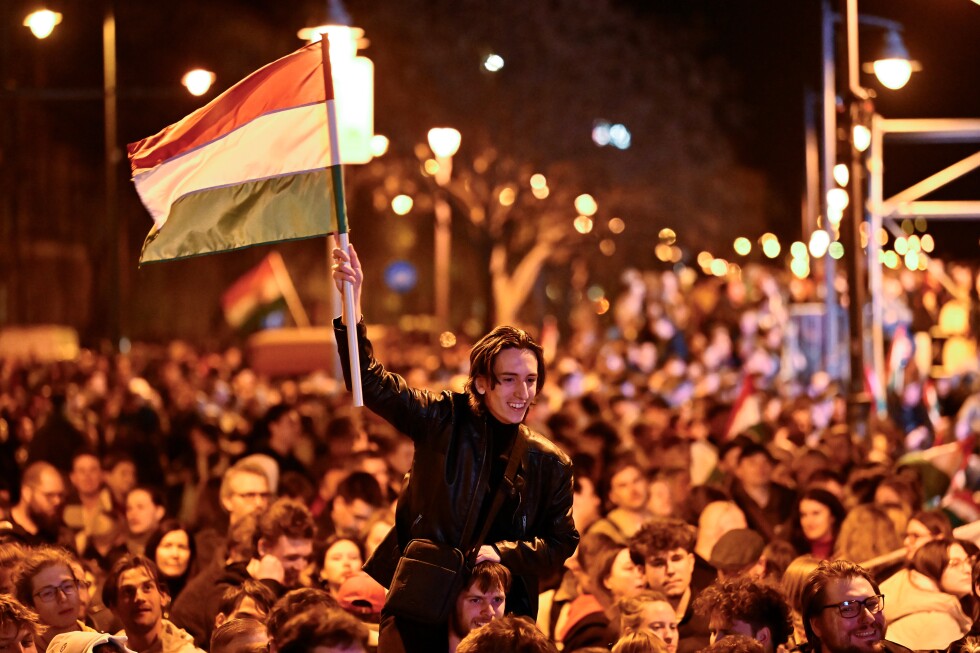
As hundreds of thousands of people took to the streets to celebrate the historic win by pro-European candidate Péter Magyar, music from some of Hungary’s most popular — and most Orbán-critical — performers filled the air. Teenagers scaled Budapest’s iconic Chain Bridge and blasted revolutionary anthems by artists whose songs captured young people’s frustrations with the regime.
On the city’s trams, buses and subway cars, young people led chants and played AI-generated fan music dedicated to Magyar. In front of Hungary’s neo-Gothic parliament building, a group called “More Techno to Parliament!” celebrated Orbán’s defeat with a rave.
Such scenes underscored the important role young people played in the push to end Orbán’s autocratic rule. Before the election, a poll by 21 Research Center showed that 65% of voters under 30 supported Magyar’s Tisza party, while only 14% backed the 62-year-old Orbán.
Marcell Szabó-Temple, a 26-year-old architect, grew up on the outskirts of Budapest in a family where adults didn’t talk about politics in front of the children. In the 2018 election — the first in which he could vote and which Orbán won easily — he felt ambivalent about the political process.
But then Szabó-Temple entered university and experienced a political awakening. Although he went to the country’s top engineering school, he said the state of higher education shocked him. Studying under what he described as an outdated curriculum in a crumbling building made him wonder: “Was this really all they could achieve in 12 years of governance? If so, we need something better.”
More difficulties were to come. In 2022, more than 20 Hungarian universities were disqualified from the European Union’s Erasmus exchange program as a consequence of an Orbán scheme to place control of universities in the hands of public foundations headed by political appointees.
Critics warned Orbán’s move was an attempt to take control of academia and stifle critical thought. Many university students and leadership protested the overhaul, but it was carried out anyway.
No longer able to study abroad, and disenchanted by another overwhelming victory by Orbán in the 2022 election, Szabó-Temple said he felt “like the world went silent for the next few years.”
“I stopped caring about politics, again,” he said. “It was like being back in high school: I didn’t even want to hear the news.”
But when Magyar, 45, broke into Hungarian politics in 2024, Szabó-Temple felt a greater hope for change than he ever had before.
Once an insider in Orbán’s Fidesz party, Magyar campaigned heavily on repairing Hungary’s relationship with the EU and restoring its Western orientation that had drifted increasingly close to Russia under Orbán. He frequently addressed young people at hundreds of rallies held across the country during his campaign, urging them to take the country’s future into their own hands.
Meanwhile, a new generation of musical stars, many of whom grew to fame on the internet, began producing more political content. While outlooks for young people looked increasingly dire due to economic crises and deep social divisions, the music became openly critical of Orbán’s regime.
Audiences broke out in anti-government chants during concerts at summer festivals. Government officials scolded young people for the signs of disrespect.
The musical movement reached its apex two days before the election when over 100,000 people packed a sprawling square in Budapest for a “system-breaking” concert. Over 50 artists performed, and urged young people to vote for change.
After Orbán’s defeat, Szabó-Temple said he plans to move back to Hungary from Portugal, where he’s on a work exchange.
“There was a growing sense among young people that if we can’t change the regime now, we might not want to live in Hungary for the rest of our lives. I certainly felt like that,” he said.
Like many of Hungary’s youth, he has high expectations for Tisza.
“We put our faith in them and we expect them to deliver,” he said. “If they do, I will settle down and build a family in Hungary.”
Fact Checker
Verify the accuracy of this article using The Disinformation Commission analysis and real-time sources.

10 Comments
The data point about 65% of under-30 voters supporting the pro-European challenger is quite telling. It suggests a significant generational divide and a desire among young Hungarians for a different political direction after 16 years of Orbán’s rule.
You’re right, the youth vote was clearly a critical factor in this election outcome. It will be interesting to see how the new government addresses the concerns and aspirations of this younger demographic going forward.
Fascinating to see the role of young Hungarians in the historic defeat of Orbán. Music and grassroots activism played a key part in mobilizing support for change. It’s inspiring to see a new generation shaping the political future of their country.
Indeed, the power of music to galvanize a movement is clear here. The scenes of young Hungarians leading chants and celebrations on the streets are a testament to their resolve for a more democratic future.
The victory of the pro-European candidate is certainly a notable development, given Hungary’s recent democratic backsliding under Orbán’s rule. It will be interesting to follow how this change in leadership impacts the country’s trajectory going forward.
Absolutely, this election could signal a pivotal moment for Hungary’s democratic institutions and its alignment with European values. The role of the youth vote in catalyzing this shift should not be underestimated.
The imagery of teenagers scaling the iconic Chain Bridge to blast revolutionary anthems is quite powerful. It speaks to the passion and determination of Hungary’s youth in demanding change and rejecting the status quo.
Absolutely, those kinds of symbolic acts can be incredibly galvanizing. The youth-led celebrations across Budapest seem to have captured the spirit of a new chapter unfolding in Hungarian politics.
The use of AI-generated fan music to celebrate the election result is a novel and tech-savvy touch. It underscores how young Hungarians are harnessing digital tools to amplify their political voice and vision for the country.
While the details are still emerging, this election result appears to mark a significant political shift in Hungary. It will be crucial to see how the new government navigates the country’s relationship with the EU and addresses the concerns that drove young voters to the polls.