


Listen to the article
Indigenous Transgender Weaver Challenges Tradition While Preserving Cultural Heritage
In the Indigenous community of San Pedro Jicayán in southern Mexico, Xaneri Merino wasn’t supposed to become a weaver. Born into a society where the ancient craft of the backstrap loom was traditionally reserved for women, Merino – identified as male at birth – faced significant cultural barriers to learning this ancestral art form.
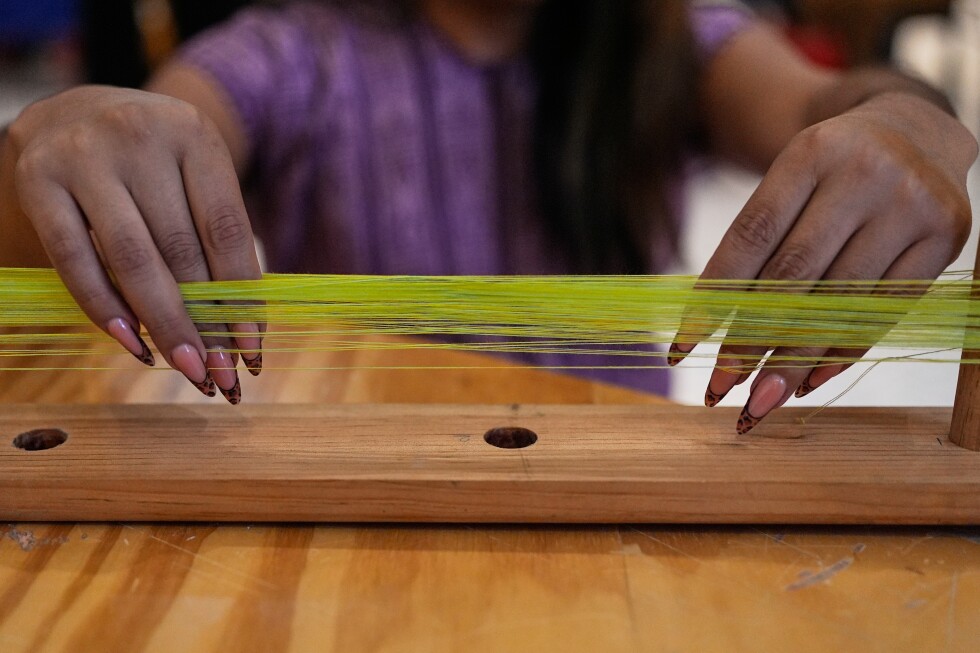
Despite these obstacles, Merino’s grandmother secretly passed down the craft, teaching her granddaughter the intricate techniques of the backstrap loom – a portable device operated using a strap secured around the weaver’s waist.
“She began sharing her knowledge with me in secret,” recalls Merino, who at age 13 would hide in her grandmother’s adobe home to practice weaving. “She taught me how to make the thread from scratch, to feel the textures and respect nature.”
This clandestine education included one of her grandmother’s most cherished lessons: the importance of environmental stewardship. “To care for nature is part of our worldview,” Merino explains. “Because it provides us with what we need to walk this world.”
Merino’s heritage spans two significant Indigenous cultures of southern Mexico. Her maternal lineage comes from the Mixtec people, whose origin stories trace the birth of gods and dynasties to sacred landscapes, while her paternal ancestry is Zapotec, where religious practices remain deeply integrated into everyday life.
Today, Merino identifies both as a transgender woman and as “muxe,” a term from Zapotec culture that refers to Indigenous people assigned male at birth who take on traditionally female roles. Often considered a third gender in Zapotec society, muxes have a distinct cultural position that predates European colonial influence in the region.
However, Merino’s path to openly practicing her craft came at a cost. At around age 15, community members spotted her weaving before a local religious celebration. The following day, she faced public scrutiny when village elders called a meeting to address what they viewed as a transgression against gender norms.
“Why would you allow him to weave, if it’s not something boys are supposed to do?” one elder asked her grandmother. “Do you realize what kind of example you’re setting for other children?”
Her grandmother defended the teaching as simply nurturing a child’s creativity and preserving cultural traditions. Nevertheless, Merino was punished by being forced to sweep the local church. The experience left deep emotional wounds.
“I developed a deep resentment toward textiles and the customs around them,” Merino says. “Having the ability to create and not being allowed to use it was like having eyes and having them taken away — I could no longer see.”
Years later, after moving to Mexico City for college, Merino found reconciliation with her craft through academic studies that included cultural management, textile arts, and postcolonial perspectives on Indigenous resistance. “That made me see how I could use my reality for a greater good,” she explains. “My loom became a means to healing.”
Today, Merino makes her living as both a weaver and instructor, hosting workshops that frame the backstrap loom as both a creative outlet and a form of cultural resistance. Her classes in Mexico City specifically target members of the LGBTQ+ community, creating safe spaces for people to connect with traditional crafts regardless of gender identity.
“Everyone is capable of learning how to weave, and it’s not just about creating a piece,” Merino explains during a recent workshop. “It’s also about weaving our own stories, as we can come to know ourselves through the loom.”
Her students appreciate both the technical instruction and the deeper cultural significance of the experience. Emilia Freire, a transgender woman, notes: “She made me realize that once I had my weaving set up and began to work, everything I carried with me through the week would come out.”
Another student, Kristhian Cravioto, celebrates finding a space where traditional crafts and LGBTQ+ identity can coexist. “This is very important for us dissidents,” says Cravioto, a designer who appreciates Indigenous crafts. “To know that no matter whether you are a man or a woman, what you do matters.”
The traditional backstrap loom itself is a marvel of Indigenous engineering—a portable system of cords, threads and wooden rods that allows weavers to control tension with their bodies. The craft demands extraordinary dedication, with Merino often weaving eight hours daily for a month to complete a single “huipil,” a traditional Indigenous tunic.
Though now based in Mexico City, Merino returns to her hometown to gather authentic materials, including increasingly rare purple dye derived from endangered sea snails found along the coast.
While she sometimes feels nostalgic for her community, Merino finds satisfaction knowing that her example has inspired change back home, where at least five transgender women and two men have taken up weaving in San Pedro Jicayán.
“We have gained visibility through the loom,” Merino says, “and that’s what this fight has been about.”
Fact Checker
Verify the accuracy of this article using The Disinformation Commission analysis and real-time sources.

10 Comments
What a remarkable way to blend Indigenous artistry, environmental stewardship, and LGBTQ+ advocacy. Merino’s journey is a testament to the transformative potential of reclaiming and reimagining traditional practices.
I’m curious to learn more about the specific techniques and symbolism Merino incorporates into their weaving. The blending of cultural heritage and personal identity seems to be a powerful creative force.
This story highlights the important role that art and craft can play in social and cultural change. Merino’s work is a inspiring example of how ancestral traditions can be leveraged to challenge norms and amplify marginalized voices.
It’s remarkable to see how Merino has been able to honor their grandmother’s teachings while also forging a new path that celebrates their identity and advocacy. This is a powerful testament to the resilience of Indigenous cultures.
I’m intrigued by how this weaver is able to honor their Indigenous roots while also pushing the boundaries of what’s traditionally accepted. The emphasis on environmental stewardship is a heartening aspect as well.
It’s wonderful to see this artisan using their craft as a tool for self-expression and advocacy. Preserving cultural heritage while also advancing social justice is truly commendable.
This story is a powerful reminder that tradition and progress need not be mutually exclusive. Merino’s resilience in the face of cultural barriers is truly inspiring. I hope their work continues to gain wider recognition.
The intergenerational knowledge transfer from Merino’s grandmother is a beautiful example of how cultural practices can be passed down in meaningful ways, even in the face of societal resistance.
Fascinating story of how an Indigenous Mexican artisan is using their ancestral weaving tradition to challenge gender norms and celebrate LGBTQ+ identity. It’s inspiring to see how they are preserving cultural heritage while also advocating for greater inclusion and representation.
The blend of tradition and progressive values is really quite remarkable. This artisan’s journey highlights the power of reclaiming and reinterpreting cultural practices to create meaningful change.