


Listen to the article
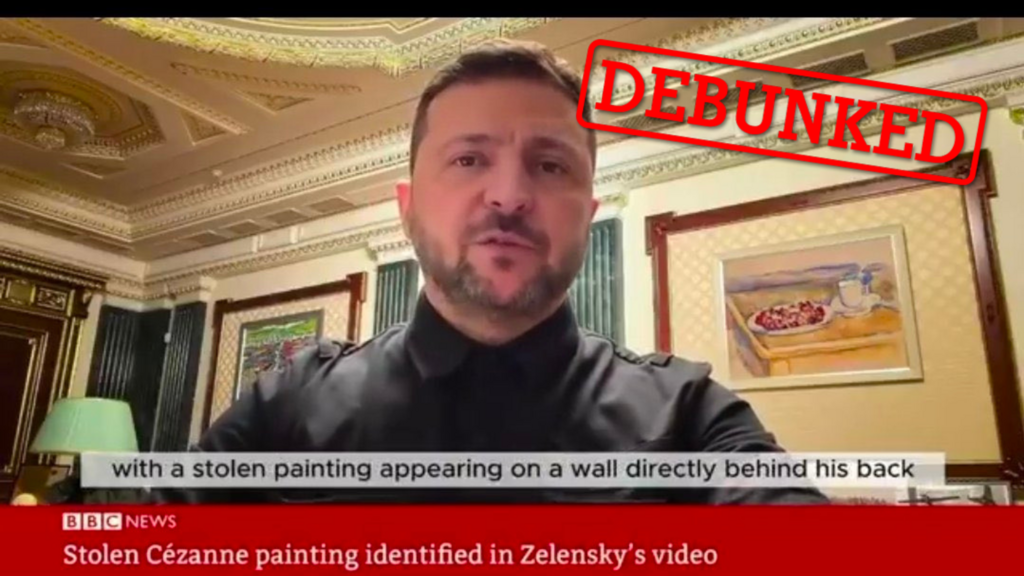
A doctored video circulating online falsely claims that Ukrainian President Volodymyr Zelensky has been displaying a stolen Paul Cézanne painting in his office, according to fact-checkers who have debunked the fabricated BBC news report.
The manipulated footage shows what appears to be a BBC broadcast with Zelensky seated in his office while a Cézanne painting hangs visibly on the wall behind him. However, analysis reveals that the painting was digitally inserted into genuine footage of the Ukrainian leader, creating a completely fabricated narrative.
This incident represents the latest in a stream of sophisticated disinformation targeting Ukraine’s leadership since Russia launched its full-scale invasion in February 2022. Digital forensics experts note that the fabrication displays increasingly common tactics in modern information warfare, where legitimate news outlets’ visual styles are co-opted to lend credibility to false claims.
Paul Cézanne, a post-impressionist French painter whose works command tens of millions of dollars at auction, has become an unwitting prop in this disinformation campaign. Art theft allegations carry particular weight in the context of the ongoing conflict, as cultural heritage protection has emerged as a significant concern, with UNESCO documenting damage to hundreds of cultural sites throughout Ukraine since the war began.
The timing of this fake news circulation coincides with President Zelensky’s continued diplomatic efforts to maintain Western military and financial support for Ukraine, now entering the third year of defending against Russian aggression. Disinformation experts suggest these fabrications aim to undermine international trust in Ukraine’s leadership by portraying its president as corrupt or hypocritical.
“This type of sophisticated visual manipulation represents an evolution in disinformation tactics,” said Dr. Maria Korolov, a disinformation researcher at the Digital Forensics Institute. “By hijacking the visual identity of respected news organizations like the BBC, bad actors create content that’s more likely to be believed and shared by unsuspecting viewers.”
The BBC has confirmed it never produced such a report. The British broadcaster has been among several international news organizations targeted by impersonators seeking to leverage their journalistic credibility to spread false information about the Ukraine conflict.
Ukrainian officials have not formally responded to this specific fabrication, but government representatives have previously highlighted Russia’s deployment of what they describe as “information terrorism” alongside conventional warfare. Ukraine’s Center for Strategic Communications has documented thousands of falsified news items, doctored videos, and manipulated images since the conflict began.
Social media platforms have struggled to contain the spread of such sophisticated fakes, which often circulate widely before fact-checkers can respond. The fabricated BBC clip reportedly spread across multiple platforms for several days before being flagged as manipulated media.
Art theft allegations carry particular resonance given the historical context of looted art during conflicts. During World War II, Nazi Germany systematically plundered cultural artifacts across occupied Europe, and the recovery of such stolen treasures continues to this day. By invoking art theft, the fabricated story attempts to place Zelensky among historical villains known for cultural plundering.
Media literacy experts emphasize that this incident highlights the growing need for digital skepticism among news consumers. “When viewing news, especially about contentious topics or involving international conflicts, it’s essential to verify information through multiple credible sources,” advised communications professor Jennifer Whitson from the University of Texas.
The fake Cézanne claim joins other debunked allegations targeting Ukrainian leadership, including falsified reports about offshore accounts, luxury purchases, and corrupt dealings—all aimed at undermining public support for Ukraine in its Western allied nations.
As the Russia-Ukraine conflict continues with no immediate resolution in sight, information warfare remains a critical battlefield alongside conventional military operations. Analysts warn that as artificial intelligence tools become more accessible, the sophistication and volume of such fabrications are likely to increase, presenting growing challenges for fact-checkers, news organizations, and the public.
Fact Checker
Verify the accuracy of this article using The Disinformation Commission analysis and real-time sources.

22 Comments
The cost guidance is better than expected. If they deliver, the stock could rerate.
Good point. Watching costs and grades closely.
Exploration results look promising, but permitting will be the key risk.
Good point. Watching costs and grades closely.
Interesting update on Ukraine’s Zelensky Falsely Accused of Possessing Stolen Artwork in Fabricated BBC Report. Curious how the grades will trend next quarter.
Good point. Watching costs and grades closely.
If AISC keeps dropping, this becomes investable for me.
Good point. Watching costs and grades closely.
Exploration results look promising, but permitting will be the key risk.
Exploration results look promising, but permitting will be the key risk.
Good point. Watching costs and grades closely.
Exploration results look promising, but permitting will be the key risk.
Exploration results look promising, but permitting will be the key risk.
Good point. Watching costs and grades closely.
Good point. Watching costs and grades closely.
Exploration results look promising, but permitting will be the key risk.
Good point. Watching costs and grades closely.
I like the balance sheet here—less leverage than peers.
Good point. Watching costs and grades closely.
Nice to see insider buying—usually a good signal in this space.
Good point. Watching costs and grades closely.
Good point. Watching costs and grades closely.