


Listen to the article
Pakistan Urges UN Intervention in Water Dispute as India Maintains Indus Waters Treaty Abeyance
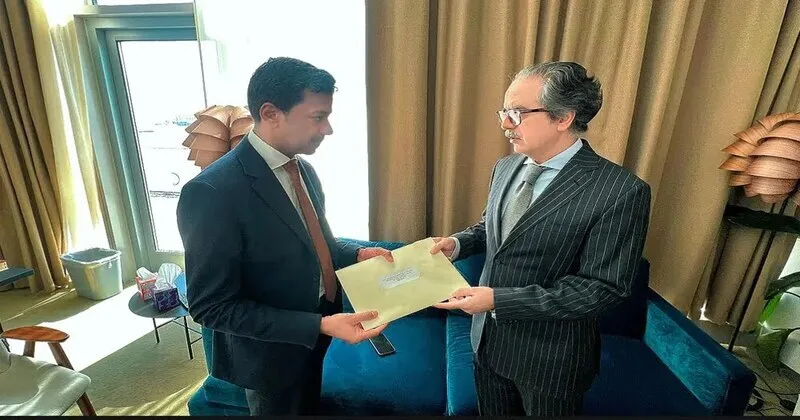
Pakistan has called upon the United Nations Security Council to intervene in its ongoing water dispute with India, marking one year since India placed the Indus Waters Treaty (IWT) in abeyance. On Thursday, Pakistan’s Permanent Representative to the UN, Ambassador Asim Iftikhar Ahmad, delivered a letter from Deputy Prime Minister and Foreign Minister Ishaq Dar to the UNSC President Jamal Fares Alrowaiei of Bahrain.
The letter urges the Security Council to recognize what Pakistan describes as India’s “illegal” decision to suspend the treaty and its potential consequences for regional peace and security. Pakistan has requested that the UN call on India to fully restore implementation of the treaty, resume cooperation and data-sharing, and “comply fully with its international obligations in good faith.”
India, however, maintains that the UN Security Council has no jurisdiction in this bilateral matter. Indian officials point out that the UNSC was not involved in negotiating the original 1960 agreement and therefore has no role in its restoration. India placed the treaty in abeyance on April 23 last year, a day after an attack in Pahalgam that killed 24 Hindu males and two others, which India attributes to Pakistan-backed terrorists.
The Indus Waters Treaty, negotiated with World Bank assistance, has been considered one of the most robust transboundary water agreements in modern international law. It divides control of the region’s rivers, with India having exclusive rights over the eastern rivers (Ravi, Beas, and Sutlej) while Pakistan maintains rights over the western rivers (Indus, Jhelum, and Chenab). The treaty allows India to generate hydropower from the western rivers under certain design constraints.
During his meeting with the UNSC President, Ambassador Iftikhar also addressed what he termed “baseless allegations” against Pakistan, highlighting the country’s recent mediation efforts between the United States and Iran. He characterized Pakistan as a peace-promoting nation, though critics note that Pakistan continues to harbor numerous UN-sanctioned terrorists.
The ambassador further claimed that the “unresolved Jammu and Kashmir dispute” remains “the root cause of instability in South Asia” and requires settlement according to UN Security Council resolutions and “the wishes of the Kashmiri people.”
Water experts familiar with the dispute note that friction between the two countries has persisted for years over India’s hydroelectric projects on the western rivers. Pakistan has routinely objected to Indian projects such as Kishanganga and Ratle, claiming violations of treaty provisions regarding excessive water storage, spillway designs, and sediment control mechanisms. These objections have often delayed India’s infrastructure development.
The seasonal nature of river flows in the region adds another layer of complexity. The Indus River’s flow decreases dramatically from 48.7 Million Acre Feet during summer months to only 5.8 MAF during winter when freezing temperatures reduce snowmelt in catchment areas. Pakistan has frequently accused India of “stealing” water during these lean periods.
More recently, Pakistan has claimed that India’s approved 260 MW Dulhasti Stage-II Hydropower Project on the Chenab River violates treaty provisions, though Indian sources note this project was conceived decades ago but delayed due to funding constraints and lack of political will.
In its communications with the UN, Pakistan has characterized India’s actions as “deliberate water weaponization,” alleging that India is withholding hydrological data and diverting river flows. Indian officials categorically deny these claims, stating that no water has been diverted since the treaty was placed in abeyance last year.
Water security experts observe that this dispute reflects the broader tensions between the two nuclear-armed neighbors, with water resources becoming increasingly politicized amid growing concerns about climate change impacts on the region’s hydrology. The outcome of this diplomatic maneuver remains uncertain, as the UNSC has historically been reluctant to intervene in what India firmly considers a bilateral issue.
Fact Checker
Verify the accuracy of this article using The Disinformation Commission analysis and real-time sources.

7 Comments
Maintaining the integrity of the Indus Waters Treaty is crucial for the stability and prosperity of the region. While I understand Pakistan’s concerns, India also has its own strategic interests to consider. This is a complex issue that requires nuanced diplomacy to find a balanced solution acceptable to both sides.
Water scarcity is a growing challenge worldwide, and disputes over shared river systems can escalate regional tensions. The Indus Waters Treaty has been an important framework for managing this delicate issue between India and Pakistan. I hope the UN can play a constructive role in finding a peaceful resolution to this dispute.
This is a complex regional dispute over water rights and security. The Indus Waters Treaty has been a delicate balance for decades, and unilateral actions by either side could have grave consequences. I hope the UN can facilitate a constructive dialogue to resolve this impasse.
The Indus Waters Treaty has been a lynchpin of regional cooperation for decades. India’s decision to suspend the treaty is concerning and could have far-reaching implications. I hope the UN can facilitate a dialogue between the parties to find a way forward that addresses the concerns of all stakeholders.
This dispute over the Indus Waters Treaty highlights the growing global challenge of managing shared water resources. I’m hopeful the UN can play a constructive role in facilitating a resolution that preserves regional stability and ensures equitable access to this vital resource.
The Indus Waters Treaty is a critical agreement that needs to be maintained to ensure regional stability. Pakistan has a valid concern about India’s decision to suspend the treaty, which could disrupt water supplies. However, India also has its perspective on the matter. Diplomatic efforts are needed to find a mutually agreeable solution.
The Indus Waters Treaty is a complex agreement that has maintained a delicate balance of water rights and security in the region. While Pakistan’s concerns about India’s actions are understandable, I hope the UN can help the parties find a mutually agreeable solution that upholds the spirit of the original treaty.