


Listen to the article
In a powerful educational initiative, the Museum of Tolerance brought its mobile experience to Westview High School last Thursday, offering students a thought-provoking lesson on combating hate and bias in today’s increasingly polarized world.
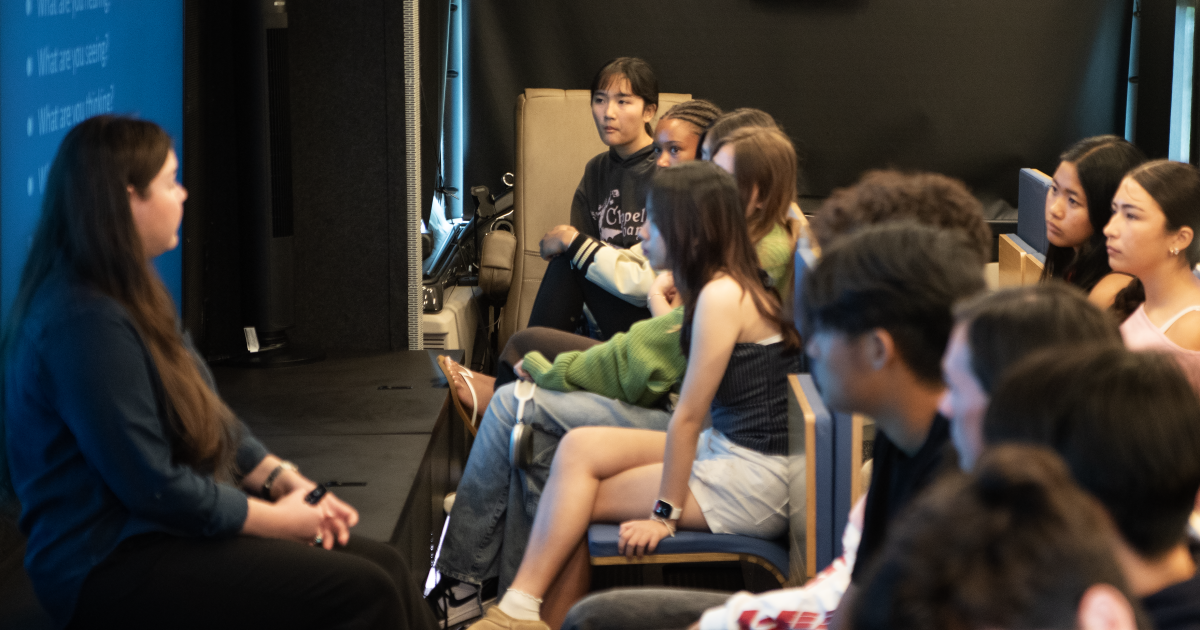
The traveling exhibition, housed in a mobile classroom, allowed students to examine how propaganda historically influenced ordinary people to commit atrocities. Among the displayed artifacts was Hermann Otto Hoyer’s painting “In the Beginning was the Word,” depicting Adolf Hitler addressing an early Nazi meeting in a quasi-messianic light.
“This is a glorified version of one of the first meetings that Hitler held after World War I,” explained Ewa Geisler, the Mobile Museum of Tolerance workshop facilitator. “All of these people, they’re looking to him because he’s telling them that he’s going to restore Germany.”
The day’s workshop, titled “The Power of Ordinary People,” focused on how everyday individuals can be influenced to participate in historical atrocities. Geisler guided students through various propaganda examples from Nazi Germany, demonstrating their powerful effects on public sentiment and behavior.
“It’s important for these students to understand that we all are ordinary and we all can affect others with the choices that we make today,” Geisler emphasized, noting that students typically emerge from the experience with deeper insights into how events like the Holocaust occurred and how history risks repeating itself.
For tenth-grader Gabe Lee, the experience was eye-opening. “It showed us that it was all entirely made up of ordinary people,” he reflected. “They weren’t crazy or anything. It was just what they saw and they believed.”
His classmate Malia Meng drew concerning parallels to contemporary politics. “I feel like there’s a lot of political worshiping going on nowadays, too, towards specific people,” she observed. “And it’s just a little worrying.”
The Mobile Museum of Tolerance, which launched in 2020 during the pandemic, now travels to schools throughout California, conducting workshops that help students identify and combat hatred. Its mission has taken on increased urgency amid rising polarization in American society and the proliferation of misinformation online.
A recent study by the California Commission on the State of Hate revealed that teenagers are more than twice as likely as adults to experience hate. This statistic underscores the importance of teaching critical thinking skills to young people navigating an increasingly complex information landscape.
The museum’s curriculum notably addresses online hate and misinformation—topics of particular relevance to today’s digital-native students. Fallon Allshire, another student participant, voiced concern about her peers’ vulnerability to misleading online content.
“There’s actually a lot of students in my AP World History class who are very uninformed,” she said. “It’s very prevalent with a lot of high school students, especially with the rise of social media and how things can be skewed.”
This observation highlights a growing challenge for educators nationwide as they attempt to foster media literacy and critical thinking amid an unprecedented flood of information—and misinformation—available to students.
Tenth-grader Aiden Lee recognized the contemporary relevance of the historical lessons. “Because of the internet, information spreads so quickly,” he noted. “And it’s very easy to just believe what you see. So I think it’s really important for people to fact-check the information that they hear.”
The Museum of Tolerance’s mobile initiative represents part of a broader educational movement to equip students with tools to recognize propaganda and bias. As hate crimes and political extremism continue to make headlines across the country, such educational interventions aim to foster a more informed, critically-thinking generation.
As students returned to their regular classrooms after the experience, they carried with them not just historical knowledge about the Holocaust, but crucial skills for navigating today’s information ecosystem—perhaps the most valuable lesson the mobile museum could impart in an era of digital information overload.
Fact Checker
Verify the accuracy of this article using The Disinformation Commission analysis and real-time sources.

10 Comments
This mobile museum initiative sounds like an impactful way to teach students about the mechanics of propaganda and its real-world consequences. Hands-on exploration of these historical artifacts must be eye-opening.
Yes, bringing these difficult topics to life through interactive exhibits is likely more effective than lectures. Kudos to the organizers for this innovative approach.
The mobile museum’s interactive approach to teaching about hate propaganda sounds impactful. Allowing students to directly engage with historical artifacts must make the lessons more visceral and memorable.
Yes, this hands-on learning experience seems far more effective than passive lectures. Kudos to the organizers for this innovative educational model.
Bringing this traveling exhibition to high schools is a smart way to reach young audiences. Exposing them to historical examples of propaganda’s dangers can help shape more informed, discerning citizens.
It’s concerning to see how even seemingly ordinary people can be manipulated by hateful propaganda. Equipping the next generation with the tools to recognize and resist such influence is vital for a more just, tolerant future.
Educating young people on the dangers of hate propaganda is crucial. Exploring historical examples like Nazi Germany’s tactics can help students understand how ordinary people can be manipulated into committing atrocities.
Agreed. Fostering critical thinking and media literacy is key to countering such insidious influence.
The mobile museum’s focus on examining propaganda’s power to sway public sentiment is crucial. Understanding these insidious tactics is the first step towards inoculating against their effects.
Absolutely. Developing students’ critical thinking skills to analyze media and information is an important lifelong lesson.